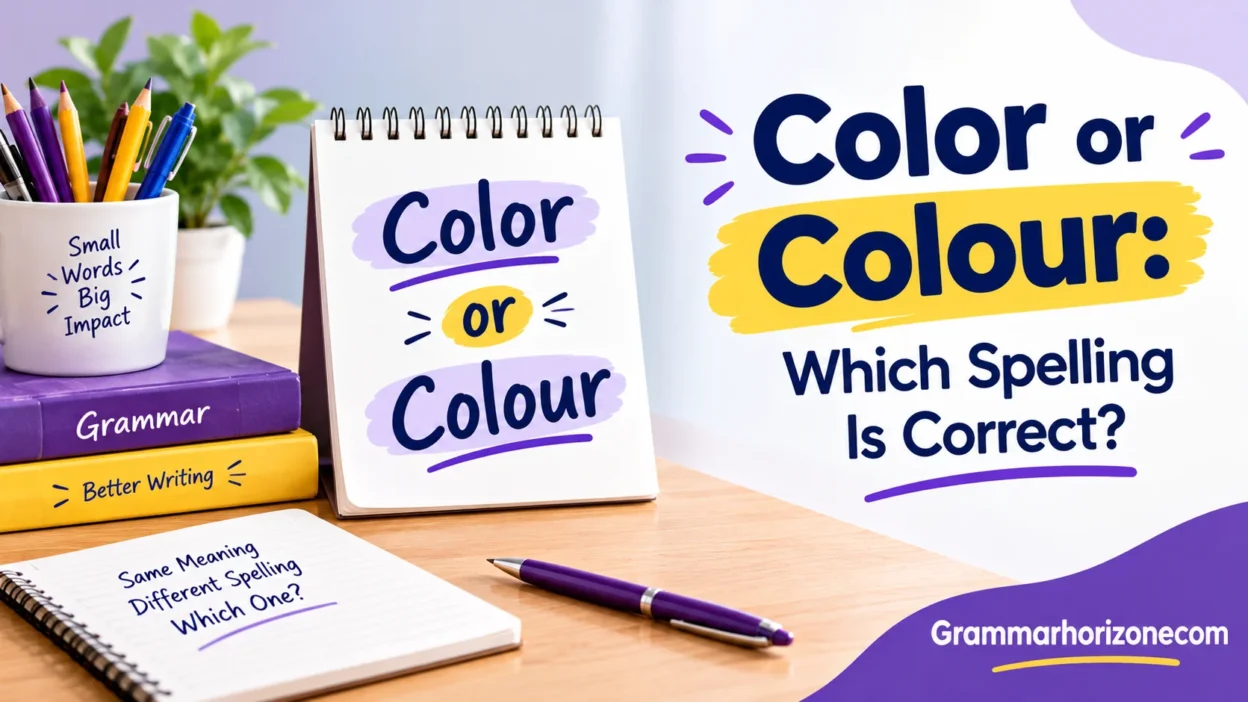
Color or Colour shows how English spelling changes across regions, helping writers choose the correct form for their audience and maintain consistency.The difference between color and colour comes from regional spelling conventions in the English language. American English uses color, while British English uses colour. Both words have the same meaning, pronunciation, and grammatical function, but their spelling patterns reflect different language traditions. When preparing school assignments, educational writing, books, websites, or business documents, consider your audience and preferred writing style. A US audience generally expects American spelling, while a British audience usually expects British spelling.
The history of these spellings connects to regional history, cultural identity, and language evolution. American spelling reformer Noah Webster supported changes that helped distinguish American English from traditional British English. His first American dictionary, published in 1806, helped establish several American spelling preferences, including the removal of unnecessary letters in selected words. This development contributed to the use of color in modern American English, while colour remained common in Britain and many Commonwealth regions. Similar differences appear in words such as programme and catalogue in British usage.
When choosing between color and colour, focus on your readers and the purpose of your content. Use color when following US English conventions and colour when following standard British conventions. The same rule applies to professional writing, written communication, marketing copy, social media captions, emails, and academic papers. Both forms can describe red, blue, green, and yellow, as well as a shade or hue in painting, dyeing, and figurative expressions. Editing tools such as Microsoft Word and autocorrect can flag spelling differences, but they may also switch between regional settings.
Quick Answer: Color or Colour?
Color is correct in American English, and colour is correct in British English. Both words describe the visual appearance of something, such as a red apple, a blue sky, or a green leaf.
Here is a quick guide to remember the difference:
- Color: Standard American English spelling.
- Colour: Standard British English spelling.
- Meaning: Both words have the same meaning.
- Pronunciation: Both words are pronounced the same way in ordinary speech.
- Related words: American English uses colorful and coloring, while British English uses colourful and colouring.
For example:
- American English: My favorite color is blue.
- British English: My favorite colour is blue.
Both sentences communicate the same idea. The spelling changes because American and British English follow different conventions.
What Does Color Mean?
Color is a noun that describes the visual quality of an object based on how it interacts with light. Red roses, yellow lemons, blue jeans, and green leaves all have colors that help us recognize and describe them.
People use color in everyday conversations about clothing, art, nature, interior design, photography, and printing. Colors can also carry symbolic meanings. For example, red often represents passion or danger, while green may suggest nature or growth. These associations depend on cultural and social context.
Color can also work as a verb. When you color a picture, you add color to its shapes and details using crayons, pencils, markers, or other materials.
Examples of Color in American English
Here are some common examples of how Americans use the word color:
- Her favorite color is purple.
- The artist used bright colors in the painting.
- Please print the photograph in color instead of black and white.
- The children spent the afternoon coloring pictures.
- A fresh coat of paint changed the color of the bedroom.
In each sentence, color follows standard American spelling. The word can describe an object’s appearance or refer to the act of adding color to something.
What Does Colour Mean?
Colour has the same meaning as color. The additional letter u reflects British English spelling conventions rather than a difference in definition.
Writers in the United Kingdom commonly use colour when describing objects, discussing artwork, or explaining visual design. The spelling is also standard in Australian English and generally preferred in Canadian English.
For example, a British writer might describe a garden filled with colorful flowers as a garden filled with colourful flowers. The meaning stays the same, but the spelling follows British conventions.
Examples of Colour in British English
Consider these examples:
- Her favorite colour is purple.
- The artist used bright colours in the painting.
- Please print the photograph in colour instead of black and white.
- The children spent the afternoon colouring pictures.
- A fresh coat of paint changed the colour of the bedroom.
These sentences express the same ideas as the American examples. Only the spelling changes.
What Is the Difference Between Color and Colour?
The main difference between color and colour is regional spelling. American English generally omits the u, while British English retains it.
Neither spelling is more correct in every situation. The appropriate choice depends on your audience, publication requirements, and preferred English variety.
Color vs. Colour Comparison Table
| Feature | Color | Colour |
| English variety | American English | British English |
| Meaning | Visual quality of an object | Visual quality of an object |
| Pronunciation | Same in ordinary speech | Same in ordinary speech |
| Example | The color is beautiful. | The colour is beautiful. |
| Related adjective | Colorful | Colourful |
| Related verb form | Coloring | Colouring |
| Common usage | United States | United Kingdom, Australia, Canada |
The simplest way to remember the difference is to associate color with American English and colour with British English.
Do Color and Colour Have Different Pronunciations?
No. In ordinary speech, color and colour have the same pronunciation. The additional u in the British spelling doesn’t create another sound or syllable.
Both words generally have two syllables. Although accents can affect how people pronounce them, the spelling difference itself doesn’t change their spoken form.
This is a useful example of how English spelling can vary across regions without changing a word’s meaning or pronunciation.
When to Use Color
If you’re writing in American English, color is the spelling you should use. It is standard in US school assignments, business communication, newspaper articles, website content, product descriptions, and everyday writing.
Using American spelling helps your work meet the expectations of US readers. It also keeps your writing consistent with the conventions commonly used in American dictionaries and publications.
Examples of When to Use Color
Here are some situations where color is appropriate:
- Schoolwork: The teacher asked us to draw a picture using every color of the rainbow.
- Business writing: Please select a color for the new company logo.
- Art and design: The designer chose a warm color palette for the website.
- Printing: This printer produces high-quality color photographs.
- Fashion: Black is a versatile color that matches almost any outfit.
In each example, color follows American spelling conventions.
American Spellings of Color and Related Words
Choosing color also affects related words. American English generally omits the u in this word family.
| American spelling | Example sentence |
| Color | The color looks bright. |
| Colors | The colors complement each other. |
| Colorful | She wore a colorful dress. |
| Coloring | The child enjoys coloring pictures. |
| Colored | He chose colored paper. |
| Colorless | The liquid appeared colorless. |
Consistency matters throughout the entire word family. If you use color in one paragraph and colourful in another, your writing may look inconsistent to American readers.
When to Use Colour
When writing for a British audience, use colour. This spelling is common in British books, educational materials, newspapers, business documents, and professional publications.
British spelling conventions also influence writing in Australia and New Zealand. Canadian English generally prefers colour as well, although some organizations follow different style rules.
Examples of When to Use Colour
Here are some examples of colour in British English:
- Schoolwork: The teacher asked us to draw a picture using every colour of the rainbow.
- Business writing: Please select a colour for the new company logo.
- Art and design: The designer chose a warm colour palette for the website.
- Printing: This printer produces high-quality colour photographs.
- Fashion: Black is a versatile colour that matches almost any outfit.
The meaning stays the same in every example. The spelling simply follows British English conventions.
British Spellings of Colour and Related Words
British English retains the u in several related forms.
| British spelling | Example sentence |
| Colour | The colour looks bright. |
| Colours | The colours complement each other. |
| Colourful | She wore a colourful dress. |
| Colouring | The child enjoys colouring pictures. |
| Coloured | He chose coloured paper. |
| Colourless | The liquid appeared colourless. |
If you choose British English for an article, check these related forms during editing. Correcting only the main keyword won’t make the entire article consistent.
Color or Colour in American, British, Canadian, and Australian English
English spelling varies across countries, even when speakers understand each other perfectly. Knowing the common spelling convention in each region helps you choose the right form.
Color in American English
In the United States, color is the standard spelling. Americans also write favorite, honor, and neighbor without the letter u in these word groups.
For example, an American writer might say, “My favorite color is blue.” This spelling is appropriate for US readers, schoolwork, and most American publications.
Colour in British English
In the United Kingdom, colour is the standard spelling. British English generally retains the u in words such as favourite, honour, and neighbour.
A British writer would typically write, “My favourite colour is blue.” Both favourite and colour follow British spelling conventions.
Colour in Canadian English
Canadian English generally uses colour, following the British-style spelling for this word. However, Canadian spelling combines British and American conventions, so not every word follows the same pattern.
For example, Canadians commonly write colour but use program in many computing and general contexts. The best choice depends on the word and the style guide being followed.
Colour in Australian English
Australian English generally uses colour, along with related forms such as colourful, colouring, and colourless. These spellings are standard in Australian educational and professional writing.
If you’re writing for Australian readers, using colour will usually match their expectations. However, always follow a publication’s specific guidelines when they differ from general usage.
Why Does American English Use Color Instead of Colour?
The difference between color and colour developed through the history of English spelling. The two forms became associated with different regional conventions over time.
The word traces back through French to the Latin word color. Both spellings have historical roots, but American and British English eventually favored different forms.
Noah Webster’s Influence on American Spelling
Noah Webster was an American lexicographer and educator who lived from 1758 to 1843. He believed that American English should develop recognizable conventions of its own rather than follow British spelling in every case.
Webster promoted spelling reforms through educational books and dictionaries. His American Dictionary of the English Language, published in 1828, helped establish many spellings that remain common in the United States today.
These included:
- Color instead of colour
- Honor instead of honour
- Labor instead of labour
- Center instead of centre
- Theater instead of theatre
Webster didn’t invent every alternative spelling. Some forms already existed, but his work helped promote and standardize them in American education and publishing.
Did Americans Remove the U to Save Money?
A popular explanation claims that Americans dropped the u from words such as colour to save money on printing. However, this story oversimplifies the history of American spelling.
The changes were part of broader efforts to simplify and standardize English spelling. Educational materials, dictionaries, publishers, and ideas about American identity all played a role in shaping the conventions used today.
The important point is that color didn’t become standard simply because printers wanted to save ink. Its use grew through changes in spelling preferences and educational standards.
Common Words That Follow the Color or Colour Pattern
The spelling difference between color and colour appears in several other English words. Learning these pairs together makes it easier to recognize regional spelling patterns.
| American English | British English |
| Color | Colour |
| Favorite | Favourite |
| Honor | Honour |
| Labor | Labour |
| Neighbor | Neighbour |
| Humor | Humour |
| Flavor | Flavour |
| Rumor | Rumour |
| Behavior | Behaviour |
| Favour | Favor |
The last row reverses the order to emphasize that favor is American English and favour is British English.
Do All Similar Words Follow the Same Rule?
No. Although many words follow the -or and -our pattern, you can’t apply it to every word with a similar ending.
For example, actor, author, doctor, and error use the same spelling in both American and British English. Their spellings don’t change according to the color/colour pattern.
Learn the established spelling of each word instead of removing letters automatically. When you’re unsure, check a dictionary that matches your intended English variety.
Common Mistakes to Avoid When Choosing Color or Colour
The difference between these spellings is simple, but writers can still make mistakes when switching between American and British English.
Treating One Spelling as Incorrect
Neither color nor colour is universally incorrect. Each spelling is appropriate within its own regional convention.
For example, color is standard in an American school assignment, while colour is standard in a British assignment. The problem arises when a writer ignores the spelling requirements of the intended audience.
Mixing American and British Spellings
Imagine writing an article that uses color, favourite, honour, and colourful. Readers will understand the words, but the mixture can make the article look poorly edited.
Instead, choose one variety and apply it consistently.
- American English: Color, favorite, honor, colorful.
- British English: Colour, favourite, honour, colourful.
A consistent approach makes your work look more professional and easier to follow.
Changing Official Names and Direct Quotes
Sometimes you need to preserve a spelling that differs from the rest of your writing. Official product names, company names, and direct quotations are common examples.
For instance, if a product’s official name contains Color, don’t automatically change it to Colour in a British English article. Likewise, preserve the original spelling when quoting a source directly.
You can follow one spelling system in your own writing while keeping names and quotations accurate.
Assuming Every Spelling Difference Follows One Rule
American and British English differ in many ways, but not every difference follows the same pattern. Centre and center, for example, involve a different spelling change from colour and color.
Similarly, both gray and grey appear in English, although regional preferences differ. Check individual words rather than assuming one rule explains every spelling difference.
Color or Colour: Examples in Sentences
Comparing the same sentences makes the difference between color and colour easy to understand. The spelling changes, but the meaning stays the same.
| American English | British English |
| The color of the walls brightens the room. | The colour of the walls brightens the room. |
| She bought a colorful scarf. | She bought a colourful scarf. |
| The artist mixed several colors. | The artist mixed several colours. |
| Please print this image in color. | Please print this image in colour. |
| The coloring book kept the children busy. | The colouring book kept the children busy. |
| The flowers added color to the garden. | The flowers added colour to the garden. |
A Short Writing Example
Suppose you’re creating a product description for an American audience.
American English:
“The colorful backpack comes in three colors: blue, green, and black. Choose your favorite color to match your style.”
For a British audience, you would write:
British English:
“The colourful backpack comes in three colours: blue, green, and black. Choose your favourite colour to match your style.”
Both descriptions communicate the same information. The second version simply follows British spelling conventions.
How to Choose Between Color and Colour
Choosing the right spelling doesn’t have to be difficult. A few practical steps can help you make the right decision every time.
Identify Your Audience
Start by considering who will read your work. If you’re writing for American customers, color is usually the best choice. If your readers are mainly in the United Kingdom, colour is generally more appropriate.
For an international audience, consider your main market or the publication’s established style. You don’t need to include both spellings every time you use the word.
Follow Your Style Guide
Schools, businesses, newspapers, and academic publishers often have specific writing requirements. Some prefer American English, while others require British or Canadian conventions.
If your employer requests American English, use color throughout your document. If your university requires British English, use colour instead.
Check Related Words
After choosing the main spelling, review related forms such as colorful, coloring, and colorless.
A spell-checker can help identify inconsistencies, but it may not know which English variety you intend to use. Set the document’s language preference before editing whenever possible.
Keep SEO Content Consistent
If you write blog posts, product pages, or other search-focused content, match the spelling to your target readers.
For example, a US-focused article might include both color and colour when explaining their difference. However, the rest of the article should use color consistently if it follows American English.
Good SEO content answers the reader’s question naturally. Avoid repeating spelling variations unnaturally just to target more keywords.
Conclusion
Choosing between color or colour depends on the regional spelling rules you follow. Color is the standard spelling in American English, while colour is preferred in British English and many Commonwealth countries, including Canada. Both words have the same meaning and pronunciation, so neither is universally more correct than the other. The key is to understand your audience and maintain consistency throughout your writing. Whether you’re preparing an academic paper, a business document, a website, or a social media post, using the appropriate spelling helps your content look clear, accurate, and professional.
Frequently Asked Questions
1. Is it color or colour?
Both spellings are correct. Color is used in American English, while colour is the standard form in British English.
2. Why do Americans spell it color instead of colour?
American spelling was influenced by Noah Webster, who supported simplifying certain English spellings. Removing the u in words such as colour helped establish a distinct American spelling style.
3. Does Canada use color or colour?
Canadian English generally uses colour, following British spelling traditions for this word. However, Canadian English also includes several American spelling influences.
4. Do color and colour have different meanings?
No. Color and colour mean exactly the same thing. Both refer to qualities such as red, blue, and green, or to the appearance of an object as perceived through light.
5. Should I use color or colour in professional writing?
Use color when writing for an American audience and colour when following British English conventions. Choose the spelling that matches your audience or style guide, and use it consistently throughout your document.