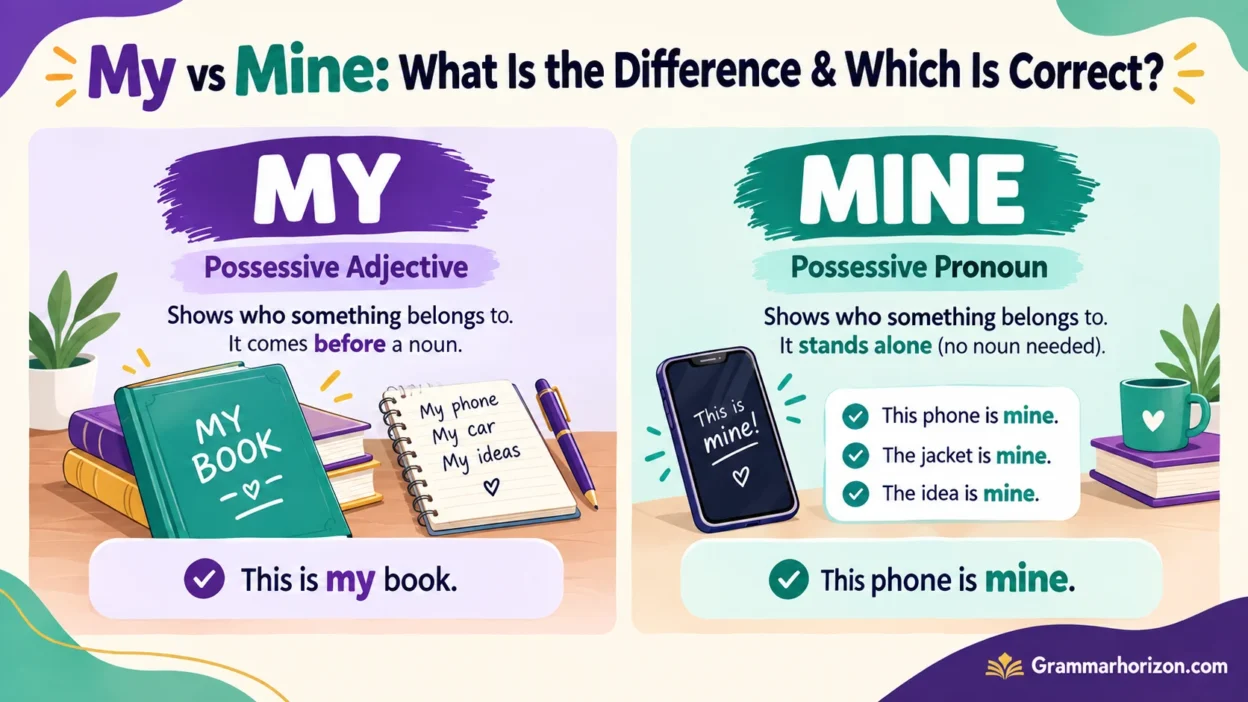
My vs Mine is easier when you understand how each possessive word works in English sentences and shows ownership or possession. My usually comes before a noun, while mine can stand alone. This difference can confuse learners, especially during everyday writing and speaking, because both words express something that belongs to someone. For example, “This is my book” uses my before a noun, while “This book is mine” uses mine without repeating the noun. Understanding this simple rule helps you write and speak more naturally and correctly. It also makes English learners more comfortable when communicating with native speakers in everyday conversations.
The easiest way to remember the difference is to see my as a word that normally needs another word after it, while mine can work alone. Learners often mix up these forms because they look similar, but they have different grammatical purposes. You can say “That is my phone,” but you can also say “That phone is mine.” These examples show how both forms serve different roles while still showing ownership. Memory tricks, real-life situations, and practice exercises can make the pattern easier to learn and master. If you’ve ever paused while writing because you weren’t sure which form to use, this simple approach can give you more confidence and help you avoid common mistakes.
The good news is that the rule is surprisingly simple, and regular practice makes it feel natural. My is a possessive adjective, so it works with a noun, while mine is a possessive pronoun, so it replaces the noun. Knowing this distinction can improve your grammar, usage, speaking, and writing, while helping your sentences sound clearer and less awkward. A short English test can help you check your progress, and repeated examples can strengthen your understanding. Each form works in its own place, so you don’t need to memorize dozens of complicated rules. Once you understand when to use my and mine, you can communicate more naturally, correctly, and confidently.
Quick Answer
The difference between my and mine is straightforward:
- My is a possessive determiner. It must come before a noun.
- My book
- My laptop
- My friends
- Mine is a possessive pronoun. It replaces the noun and stands alone.
- The book is mine.
- That laptop is mine.
- Those friends are mine.
Easy Rule to Remember
If a noun comes next, use my.
If no noun follows, use mine.
Examples
- This is my phone. ✅
- This phone is mine. ✅
- This is mine phone. ❌
- This phone is my. ❌
Comparison Overview
| Feature | My | Mine |
| Part of Speech | Possessive determiner | Possessive pronoun |
| Comes Before a Noun | Yes | No |
| Can Stand Alone | No | Yes |
| Shows Ownership | Yes | Yes |
| Example | My backpack | The backpack is mine |
Main Differences Between My vs Mine
Although both words express ownership, they are not interchangeable.
| My | Mine |
| Always followed by a noun | Never followed directly by a noun |
| Modifies a noun | Replaces a noun |
| Cannot stand alone | Can stand alone |
| Used before people, places, or things | Used after the noun is already understood |
Examples
| Correct | Incorrect |
| My car is new. | Mine car is new. |
| That car is mine. | That car is my. |
| My dog is friendly. | Mine dog is friendly. |
| The dog is mine. | The dog is my. |
Understanding Possessive Words in English
Possessive words show that something belongs to someone.
English has several possessive words:
| Subject | Possessive Determiner | Possessive Pronoun |
| I | My | Mine |
| You | Your | Yours |
| He | His | His |
| She | Her | Hers |
| We | Our | Ours |
| They | Their | Theirs |
| It | Its | — |
Notice that my and mine follow the same pattern as your and yours.
- My phone → The phone is mine.
- Your phone → The phone is yours.
Understanding this pattern makes English much easier.
What Is a Possessive Determiner?
A possessive determiner tells readers or listeners which noun belongs to someone.
It always appears immediately before the noun.
Examples:
- My room
- My bicycle
- My homework
- My family
- My idea
Without the noun, my becomes incomplete.
Incorrect:
- The pen is my.
Correct:
- The pen is mine.
What Is a Possessive Pronoun?
A possessive pronoun replaces the noun instead of describing it.
That means you don’t have to repeat the noun.
Instead of saying:
- That notebook is my notebook.
You simply say:
- That notebook is mine.
This makes writing smoother and avoids unnecessary repetition.
When to Use My
Use my whenever a noun immediately follows.
Before Singular Nouns
Examples:
- My computer crashed.
- My teacher explained the lesson.
- My jacket is blue.
Before Plural Nouns
Examples:
- My parents are visiting.
- My cousins live nearby.
- My books are on the shelf.
Before Uncountable Nouns
Examples:
- My advice
- My information
- My furniture
- My knowledge
Before Gerunds
A gerund is an -ing verb functioning as a noun.
Examples:
- My singing improved.
- My writing has become clearer.
- My driving needs practice.
Common Sentence Patterns with My
- My house
- My opinion
- My favorite movie
- My first job
- My best friend
When to Use Mine
Use mine whenever the noun has already been mentioned or is understood.
As a Standalone Possessive Pronoun
Examples:
- The red umbrella is mine.
- That notebook is mine.
- The larger suitcase is mine.
After Linking Verbs
Common linking verbs include:
- is
- are
- was
- were
- seems
- becomes
Examples:
- This seat is mine.
- The decision was mine.
- The opportunity became mine.
In Short Answers
Examples
Whose keys are these?
Mine.
Whose laptop is this?
It’s mine.
To Avoid Repeating the Noun
Instead of writing:
Your answer is better than my answer.
Write:
Your answer is better than mine.
The second sentence sounds much more natural.
My vs Mine in the Same Sentence
Sometimes both words appear together.
Examples
- My phone is newer than mine was last year.
- My bike is red, but yours is faster than mine.
- My presentation received more praise than mine did previously.
- My laptop is lighter than the one that used to be mine.
Notice how my introduces the noun while mine replaces it later.
My vs Mine Examples
My vs mine examples show how both words express possession, with my appearing before a noun while mine stands alone without a noun.
Everyday Conversation
- My coffee is cold.
- That coffee isn’t mine.
- My wallet is missing.
- The blue wallet is mine.
- My seat is near the window.
School Examples
- My homework is finished.
- That notebook is mine.
- My teacher gave us extra practice.
- My project earned an A.
Workplace Examples
- My report is complete.
- The final proposal is mine.
- My manager approved the budget.
- My schedule changed yesterday.
Email Examples
- My attachment is included below.
- The final version is mine.
- My response was sent this morning.
Social Media Examples
- My vacation starts tomorrow.
- That photo is mine.
- My new recipe turned out great.
Common Mistakes People Make
Many learners make the same mistakes repeatedly.
Saying “Mine Book”
Incorrect:
Mine book
Correct:
My book
Remember:
My always comes before a noun.
Saying “My Is Better”
Incorrect:
My is better.
Correct:
Mine is better.
Forgetting the Noun
Incorrect:
This is my.
Correct:
This is mine.
Repeating the Noun
Instead of:
This phone is my phone.
Say:
This phone is mine.
The second sentence is shorter and more natural.
My vs Mine in Questions
Questions often reveal the difference clearly.
Examples
Is this my jacket?
Is this jacket mine?
Both are correct.
However, notice the sentence structure changes.
More examples:
- Is this my seat?
- Is this seat mine?
- Is that my backpack?
- Is that backpack mine?
My vs Mine with Different Types of Nouns
People
- My brother
- My sister
- My parents
Places
- My hometown
- My office
- My neighborhood
Things
- My laptop
- My headphones
- My bicycle
Ideas
- My opinion
- My suggestion
- My solution
Possessions
- My passport
- My watch
- My passport is mine.
My vs Mine in Common English Expressions
Many everyday expressions use these words naturally.
Examples include:
- A friend of mine
- A neighbor of mine
- A colleague of mine
- That’s mine.
- My own business
- My turn
- My pleasure
These expressions appear frequently in spoken English.
My vs Mine in American and British English
There is no grammatical difference between American English and British English when using my and mine.
Both varieties follow exactly the same rules.
American English:
- My apartment.
- That apartment is mine.
British English:
- My flat.
- That flat is mine.
The vocabulary changes, but the grammar does not.
My vs Mine in Formal and Informal Writing
Whether you’re writing an academic paper, a business email, or a text message, the grammar stays the same.
Formal Writing
- My research focuses on language acquisition.
- The final recommendation is mine.
Business Communication
- My proposal includes three solutions.
- The final presentation is mine.
Casual Conversation
- My pizza arrived.
- The last slice is mine.
Grammar Rules You Should Never Forget
Keep these rules in mind whenever you write.
- My always comes before a noun.
- Mine replaces a noun.
- Never write mine car or mine house.
- Use mine after linking verbs.
- Use my before singular, plural, and uncountable nouns.
- Both words express ownership.
- Mine makes sentences shorter by avoiding repetition.
Memory Trick to Remember the Difference
Here’s a quick trick.
Imagine my as a helper.
It always needs a noun beside it.
Imagine mine as independent.
It doesn’t need a noun because it replaces one.
Think about these examples.
- My backpack
- My notebook
- My bicycle
Now compare them.
- The backpack is mine.
- The notebook is mine.
- The bicycle is mine.
If you remember that my needs company while mine works alone, you’ll rarely make mistakes.
Conclusion
Understanding My vs Mine doesn’t have to be complicated. My comes before a noun, while mine replaces the noun and can stand alone. Once you understand this simple difference, regular practice will help you avoid common mistakes and use both forms naturally in everyday English.
FAQs
Q1. Is my a possessive adjective?
Yes. My is a possessive adjective because it comes before a noun, such as “my book” or “my car.”
Q2. Is mine a possessive pronoun?
Yes. Mine is a possessive pronoun because it can stand alone and replace a noun, such as “The book is mine.”
Q3. What is the main difference between my and mine?
The main difference is their position and grammatical role. My normally comes before a noun, while mine stands alone.
Q4. Can I say “This book is my”?
No. The correct sentence is “This book is mine.” Here, mine replaces “my book.”
Q5. Can I say “This is mine book”?
No. The correct form is “This is my book.” Use my directly before the noun.
Q6. Are my and mine interchangeable?
No. Although both show possession, they have different grammatical functions and cannot always replace each other.
Q7. How can I remember when to use my or mine?
A simple memory trick is: my + noun, but mine works without the noun. For example, “my phone” and “The phone is mine.”