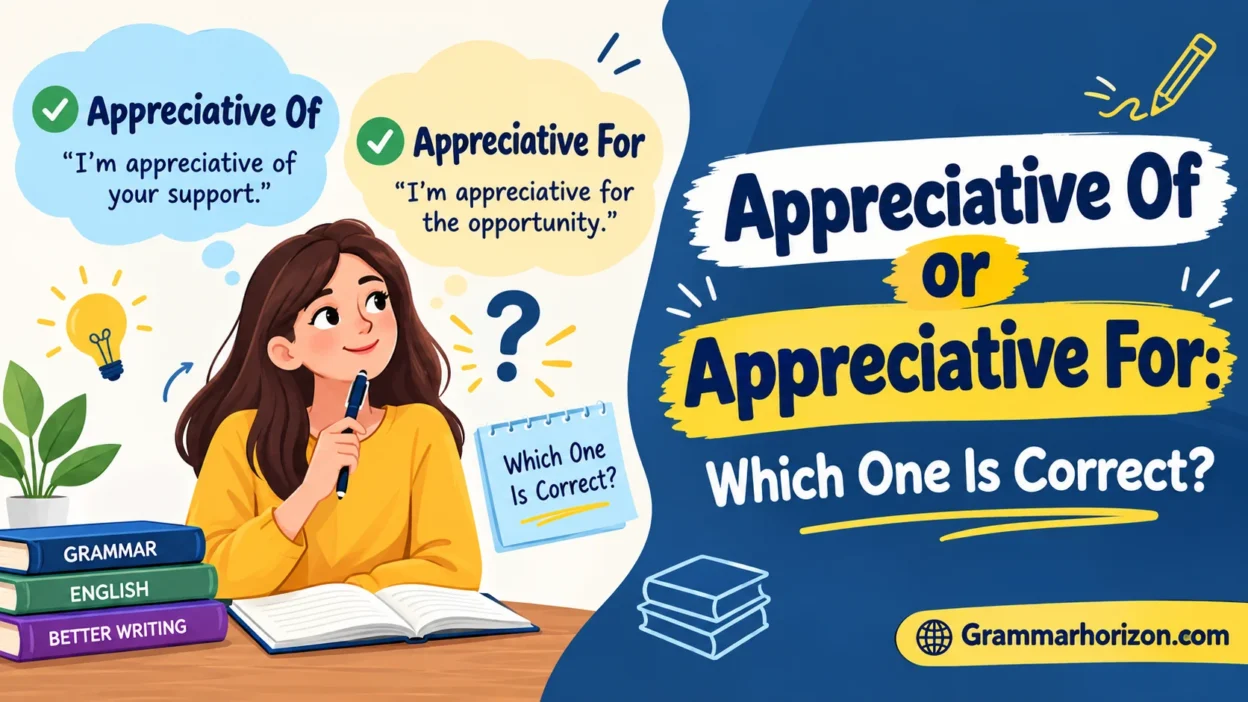
Appreciative Of or Appreciative For is a common English grammar question that confuses people when thanking someone for their help, kindness, or support. Both expressions relate to appreciation, gratitude, and thankfulness, but appreciative of is the preferred construction in standard English. For example, “I am appreciative of your kindness” is a natural sentence because it shows that you recognize the value of someone’s actions. Understanding the meaning of appreciative helps you choose the right preposition in everyday conversations, professional emails, academic writing, and personal messages. Clear word choice also helps you communicate feelings and express feelings naturally.
Understanding appreciative of meaning and appreciative for meaning makes preposition usage easier. In most situations, “appreciative of something” is the natural construction, as in “She is appreciative of her teacher’s help.” Although some speakers use appreciative for, it is less common and may sound awkward depending on the context. When you want to express gratitude for something you received, “I am grateful for your support” is a natural alternative. These gratitude expressions work well in spoken and written communication. Learning the relevant grammar rules improves sentence construction, sentence clarity, grammatical accuracy, and language accuracy.
In professional, personal, and academic communication, using the correct preposition makes your message sound polished. For example, “I am appreciative of your time” suits professional writing, while “I am grateful for your advice” offers another clear way to show appreciation. Both examples demonstrate proper word usage and effective communication. As you improve your English usage, English expressions, English writing, and English speaking, focus on communicating confidently and expressing appreciation naturally. Understanding the difference between appreciative of and appreciative for supports language learning and helps you use standard English correctly.
Quick Answer
Appreciative is the standard and preferred expression in English. Use it when recognizing the value, kindness, effort, support, or qualities of someone or something.
Appreciation is less common and often sounds unnatural in standard English. In many situations, you should replace it with appreciative or grateful for, depending on your intended meaning.
Consider these examples:
- Correct: I am appreciative of your help.
- Less natural: I am appreciative for your help.
- Correct: I am grateful for your help.
- Correct: I am grateful to you for helping me.
The easiest rule to remember is that you are usually appreciative of something, grateful for something, and grateful to someone.
What Does Appreciative Of Mean?
The word appreciative is an adjective that describes someone who recognizes the value, importance, kindness, or quality of something. It can also describe a person who feels or expresses gratitude.
When you say you are appreciative of something, you show that you recognize its value or understand the effort behind it.
For example, if your coworker helps you complete an important project, you might say, “I’m appreciative of your help.” This sentence shows that you recognize and value the effort your coworker made.
The expression appreciative of can refer to many things, including:
- Help and support: I am appreciative of your support during a difficult time.
- Kindness: She was appreciative of her friend’s kindness.
- Effort: The manager was appreciative of the team’s hard work.
- Opportunities: He is appreciative of the opportunity to learn new skills.
- Time and patience: We are appreciative of your time and patience.
- Personal qualities: I am appreciative of your honesty and understanding.
In each example, the preposition introduces the person, action, quality, or thing being valued.
When to Use Appreciative Of
Use appreciative of when you want to acknowledge something positive or show that you understand its value. This expression works well in personal conversations, workplace communication, and formal writing.
Expressing gratitude for someone’s actions
When someone does something helpful, appreciative of allows you to acknowledge their contribution.
Example: I am appreciative of everything you did to make the event successful.
Recognizing effort or dedication
You can use this expression to show that you notice the time and energy someone has invested in a task.
Example: Our supervisor is appreciative of the dedication shown by every team member.
Acknowledging an opportunity
The phrase also works when discussing something valuable that you have experienced or received.
Example: She is appreciative of the chance to study abroad.
Recognizing personal qualities
You can express appreciation for someone’s honesty, patience, generosity, or understanding.
Example: I am appreciative of your honesty, even when the truth is difficult to hear.
These examples show that appreciative of is useful whenever you want to recognize value, effort, or kindness.
What Does Appreciative For Mean?
The expression appreciative for is sometimes used by English speakers, but it is less established than appreciative of as a standard grammatical pattern.
The confusion often arises because appreciative, grateful, and thankful have similar meanings. However, these adjectives do not always use the same prepositions.
For example:
- Less natural: I am appreciative for your advice.
- Preferred: I am appreciative of your advice.
- Also correct: I am grateful for your advice.
- Also correct: I am thankful for your advice.
The second sentence follows the established pattern for the adjective appreciative. The third and fourth sentences use adjectives that naturally pair with for.
Although readers will probably understand what you mean when you say appreciative for, the phrase may sound awkward in formal or professional writing. Choosing a more conventional expression helps your message sound polished.
Can Appreciative For Ever Be Correct?
It is too absolute to claim that appreciative for never appears in English. Some speakers use it in conversation, and occasional examples occur in writing. However, its use is less conventional than appreciative of.
When writing a school assignment, business email, professional report, or blog post, appreciative of is generally the safer choice.
If you want to use for, consider these alternatives:
- I am grateful for your assistance.
- We are thankful for your encouragement.
- She expressed her appreciation for the opportunity.
- I appreciate your patience.
Notice that each alternative follows a different grammatical pattern. Learning these patterns will help you avoid awkward sentences.
Why Do People Confuse Appreciative Of and Appreciative For?
The confusion usually comes from the similarities between expressions that communicate gratitude.
For instance, these sentences are both correct:
- I am grateful for your help.
- I am appreciative of your help.
Because grateful and appreciative have related meanings, writers sometimes transfer the preposition from one expression to the other.
This happens with many English adjectives. Some adjectives naturally pair with particular prepositions, and these combinations often need to be learned through practice.
| Adjective | Standard preposition | Example |
| Appreciative | Of | I am appreciative of your efforts. |
| Grateful | For | I am grateful for your efforts. |
| Interested | In | She is interested in science. |
| Proud | Of | They are proud of their achievement. |
| Responsible | For | He is responsible for the report. |
| Aware | Of | We are aware of the problem. |
The best way to learn these combinations is to memorize them as complete expressions rather than learning each adjective in isolation.
Appreciative Of or. Appreciative For: Main Differences
The primary difference between appreciative of and appreciative for concerns conventional usage rather than a completely different meaning.
Appreciative of is the standard construction. Appreciative for may be understood, but it is generally less natural. If you want to use for, choosing grateful for or thankful for is usually better.
| Expression | Typical meaning or use | Example |
| Appreciative of | Recognizing value or expressing appreciation | I am appreciative of your kindness. |
| Appreciative for | Less established construction | I am appreciative for your kindness. |
| Grateful for | Feeling gratitude for something received | I am grateful for your kindness. |
| Thankful for | Expressing gratitude or relief | I am thankful for your kindness. |
| Appreciate + object | Directly acknowledging value or help | I appreciate your kindness. |
| Appreciation for | Expressing recognition or gratitude | I expressed my appreciation for your kindness. |
The table highlights an important point: appreciative of and appreciation for are both standard, but they use different grammatical structures because one contains an adjective and the other contains a noun.
Appreciative Of or Grateful For
These expressions are often interchangeable in meaning, but they follow different grammatical patterns.
Appreciative of emphasizes recognizing the value, quality, effort, or kindness of something. Grateful for emphasizes the feeling of gratitude toward something received, experienced, or provided.
Compare the examples:
- I am appreciative of your thoughtful advice.
- I am grateful for your thoughtful advice.
Both sentences are correct. The difference is subtle, and you do not need to force a sharp distinction between their meanings.
Here are a few more examples.
Appreciative of:
- We are appreciative of your continued cooperation.
- She was appreciative of the support she received.
- The teacher was appreciative of the students’ efforts.
Grateful for:
- We are grateful for your continued cooperation.
- She was grateful for the support she received.
- The teacher was grateful for the students’ efforts.
Both constructions can express sincere gratitude. The key is to use the preposition that naturally follows the adjective.
Appreciative Of or Appreciative For in Different Situations
Understanding the basic rule is helpful, but you also need to know how it applies to everyday communication. The following examples show how to use these expressions in common situations.
Appreciative Of or Appreciative For in Professional Emails
Professional emails often require polite, clear language. When thanking a colleague, client, supervisor, or business partner, appreciative of is a reliable choice.
For example:
“Dear Sarah,
I am appreciative of your support throughout this project. Your attention to detail and willingness to help made a real difference.
Thank you again for your time and effort.”
This message sounds professional because it identifies the contribution being acknowledged.
You could also write:
- I am grateful for your assistance with the project.
- I appreciate your help with the project.
- We are appreciative of your continued cooperation.
- I am appreciative of the time you took to explain the process.
All these sentences communicate gratitude. Your choice depends on the tone and context of the email.
Appreciative Of or Appreciative For in Everyday Conversations
In casual conversations, people often prefer short and direct expressions of gratitude.
For example, if a friend helps you move into a new apartment, you could say:
- I am appreciative of your help.
- I am grateful for your help.
- I really appreciate your help.
The third option may sound the most natural in a relaxed conversation. The first is correct, although it can sound slightly more formal.
If you are speaking with family members or close friends, you usually do not need a complicated sentence to communicate sincere appreciation.
Appreciative Of or Appreciative For in Academic Writing
In academic writing, grammatical consistency and precise word choice are important. If you use appreciative, follow it with or in the standard construction.
For example:
- The researcher was appreciative of the participants’ contributions.
- The author is appreciative of the feedback received from reviewers.
- The students were appreciative of the opportunity to participate in the study.
- The professor was appreciative of the students’ thoughtful questions.
Avoid using appreciative for when you can express the same idea with the more established form.
Academic writing does not require unnecessarily complicated language. A simple, grammatically sound sentence is usually more effective than one that uses awkward phrasing.
Appreciative Of or Appreciative For: Common Mistakes to Avoid
Even experienced writers sometimes choose the wrong preposition. The following mistakes are easy to correct once you understand the grammatical patterns.
Using For After Appreciative
Less natural: I am appreciative for your generosity.
Preferred: I am appreciative of your generosity.
Alternative: I am grateful for your generosity.
Why it matters: Appreciative of is the established adjective-preposition combination. Choose it when you want to use the adjective appreciative.
Confusing Appreciative With Appreciate
The words appreciative and appreciate are related, but they perform different grammatical roles.
- Appreciative is an adjective: I am appreciative of your help.
- Appreciate is a verb: I appreciate your help.
Incorrect: I appreciate of your help.
Correct: I appreciate your help.
The verb appreciate takes a direct object in this sentence. You do not need to insert between the verb and the thing being appreciated.
Confusing Appreciative Of With Appreciation For
Both expressions are correct, but their structures differ.
- Correct: We are appreciative of your generosity.
- Correct: We expressed our appreciation for your generosity.
The first sentence uses the adjective appreciative. The second uses the noun appreciation.
This distinction is useful in formal letters, reports, and thank-you messages.
Assuming Similar Words Always Use the Same Preposition
English prepositions often depend on conventional usage rather than simple logic.
For example, you say you are interested in a subject but curious about a subject. Both expressions describe interest, yet their prepositions differ.
The same principle applies to appreciative of and grateful for. Learn the complete expressions instead of assuming that related words always share the same grammatical pattern.
Appreciative Of: More Examples in Sentences
The following examples demonstrate how to use appreciative of in different contexts.
Personal Relationships
- I am appreciative of the love and support my family gives me.
- She was appreciative of her friend’s thoughtful gesture.
- He is appreciative of everyone who stood by him during a difficult period.
- We are appreciative of your understanding and patience.
- I am truly appreciative of everything you have done for me.
Workplace and Business
- The director was appreciative of the employees’ hard work.
- Our company is appreciative of your continued trust.
- I am appreciative of the feedback you provided during the meeting.
- The team was appreciative of the manager’s encouragement.
- We remain appreciative of your time and cooperation.
Education and Learning
- The students were appreciative of their teacher’s guidance.
- I am appreciative of the opportunity to improve my writing skills.
- The researcher was appreciative of the participants’ time.
- She remained appreciative of the lessons she learned during her studies.
- The class was appreciative of the extra explanation before the exam.
Everyday Situations
- I am appreciative of the quiet moments I get to enjoy.
- He was appreciative of the extra time his neighbor gave him.
- We are appreciative of the beautiful weather during our trip.
- She is appreciative of the small things that make life enjoyable.
- I am appreciative of your patience while I learn something new.
These examples show that appreciative of can describe gratitude toward people, actions, opportunities, experiences, and qualities.
A Practical Case Study: Choosing the Right Expression
Imagine that a new employee receives help from a colleague during their first week at work. The colleague explains the company’s software, answers questions, and helps the employee complete an important assignment.
The employee wants to send a thank-you email.
Here are four possible versions.
Version A:
I am appreciative for your help during my first week.
The message is understandable, but appreciative for is less idiomatic than the standard construction.
Version B:
I am appreciative of your help during my first week.
This is grammatically sound and expresses recognition of the colleague’s support.
Version C:
I am grateful for your help during my first week.
This is also grammatically sound and expresses gratitude naturally.
Version D:
I appreciate your help during my first week.
This version is direct, professional, and natural.
Which version should the employee choose? Versions B, C, and D are all good options. Version D is especially straightforward, while B and C offer slightly different ways to express appreciation.
The lesson is simple: you do not have to choose between sounding professional and sounding natural. You can do both by using established grammatical patterns.
Conclusion
Understanding the difference between appreciative of and appreciative for helps you communicate clearly and avoid common English grammar mistakes. In standard English, appreciative of is the preferred expression when recognizing someone’s kindness, help, effort, or support. For example, “I am appreciative of your advice” sounds natural and grammatically correct. When expressing gratitude for something you have received, you can also use “grateful for,” as in “I am grateful for your support.” Learning these expressions will improve your word choice and help you write more confidently in personal messages, professional emails, and academic writing.
Frequently Asked Questions
Q1. Is it appreciative of or appreciative for?
Appreciative of is the standard and more widely accepted expression. For example, “I am appreciative of your kindness” is grammatically correct.
Q2. Is appreciative grammar correct?
Appreciative for is less common and may sound unnatural in many contexts. In most cases, use appreciative of or choose grateful for, depending on your sentence.
Q3. What does appreciative of mean?
Appreciative of means recognizing the value, kindness, effort, or support someone has provided. For example, “She is appreciative of her teacher’s help.”
Q4. Can I say I am appreciative of your help?
Yes. “I am appreciative of your help” is grammatically correct and expresses gratitude for someone’s assistance.
Q5. What is another way to say appreciative of?
You can use phrases such as grateful for, thankful for, or appreciative of someone’s efforts. For example, “I am grateful for your support” is a natural way to express appreciation.