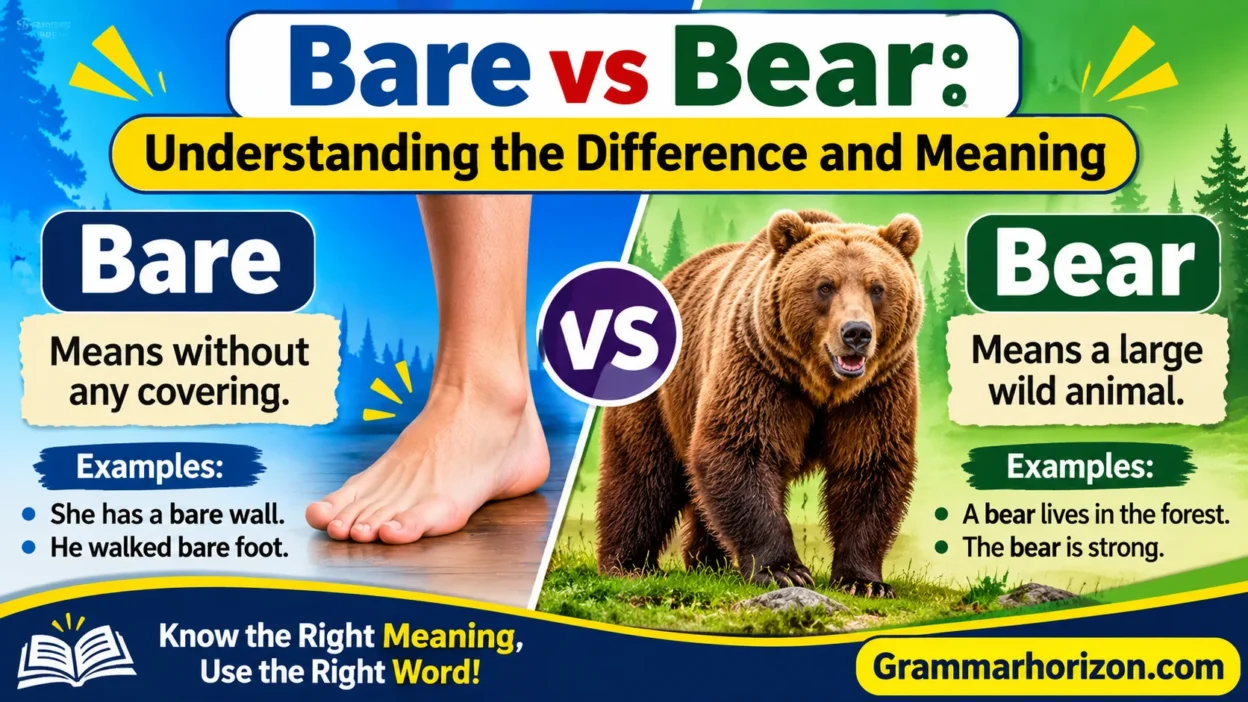
Bare vs Bear is a common English grammar topic because both words have the same pronunciation and sound alike, but their meanings, spelling, and grammatical functions are different. In the English language, bare describes something uncovered, exposed, empty, or without something. In contrast, bear can refer to a large animal or describe carrying, supporting, tolerating, and enduring something.
In everyday use, the correct word depends on the action or idea you want to express. For example, bare feet means feet without shoes or socks. You can also use bare to describe an empty room or an exposed surface. However, bear has a different purpose in sentences such as “I cannot bear this pain.” Here, it means you cannot tolerate or endure something difficult. Choosing the wrong spelling can change the entire meaning of a sentence and create confusion for readers.
Both words appear in everyday conversations, professional writing, books, and common English expressions. A simple way to remember the difference is to connect bare with something uncovered and bear with an animal or the ability to carry a burden. This practical approach makes learning easier and helps you use both words correctly in different situations.
Quick Answer: Bare vs Bear
Bare means uncovered, exposed, empty, or without a covering. It can also work as a verb meaning to uncover or reveal something. Bear refers to a large animal or works as a verb meaning to carry, support, tolerate, or endure something.
Here are some simple examples:
- Bare feet: She walked across the grass with bare feet.
- Bear an animal: We saw a brown bear in the forest.
- Bare as a verb: The dog bared its teeth.
- Bear as a verb: I cannot bear the noise.
- Bear responsibility: She agreed to bear the responsibility for the mistake.
The easiest way to remember the difference is that bare relates to something uncovered or exposed, while bear relates to an animal or the action of carrying and enduring something.
What Does Bare Mean?
Bare is an English word that functions mainly as an adjective and sometimes as a verb. As an adjective, it describes something uncovered, exposed, empty, or lacking decoration. As a verb, it means to uncover, expose, or reveal something.
The word is commonly used when describing physical objects, body parts, rooms, surfaces, and situations where something is missing or exposed.
For example:
- The walls were bare after the furniture was removed.
- He walked across the beach with bare feet.
- The tree branches were bare in winter.
- She decided to bare her feelings.
In these sentences, bare communicates either the absence of a covering or the act of revealing something.
Bare as an Adjective
As an adjective, bare describes something that has no covering, decoration, or additional items. It can also describe a situation where only the most basic things are available.
For example:
- The room had bare walls.
- He stood outside with bare feet.
- The table was bare after dinner.
- The mountain had bare rocks near its peak.
- She wore a simple dress with bare shoulders.
In each sentence, bare describes something exposed or without its usual covering.
It can also describe something that has very little or nothing extra. For example, a room with bare walls has no pictures, decorations, or other objects hanging on them.
Bare as a Verb
As a verb, bare means to uncover, expose, or reveal something that was previously hidden or covered. Its past tense and past participle forms are both bared.
For example:
- He bared his arms in the warm sunlight.
- The dog bared its teeth when it felt threatened.
- She bared her emotions during the conversation.
- The investigation bared the truth about the incident.
- He bared his chest while swimming.
The word can describe both physical exposure and emotional openness.
For example, when someone bares their feelings, they openly reveal their emotions. Similarly, when an animal bares its teeth, it exposes its teeth, often as a warning.
Common Expressions with Bare
Several everyday English expressions contain the word bare. These expressions describe simplicity, exposure, or the absence of unnecessary things.
| Expression | Meaning | Example |
| Bare minimum | The smallest amount necessary | He did the bare minimum at work. |
| Bare feet | Feet without shoes or socks | Children played in bare feet. |
| Bare hands | Hands without gloves or tools | He moved the box with bare hands. |
| Bare essentials | Only the most necessary things | Pack the bare essentials for the trip. |
| Bare bones | The basic structure or simplest form | The report contains the bare bones of the proposal. |
| Bare facts | Basic facts without additional details | The journalist presented the bare facts. |
These expressions are useful in everyday conversations and professional writing. For example, bare minimum is often used when describing the least amount of effort or work required to complete a task.
What Does Bear Mean?
Bear is an English word that functions as both a noun and a verb. As a noun, it refers to a large mammal with a strong body, thick fur, and powerful limbs. As a verb, it has several meanings, including carrying, supporting, tolerating, enduring, and producing.
The meaning depends on how the word is used in a sentence.
For example:
- A bear walked through the forest.
- I cannot bear this headache.
- She will bear the responsibility for the decision.
- This tree bears delicious fruit.
- The document bears his signature.
The same spelling can communicate different ideas, so understanding the context is important.
Bear as a Noun
As a noun, bear refers to a large mammal belonging to the family Ursidae. Bears are powerful animals found in different parts of the world. They generally have large bodies, strong claws, and thick fur.
Some commonly known types include:
- Brown bears: Large bears found across parts of North America, Europe, and Asia.
- Polar bears: Arctic animals adapted to cold environments and sea ice.
- American black bears: Bears found in North America, often living in forests and mountainous areas.
- Giant pandas: Bears native to China that mainly eat bamboo.
Examples of bear as a noun include:
- A brown bear crossed the road.
- The polar bear lives in Arctic regions.
- We saw a black bear during our camping trip.
- The giant panda is a member of the bear family.
- A bear was searching for food near the river.
In these sentences, bear refers to the animal rather than an action.
Bear as a Verb
As a verb, bear has several meanings. It can describe carrying something, tolerating difficulty, accepting responsibility, or producing something.
Understanding these meanings will help you use the word correctly.
To carry or support something
Use bear when someone or something carries weight or supports a physical or figurative load.
Examples:
- This bridge can bear heavy traffic.
- The table cannot bear that much weight.
- The workers must bear the equipment carefully.
- The roof bears the weight of the upper floor.
To tolerate or endure something
Use bear when describing the ability to tolerate an unpleasant experience, situation, or feeling.
Examples:
- I cannot bear this noise.
- She couldn’t bear the thought of losing her job.
- He had to bear the pain after the accident.
- They could no longer bear the difficult conditions.
To accept responsibility
The verb bear can also describe accepting responsibility, costs, or consequences.
Examples:
- She agreed to bear the responsibility.
- The company will bear the expenses.
- Parents often bear the responsibility of supporting their children.
- He must bear the consequences of his actions.
To produce or give something
Use bear when describing something that produces fruit, results, or offspring.
Examples:
- This tree bears delicious apples.
- The plant bears beautiful flowers.
- The research may bear positive results.
- The farm animals bear healthy offspring.
To display or show something
The verb can also describe carrying or displaying a particular feature, mark, name, or sign.
Examples:
- The document bears his signature.
- The package bears a warning label.
- The building bears the company’s name.
- The letter bears yesterday’s date.
Different Forms of the Verb Bear
The verb bear has several forms. Understanding them is important because its past tense and past participle forms are different from its present form.
| Verb Form | Word | Example |
| Present | Bear | I can bear the responsibility. |
| Past | Bore | She bore the pain bravely. |
| Past participle | Borne | The costs have been borne by the company. |
| Past participle for birth | Born | He was born in 2001. |
| Present participle | Bearing | They are bearing the expenses. |
The distinction between born and borne is particularly important.
Borne vs Born
Both born and borne come from the verb bear, but they have different uses.
Borne is used when discussing carrying, supporting, enduring, or accepting something.
Examples:
- She has borne many responsibilities.
- The financial costs were borne by the company.
- He has borne the consequences of his decision.
Born is mainly used when talking about birth.
Examples:
- She was born in London.
- My brother was born in December.
- The child was born healthy.
A simple way to remember this distinction is that born relates to birth, while borne generally relates to carrying or enduring something.
Main Differences Between Bare vs Bear
The main difference between bare and bear is their meaning and grammatical function. Although they sound the same, they serve different purposes in sentences.
Bare describes something uncovered, exposed, or lacking decoration. It can also mean to reveal something. Bear refers to an animal or describes carrying, tolerating, supporting, or producing something.
Bare vs Bear Comparison Table
| Feature | Bare | Bear |
| Pronunciation | /ber/ | /ber/ |
| Main meaning | Uncovered or exposed | Animal, carry, or endure |
| Part of speech | Adjective, verb | Noun, verb |
| Adjective use | Bare walls | Not normally used this way |
| Noun use | Not commonly used as a noun | A large animal |
| Verb use | To uncover or reveal | To carry or tolerate |
| Common expression | Bare minimum | Bear in mind |
| Example | Bare feet | Bear the responsibility |
Difference in Meaning
Consider these examples:
- The room had bare walls.
- The room had a bear inside.
In the first sentence, bare describes walls without decorations or coverings. In the second sentence, bear refers to an animal.
Now consider these examples:
- She decided to bare her feelings.
- She couldn’t bear the pain.
The first sentence means that she revealed her emotions. The second means that she couldn’t tolerate the pain.
These examples show that replacing one word with the other can completely change a sentence’s meaning.
Difference in Pronunciation and Spelling
Bare and bear are homophones. This means they have the same pronunciation but different spellings and meanings.
When speaking, listeners usually understand the intended meaning from the surrounding sentence. However, when writing, you must select the correct spelling.
For example:
- Bare hands (hands without gloves)
- Bear hands (incorrect for this meaning)
- Bear with me (please be patient)
- Bare with me (incorrect for this expression)
Because pronunciation cannot distinguish these words, understanding their meanings is the best way to use them correctly.
Bare vs Bear: When to Use Each Word
Choosing between bare and bear becomes easier when you identify what your sentence is describing.
When to Use Bare
Use bare when describing something uncovered, exposed, empty, or without decoration.
Examples:
- The walls are bare.
- She walked with bare feet.
- The table was bare.
- He showed his bare arms.
You can also use bare as a verb when someone reveals or uncovers something.
Examples:
- The dog bared its teeth.
- She bared her soul.
- He bared his chest.
- The investigation bared the truth.
When to Use Bear
Use bear when referring to the animal or describing an action such as carrying, tolerating, supporting, or enduring.
Examples:
- A bear lives in the forest.
- I cannot bear the noise.
- She must bear the responsibility.
- The bridge can bear heavy loads.
- The tree bears fruit every summer.
Remember that bear has several meanings, so you should always consider the context.
Bare vs Bear in Common Expressions and Idioms
Both words appear in common English expressions. Learning these phrases can help you recognize their correct spelling and meaning.
Common Expressions with Bare
Bare minimum: The smallest amount needed to complete something.
Example: He only did the bare minimum to finish his assignment.
Bare necessities: The basic things required for everyday life.
Example: We packed only the bare necessities for our journey.
Bare hands: Hands without gloves or protective coverings.
Example: The worker picked up the small object with his bare hands.
Bare bones: The simplest or most basic structure of something.
Example: The manager presented the bare bones of the business plan.
Bare facts: Basic information without unnecessary details.
Example: The report explains the bare facts of the situation.
Common Expressions with Bear
Bear in mind: To remember or consider something.
Example: Bear in mind that the deadline is approaching.
Bear with me: To be patient while someone finishes something or explains something.
Example: Please bear with me while I check your information.
Bear the burden: To accept or carry a difficult responsibility.
Example: She had to bear the burden of supporting her family.
Bear the cost: To pay for or accept an expense.
Example: The company will bear the cost of repairs.
Can’t bear it: To be unable to tolerate something.
Example: I can’t bear the sound of loud alarms.
Grin and bear it: To accept an unpleasant situation without complaining.
Example: The journey was uncomfortable, but we had to grin and bear it.
These expressions are commonly used in conversations, books, articles, and professional communication. Pay special attention to their spelling because replacing bear with bare changes the meaning or makes the expression incorrect.
Conclusion
Understanding the difference between bare vs bear makes your English writing clearer and helps you avoid common spelling mistakes. Although both words have the same pronunciation, they serve different purposes. Bare describes something uncovered, empty, or exposed, while bear refers to an animal or the act of carrying, tolerating, or enduring something. Remembering these simple differences will help you choose the correct word in everyday conversations and professional writing.
Frequently Asked Questions
Q1. What is the main difference between Bare and Bear?
Bare means uncovered, exposed, or empty. Bear refers to a large animal or means to carry, tolerate, or endure something.
Q2. Are Bare and Bear pronounced the same?
Yes, bare and bear are homophones. They have the same pronunciation but different spellings and meanings.
Q3. How do you use Bare in a sentence?
You use bare to describe something uncovered or without covering. For example, “He walked across the grass with bare feet.”
Q4. How do you use Bear in a sentence?
You use bear when talking about carrying, supporting, or tolerating something. For example, “I cannot bear the pain any longer.”
Q5. Is Bear always used to describe an animal?
No. Bear can describe a large animal, but it is also a verb meaning to carry, support, tolerate, or endure something.