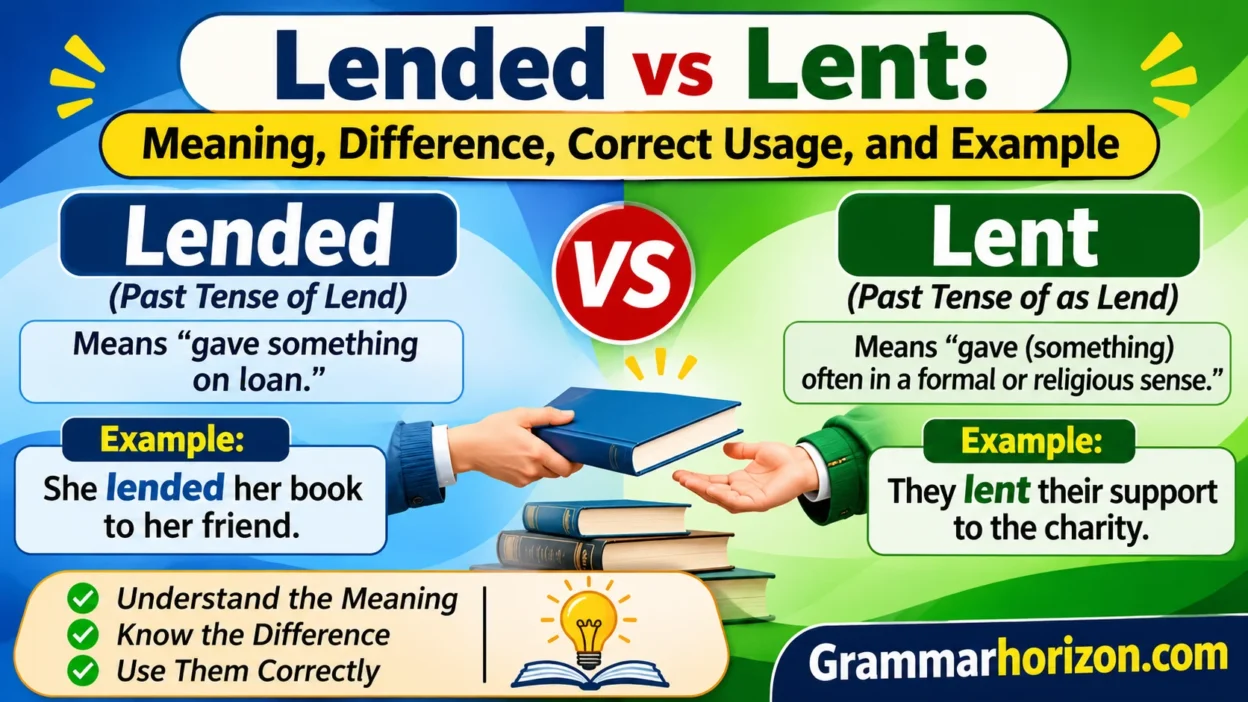
Lended vs Lent is a common grammar question because many English learners and English writers find it difficult to understand irregular verbs and their grammar rules. The verb lend means giving money, objects, or something else to another person for temporary use with an expectation of return. For example, you can lend someone money or an item for temporary lending, expecting them to return it later. In modern English, lent is the correct past tense and past participle of lend, while lended is a nonstandard verb form. Understanding these word differences, word meanings, and grammatical forms improves your English grammar, English vocabulary, and everyday communication.
Unlike regular verbs, which usually form their past forms by adding an -ed ending, lend follows an irregular pattern. Its main verb forms are lend, lent, and lent. This change in spelling is called irregular conjugation, which does not follow the usual past tense formation. Similar verb patterns appear in send, sent and spend, spent. These practical examples help explain verb conjugation, verb tense, and past participle forms. When learning sentence structure, spelling, and correct usage, it is helpful to remember these forms together. A useful grammar guide should also explain the present tense, past tense, and how different forms appear in everyday sentences.
Using lent instead of lended is necessary for standard English and grammatical accuracy. Although some people use lended in informal speech, it remains nonstandard English in modern usage. For example, “I lent him my book yesterday” is correct, while “I lended him my book yesterday” is not standard English. Knowing this difference helps prevent grammar mistakes and writing mistakes in emails, school assignments, professional documents, and everyday conversations. Improving your writing skills requires a clear grammar understanding and regular practice with usage examples. Consistent language learning and attention to language rules will help you use lend correctly and maintain correct grammar in different situations.
Quick Answer: Lended vs Lent
Lent is the correct past tense and past participle of the verb lend. Lended is not the standard form and should generally be avoided in modern English.
For example:
- Correct: I lent my friend $50 yesterday.
- Incorrect: I lended my friend $50 yesterday.
- Correct: She has lent me her laptop.
- Incorrect: She has lended me her laptop.
Use lend when describing something in the present or making a request. Use lent when discussing a completed past action or forming a perfect tense.
| Verb Form | Correct Word | Example |
| Base form | Lend | I lend him books. |
| Simple past | Lent | I lent him a book. |
| Past participle | Lent | I have lent him a book. |
| Present participle | Lending | I am lending him a book. |
Remember this simple rule: Lend, lent, lent is the correct verb pattern.
What Does Lent Mean?
Lent is the simple past tense and past participle of the verb lend. It describes giving something to another person temporarily, usually with the expectation that the person will return it.
People commonly use this word when talking about money, books, vehicles, tools, equipment, and other belongings. It can also describe providing support, assistance, or resources to someone.
For example, if you gave your friend a book yesterday and expect them to return it, you can say, “I lent my friend a book.”
The word lent makes it clear that the action happened in the past. It also works with helping verbs such as has, have, and had to form perfect tenses.
Examples of Lent in Sentences
Here are some practical examples showing how to use lent correctly:
- I lent my brother some money last week.
- Sarah lent me her notebook during class.
- My neighbor lent us his car for the weekend.
- They have lent their support to the local community.
- He had lent his tools to a friend before starting the project.
- The company lent its equipment to another organization.
In each example, lent describes something that was given temporarily or support that was provided.
Different Meanings and Uses of Lent
Although lent most commonly refers to giving something temporarily, it can also appear in expressions with broader meanings.
- Money: She lent me $100 to pay the bill.
- Personal belongings: He lent his jacket to his cousin.
- Equipment: The school lent students computers for their assignments.
- Support: Her experience lent credibility to the proposal.
- Influence: His presence lent confidence to the team.
Notice that the last two examples do not involve physically returning an object. Here, lent means contributing or adding something valuable to a situation.
What Does Lended Mean?
Lended is a nonstandard form that some English speakers and learners use as the past tense of lend. It usually appears when someone applies the regular past-tense rule of adding -ed to a verb.
In English, many verbs form their past tense by adding -ed. For example, walk becomes walk, clean becomes cleaned, and help becomes helped. Because lend ends in a consonant, someone unfamiliar with its irregular form might assume that lended follows the same pattern.
However, lend does not follow the regular pattern. Its accepted past tense and past participle are both lent. Therefore, use lent instead of lended in standard English.
Examples of Incorrect Lended Usage
Here are some sentences that use lended incorrectly in standard English:
- She lended me her notes before the examination.
- My father lended his car to our neighbor.
- They lended money to the small business.
- He has lended his laptop to a colleague.
- The teacher lended us some books.
Corrected Examples Using Lent
The following sentences show the correct way to express the same ideas:
- She lent me her notes before the examination.
- My father lent his car to our neighbor.
- They lent money to the small business.
- He has lent his laptop to a colleague.
- The teacher lent us some books.
The important point is that the meaning does not change when you replace lended with lent. You are simply using the correct grammatical form.
Why Is Lent the Correct Past Tense of Lend?
The main reason lent is correct is that lend is an irregular verb. Irregular verbs do not always form their past tense by adding -ed. Instead, they may change their spelling or pronunciation.
For example, consider these common English verbs:
| Base Form | Past Tense | Past Participle |
| Lend | Lent | Lent |
| Send | Sent | Sent |
| Spend | Spent | Spent |
| Bend | Bent | Bent |
| Build | Built | Built |
| Keep | Kept | Kept |
| Sleep | Slept | Slept |
As you can see, several verbs change their endings instead of using the regular -ed pattern. The verb lend follows the same general pattern as send and spend.
Why Does Lended Sound Correct to Some People?
The word lended may sound reasonable because English learners often rely on familiar grammar rules when forming past-tense verbs.
For example:
- Open → Opened
- Play → Played
- Listen → Listened
- Lend → Lended (nonstandard)
The first three examples use regular past-tense forms. However, lend belongs to the irregular verb group.
This is why learning verbs individually is important. You cannot assume that every English verb follows the same spelling pattern.
A useful way to remember the correct form is to learn lend, lent, and lending together rather than memorizing only the base verb.
Lend, Lent, and Lending: Understanding All Verb Forms
The verb lend has different forms depending on the tense and sentence structure. Knowing when to use each form will help you write grammatically correct sentences.
Lend: The Base Form
Lend is the base form of the verb. It is used when discussing present actions, general habits, future possibilities, requests, and instructions.
It also follows modal verbs such as can, could, will, would, should, and may.
Examples:
- I regularly lend books to my classmates.
- Can you lend me your phone?
- Banks lend money to individuals and businesses.
- She will lend us her camera tomorrow.
- You should not lend money without understanding the agreement.
Remember that modal verbs take the base form of the main verb. Therefore, you should say “Can you lend me some money?” rather than “Can you lent me some money?”
Lent: The Past Tense and Past Participle
Lent is used when describing an action that happened in the past. It is also used with auxiliary verbs to form perfect tenses.
Examples:
- I lent my bicycle to James yesterday.
- She lent me her favorite book last month.
- We have lent our equipment to the school.
- They had lent the money before the agreement expired.
- My uncle has lent me his car several times.
The form stays the same whether you use it as a simple past verb or a past participle. The helping verb and the surrounding sentence determine the tense.
Lending: The Present Participle
Lending is the present participle and gerund form of lend. It is commonly used in continuous tenses and when the action functions as a noun.
Examples:
- I am lending my laptop to my brother.
- The bank is lending money to qualified customers.
- She was lending books to students during the summer.
- Lending personal belongings requires trust.
- The organization is interested in lending equipment to local schools.
Complete Verb Forms of Lend
| Grammatical Form | Verb | Example |
| Base form | Lend | I lend my books. |
| Third-person singular | Lends | He lends his car. |
| Simple past | Lent | She lent me money. |
| Past participle | Lent | I have lent him money. |
| Present participle | Lending | They are lending books. |
| Infinitive | To lend | I want to lend my bicycle. |
| Negative form | Do not lend | Do not lend your password. |
Learning these forms makes it easier to choose the right word when writing about past, present, and future situations.
When to Use Lent in a Sentence
You should use lent whenever you describe a completed action involving the verb lend or need its past participle form.
The word appears in different situations, including personal conversations, financial transactions, business arrangements, and formal writing.
Here are the most common situations.
When Describing a Completed Past Action
Use lent when someone gave something to another person temporarily at a specific time in the past.
Examples:
- I lent my friend $20 yesterday.
- She lent her dress to her sister last weekend.
- The library lent me three books last month.
These actions happened in the past, so lent is the appropriate form.
When Using Has, Have, or Had
Use lent after has, have, or had when forming perfect tenses.
Examples:
- I have lent him my notes.
- She has lent her car to a neighbor.
- They had lent the equipment before the event started.
The helping verb changes according to the tense, but the past participle remains lent.
When Talking About Money
The verb lend is commonly used when discussing money that someone gives temporarily and expects to receive back.
Examples:
- My brother lent me $500 for my business.
- The bank lent the family money to purchase a house.
- She has lent money to several friends.
In financial contexts, lent can refer to personal loans, business loans, or other lending arrangements.
When Talking About Support or Assistance
The word lent can also describe giving help, encouragement, or support.
Examples:
- The manager lent his support to the new project.
- Her experience lent credibility to the discussion.
- The community lent a helping hand to families affected by the storm.
In these sentences, the word does not describe borrowing a physical object. It describes providing something useful to another person or situation.
Lended vs Lent: Common Mistakes to Avoid
Many mistakes involving lended and lent happen because writers misunderstand irregular verbs or forget which form belongs in a particular tense.
Here are some common errors and their corrections.
| Incorrect Sentence | Correct Sentence |
| She lended me her book. | She lent me her book. |
| He has lended some money. | He has lent some money. |
| They lended us their car. | They lent us their car. |
| I had lended him my phone. | I had lent him my phone. |
| Can you lend me $10? | Can you lend me $10? |
| She is lamenting her notes. | She is lending her notes. |
Using Lended Instead of Lent
This is the main mistake. Since lend is irregular, adding -ed does not create its standard past-tense form.
Incorrect: My friend lended me his bicycle.
Correct: My friend lent me his bicycle.
Using Lent After Modal Verbs
Modal verbs such as can, could, will, and should require the base form of the main verb.
Incorrect: Could you lend me your notebook?
Correct: Could you lend me your notebook?
Confusing the Past Tense With the Past Participle
Although lent works as both forms, its use depends on the sentence structure.
Simple past: She lent me her camera yesterday.
Present perfect: She has lent me her camera before.
Both sentences are correct, but they describe the action using different tenses.
Using Lent Instead of Lending
Use lending when describing an ongoing action or using the verb as a gerund.
Incorrect: He lent me his car.
Correct: He is lending me his car.
The continuous form requires a form to be followed by the present participle.
Lend vs Borrow: What Is the Difference?
Another common source of confusion is the difference between lend and borrow. Both words describe the same temporary exchange, but they represent opposite sides of the situation.
Lend means giving something to another person temporarily, while borrow means receiving something temporarily from someone else.
For example, if you give your friend $30 and expect them to return it, you lend the money. From your friend’s perspective, they borrow the money.
Examples of Lend and Borrow
| Lend | Borrow |
| I lent Sarah my book. | Sarah borrowed my book. |
| He lent me his car. | I borrowed his car. |
| My father lent me $100. | I borrowed $100 from my father. |
| She lent him a laptop. | He borrowed a laptop from her. |
How to Remember the Difference
Use this simple trick:
- Lend = Give: You allow someone else to use something temporarily.
- Borrow = Receive: You take something from someone temporarily and expect to return it.
For example, if your friend asks, “Can you lend me your pen?” they are asking you to give them temporary use of your pen.
If you ask, “Can I borrow your pen?” you are asking to receive it temporarily.
Understanding this distinction will help you avoid another common English grammar mistake.
Lended vs Lent: Comparison Table
The following table summarizes the important differences between these two forms.
| Feature | Lended | Lent |
| Base verb | Lend | Lend |
| Grammatical status | Nonstandard form | Standard English form |
| Past tense | Incorrect in standard English | Correct |
| Past participle | Incorrect in standard English | Correct |
| Used in formal writing | Avoid | Yes |
| Used in everyday English | Avoid | Yes |
| Example | She lended me money. | She lent me money. |
The table makes the main rule clear: lent is the correct choice in standard English.
Conclusion
Understanding Lended vs Lent is important for using correct English grammar. Lent is the correct past tense and past participle of lend, while lended is considered nonstandard in modern English. Although regular verbs usually take an -ed ending, lend follows an irregular pattern, just like send and spend. Remembering these verb forms will help you avoid common grammar mistakes and improve your writing, speaking, and everyday communication.
Frequently Asked Questions
Q1. Is it lended or lent?
Lent is correct. It is the standard past tense of the verb lend. Lended is considered nonstandard in modern English.
Q2. Is lended a real English word?
Lended appears in some informal or nonstandard usage, but it is not accepted as the standard past tense of lend.
Q3. What is the past tense of lend?
The past tense of lend is lent. For example: “I lent my friend some money yesterday.”
Q4. What is the past participle of lend?
The past participle of lend is also lent. For example: “She has lent me her favorite book.”
Q5. Why is lent used instead of lended?
Lend is an irregular verb, so it does not follow the usual rule of adding -ed to form the past tense. Its correct forms are lend, lent, and lent.