May vs Can is a common topic in English grammar because both modal verbs can express permission and possibility. However, their meaning changes depending on the context and intended meaning of a sentence. May usually expresses permission or uncertainty, while Can describes ability, permission, or general possibility. For example, “May I leave early?” sounds like a polite permission request and is suitable for a formal expression. On the other hand, “Can I leave early?” uses conversational wording that feels natural in everyday conversation. Both are correct words in modern English, but their correct usage depends on the situation and level of formality.
Questions about skills show another important difference between these modal verbs. For example, “Can you drive a car?” is an ability question because it asks about someone’s ability to drive, not requesting permission. Here, Can describes driving ability, while May would not normally express the same meaning. However, May can communicate an uncertainty expression when something might happen, whereas Can often describes general possibility. Understanding these grammatical differences makes sentence structure easier to manage and helps you choose appropriate wording for different situations.
In my experience with spoken English and written English, learners often focus on memorizing grammar rules without paying attention to sentence meaning. A better approach is to consider the complete sentence, word choice, modal verb usage, and its interpretation. These communication skills improve language clarity and support natural communication. Whether you are writing a clearer sentence or trying to communicate naturally, choosing the right modal verb creates clearer writing and more effective communication. Good English usage also helps you ask permission, request permission, and express different meanings with greater confidence.
Quick Answer: May vs Can
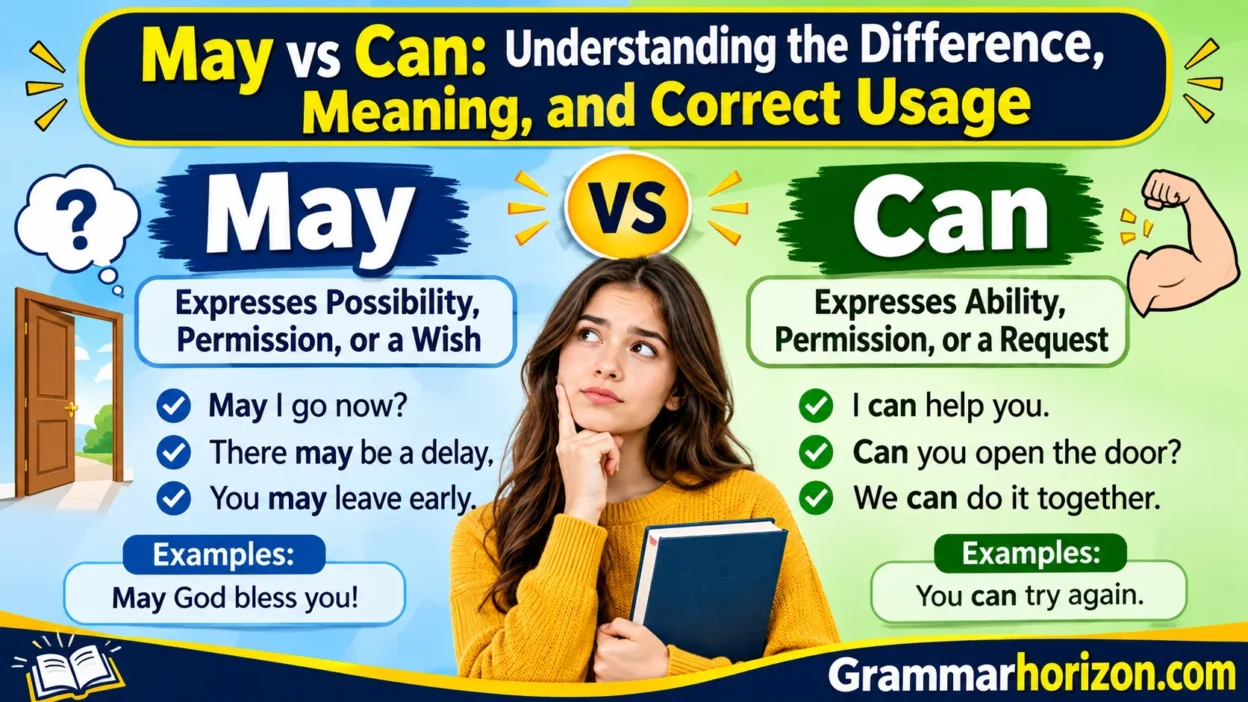
May is generally used to ask for or give permission and to express possibility. Can is commonly used to describe someone’s ability, request or grant permission, and explain general possibilities.
Here are some simple examples:
- May I enter the room? (Asking for permission politely.)
- Can you swim? (Asking about someone’s ability.)
- It may rain tomorrow. (Expressing uncertainty.)
- You can use my computer. (Giving permission.)
- Driving too fast can cause accidents. (Describing a general possibility.)
The easiest way to remember the difference is that may often relates to permission and uncertain situations, whereas can commonly relates to ability and practical possibilities. However, both words can express permission and possibility.
What Does May Mean?
May is a modal auxiliary verb used to express permission, possibility, and sometimes wishes. It helps communicate whether something is allowed or whether an event might happen. It does not change its form according to the subject.
For example:
- I may visit my friend tomorrow.
- She may need additional time.
- May I ask you something?
- You may leave the office early.
In these sentences, may communicate either permission or possibility. The exact meaning becomes clear from the surrounding words and situation.
May for Permission
One of the most common uses of may is asking for or giving permission. It is especially common in formal conversations, professional communication, classrooms, and official instructions.
For example:
- May I come inside?
- May we begin the meeting?
- You may use the conference room.
- Students may leave after submitting their assignments.
When you use may to ask a question, it often creates a polite and respectful tone. This makes it useful when speaking with teachers, managers, customers, or people you don’t know well.
May for Possibility
May also expresses uncertainty about something that could happen. It indicates that an event is possible, but the speaker isn’t certain that it will occur.
For example:
- The weather may improve this afternoon.
- He may arrive late because of traffic.
- This change may affect the company’s plans.
- We may need another meeting next week.
Notice that these sentences don’t confirm that something will happen. They simply describe a possible outcome.
May for Wishes and Formal Expressions
In formal English, may can also express wishes, hopes, or blessings. This use is common in speeches, greetings, and written expressions.
For example:
- May you have a wonderful year ahead.
- May your dreams come true.
- May peace remain in your home.
Here, may doesn’t ask for permission or describe an ordinary possibility. Instead, it expresses a wish for something positive.
What Does It Mean?
Can is a modal auxiliary verb that primarily expresses ability, permission, and possibility. It helps explain what someone is capable of doing, what someone is allowed to do, or what can happen in a particular situation.
For example:
- I can speak English.
- She can solve difficult problems.
- Can I borrow your notebook?
- Excessive heat can damage electronic equipment.
Unlike ordinary verbs, can doesn’t take an -s ending with third-person singular subjects. You say “He can drive,” not “He can drive.”
Can for Ability
The most recognizable use of can is describing physical or mental ability. It explains whether someone has the skills, knowledge, or capacity to perform an action.
For example:
- My brother can play the guitar.
- She can speak three languages.
- They can complete this project independently.
- I can remember important dates easily.
In each sentence, can describe an ability or skill. It answers questions about what someone knows how to do or is capable of doing.
Can for Permission
Can is also widely used to ask for and grant permission, especially in everyday conversations. Although traditional grammar lessons sometimes prefer may for permission, using can this way is completely acceptable in modern English.
For example:
- Can I sit here?
- Can we use your car?
- You can take my chair.
- You can leave after finishing your work.
These sentences sound natural in ordinary conversations. In many situations, people use can instead of may without causing confusion.
Can for Possibility
Another important use of can is expressing general or theoretical possibility. It describes something that is possible under certain conditions or circumstances.
For example:
- Strong winds can damage buildings.
- Learning a new language can take time.
- Mistakes can happen during important projects.
- Regular exercise can improve physical fitness.
These statements describe situations that are generally possible, rather than uncertain events expected to happen at a particular time.
Main Differences Between May vs Can
The main difference between may and can is their usual purpose in a sentence. May is commonly associated with permission and uncertain possibility, while can is strongly associated with ability, permission, and general possibility.
Although they sometimes have similar meanings, they aren’t interchangeable in every situation.
May vs Can Comparison Table
| Feature | May | Can |
| Permission | Yes | Yes |
| Physical ability | Not normally | Yes |
| Mental ability | Not normally | Yes |
| Possibility | Yes | Yes |
| Formal permission | Common | Less formal |
| Everyday requests | Common | Very common |
| General possibility | Less common | Very common |
| Expressing wishes | Yes | Not normally |
Difference in Meaning
Consider these two questions:
- May you drive a car?
- Can you drive a car?
The second sentence is the natural way to ask whether someone has the ability to drive. The first sentence is not normally used for this meaning.
Now compare:
- May I use your phone?
- Can I use your phone?
Both sentences ask for permission. The first sounds more formal, while the second is more conversational.
This shows why understanding the intended meaning matters more than memorizing a single rule.
Difference in Formality and Tone
May traditionally sounds more formal and polite when requesting permission. It is often preferred in professional settings, official communication, and respectful conversations.
Can sound more natural and relaxed in everyday speech. People commonly use it with friends, family members, classmates, and coworkers.
However, formality doesn’t make one word automatically correct and the other incorrect. Both can be appropriate depending on the situation.
When to Use May
Use may when your sentence expresses permission or an uncertain possibility. It is especially useful when you want to sound respectful or maintain a formal tone.
Understanding these situations will help you choose may correctly in both spoken and written English.
Use May to Ask for Permission
When you need approval to do something, may is a polite way to ask. It is commonly used when speaking to someone in a position of authority or in a formal environment.
Examples:
- May I speak with the principal?
- May I borrow your notebook?
- May we enter the building?
- May I take tomorrow off?
Use May to Give Permission
You can also use may to allow someone to do something. This use is common in official instructions, workplace policies, and formal conversations.
Examples:
- You may submit your assignment tomorrow.
- Employees may use the parking area.
- Visitors may enter after registration.
- Students may leave when the examination ends.
Use May to Express Uncertainty
Use may when you think something is possible but don’t know whether it will happen.
Examples:
- The manager may approve your request.
- We may visit our grandparents this weekend.
- The delivery may arrive before noon.
- She may change her decision.
These sentences communicate uncertainty rather than a confirmed fact.
When to Use Can
Use can when discussing someone’s ability, asking for permission in everyday situations, or describing something that is generally possible.
It is one of the most frequently used modal verbs in everyday English.
Use Can to Describe Ability
When someone has the physical strength, knowledge, or skill to perform an action, use can.
Examples:
- My sister can cook delicious meals.
- He can repair electronic devices.
- I can understand basic Spanish.
- Our team can finish the project on time.
These examples describe what someone is capable of doing.
Use Can to Ask for Permission
You can use can to ask whether an action is allowed. This construction is natural in everyday conversations and is widely accepted in modern English.
Examples:
- Can I open the door?
- Can we watch television?
- Can I use your charger?
- Can they join our group?
These questions are grammatically correct. You don’t need to use may every time you request permission.
Use Can to Describe General Possibility
Use can when something is possible in general or under certain conditions. It often describes situations that can happen repeatedly.
Examples:
- Too much sunlight can damage your skin.
- Lack of sleep can affect concentration.
- Regular practice can improve your writing.
- Heavy traffic can delay important deliveries.
Here, can describe general facts or possibilities rather than predicting one specific event.
May vs Can for Permission
One of the biggest sources of confusion in May vs Can is their use when asking for permission. Both words are correct, but they can create slightly different impressions.
Traditionally, grammar lessons teach students to use may for permission and can for ability. However, everyday English has changed, and people commonly use can to request permission.
Consider these examples:
| Sentence | Meaning | Tone |
| May I leave early? | Asking for permission | Formal and polite |
| Can I leave early? | Asking for permission | Conversational |
| May I use your desk? | Requesting approval | Formal |
| Can I use your desk? | Requesting approval | Casual |
| You may enter now. | Giving permission | Formal |
| You can enter now. | Giving permission | Natural and direct |
Which Is Better: May I or Can I?
Both expressions are correct. Your choice depends on the situation.
Use may I when speaking in a formal environment or when you want to sound especially respectful. I can use it in ordinary conversations with friends, family members, classmates, and coworkers.
For example, a student speaking to a teacher might say, “May I leave the classroom?” However, the same student might ask a friend, “Can I borrow your pen?”
Neither expression is automatically wrong. The difference mainly involves tone and context.
May vs Can for Possibility
Both may and can can describe possible situations, but they don’t always communicate the same type of possibility.
May generally expresses uncertainty about a particular event. Can often describes a general possibility, ability, or something that happens under certain conditions.
May for Specific Possibility
Use may when discussing an event that might happen but isn’t certain.
Examples:
- It may rain this evening.
- The company may hire new employees.
- John may attend the conference.
- The prices may increase next month.
These sentences describe possible future events without confirming their outcomes.
Can for General Possibility
Use can when explaining something that is possible in general or under particular conditions.
Examples:
- Winter temperatures can fall below freezing.
- Poor communication can create workplace problems.
- Children can learn new languages quickly.
- Regular exercise can strengthen muscles.
These statements describe general situations rather than uncertain predictions about one specific event.
May vs Can: Possibility Comparison
| May | Can |
| It may rain tomorrow. | It can rain heavily in this region. |
| She may forget the appointment. | People can forget important appointments. |
| The plan may fail. | Poor planning can lead to failure. |
| The medicine may cause side effects. | Some medicines can cause side effects. |
A useful distinction is that may often communicate a possible event, while can commonly communicate a general truth or a possibility based on known conditions.
May vs Can in Questions
The meaning of a question can change depending on whether you use may or can. The most important thing is to understand whether you’re asking about permission, ability, or possibility.
Questions About Permission
Use may or can when asking whether you’re allowed to do something.
Examples:
- May I join your team?
- Can I join your team?
- May we use this room?
- Can we use this room?
Both forms request permission. The first generally sounds more formal.
Questions About Ability
Use can when asking whether someone has the ability or skill to perform an action.
Examples:
- Can you speak French?
- Can she drive a bus?
- Can they solve this puzzle?
- Can your brother play football?
In these examples, you’re asking about someone’s ability rather than requesting permission.
Questions About Possibility
Can can also appear in questions about whether something is possible.
Examples:
- Can this machine work without electricity?
- Can anyone learn to play the piano?
- Can this road become dangerous during winter?
- Can the situation improve without additional support?
These questions explore general possibilities or practical conditions.
May vs Can in Negative Sentences
Both modal verbs have negative forms, but their meanings depend on the context.
The negative form of may is may not, while the negative form of can is cannot or its contraction can’t.
How to Use May Not
May not express uncertainty or prohibition.
When it expresses uncertainty, it means something might not happen.
Examples:
- She may not attend the meeting.
- They may not finish the work today.
- The weather may not improve.
- He may not agree with the decision.
However, when one may not express prohibition, it means someone isn’t allowed to do something.
Examples:
- Visitors may not enter this room.
- Employees may not share confidential information.
- Students may not use mobile phones during the examination.
The context helps readers understand which meaning is intended.
How to Use Cannot or Can’t
Cannot and can’t commonly express inability, impossibility, or lack of permission.
Examples of inability:
- I cannot swim.
- She can’t lift this heavy box.
- He cannot understand the instructions.
Examples of prohibition:
- You can’t park your car here.
- Students cannot leave the classroom without permission.
- Visitors can’t take photographs inside the museum.
In formal writing, cannot is often preferred. In everyday conversations, can’t is more common.
Grammatical Rules for May vs Can
Understanding the grammar of modal verbs is important because both may and can follow similar sentence structures.
They don’t change their form according to the subject. They also take the base form of the main verb rather than an infinitive with to.
May and Can Followed by the Base Verb
The basic structure is:
Subject + May/Can + Base Verb + Other Words
Examples:
- She may visit us tomorrow.
- He can solve this problem.
- They may arrive late.
- We can complete the assignment.
Don’t add to between the modal verb and the main verb.
Incorrect: She may to visit us.
Correct: She may visit us.
Incorrect: He can swim.
Correct: He can swim.
Forming Questions with May and Can
To create a question, place the modal verb before the subject.
May/Can + Subject + Base Verb + Other Words?
Examples:
- May I enter the office?
- Can she drive a car?
- May we start the lesson?
- Can they finish the project?
You don’t need to use do or does when forming questions with these modal verbs.
Incorrect: Do you speak English?
Correct: Can you speak English?
Incorrect: Do I may leave now?
Correct: May I leave now?
Forming Negative Sentences
Place not after the modal verb to create a negative sentence.
Examples:
- She may not attend the event.
- I cannot speak German.
- He can’t complete the task alone.
- You may not enter without permission.
Remember that cannot is normally written as one word.
Common Mistakes to Avoid When Using May vs Can
Writers sometimes confuse these modal verbs because their meanings overlap. Learning the following mistakes can help you avoid common grammar problems.
Using May to Describe Ability
May isn’t normally used to describe someone’s physical or mental ability.
Incorrect: She may swim very well.
Correct: She can swim very well.
The corrected sentence clearly describes a skill rather than permission or uncertainty.
Assuming Can Is Incorrect for Permission
Some people believe that can should never be used to ask for permission. This is an outdated restriction in everyday English.
Incorrect assumption: Can I borrow your book? is always grammatically wrong.
Correct: Can I borrow your book?
The sentence is natural and widely accepted. You can also use “May I borrow your book?” when you want a more formal tone.
Confusing General Possibility with Specific Uncertainty
Use can for general possibilities and may for uncertain events when that distinction matters.
Less suitable: It can rain tomorrow.
More natural: It may rain tomorrow.
However, “It can rain heavily in this area” is natural because it describes a general possibility.
Adding To After a Modal Verb
Both words should be followed by the base form of the main verb.
Incorrect: He can to drive.
Correct: He can drive.
Incorrect: They may to arrive late.
Correct: They may arrive late.
Using Do or Does with May and Can
Modal verbs form questions without do or does.
Incorrect: Does she can sing?
Correct: Can she sing?
Incorrect: Do I may leave?
Correct: May I leave?
May vs Can: Example Sentences
The following examples show how both modal verbs work in different situations.
Everyday Conversation Examples
- May I have a glass of water?
- Can you help me with this bag?
- You may sit beside me.
- I can prepare dinner tonight.
- She may visit us after work.
- We can watch a movie together.
Workplace Examples
- Employees may request additional leave.
- Can you send me the updated report?
- The manager may approve the proposal.
- Our team can complete the project this week.
- You may contact the department for assistance.
Education Examples
- Students may use dictionaries during the activity.
- Can you explain this question?
- She can solve difficult mathematical problems.
- The teacher may extend the submission deadline.
- Students can improve their writing through regular practice.
Professional Communication Examples
- May I schedule a meeting with you?
- Can you provide additional information?
- The company may introduce new policies.
- Our department can handle customer complaints.
- You may submit your documents electronically.
May vs Can in Real-Life Situations
Understanding grammar becomes easier when you see how people use words in practical situations. The following examples show how the choice between may and can changes according to the speaker’s intention.
Case Study: A Student Asking a Teacher
Imagine a student wants to leave the classroom before the lesson ends.
The student can ask:
- “May I leave the classroom?”
- “Can I leave the classroom?”
Both questions request permission. However, the first sounds more formal and respectful, while the second sounds more conversational.
Case Study: A Job Interview
An interviewer wants to understand whether a candidate has the skills needed for a position.
The interviewer asks:
“Can you operate advanced computer software?”
Using can is appropriate because the interviewer wants to know about the candidate’s ability.
Using may would not communicate the intended meaning.
Case Study: Weather Forecast
A weather reporter discusses the possibility of rain.
The reporter says:
“It may rain tomorrow afternoon.”
This sentence expresses uncertainty about a specific future event.
However, the reporter might also say:
“Heavy rain can cause flooding in low-lying areas.”
This statement explains a general possibility.
These situations show that the correct choice depends on the meaning you want to express.
Conclusion
Understanding the difference between May vs Can makes your English clearer and more natural. Both words can express permission and possibility, but they serve different purposes. May is generally more suitable for polite or formal permission requests and situations involving uncertainty. Can is commonly used for ability, general possibility, and informal permission. Choosing the correct word depends on the sentence, context, and intended meaning. With regular practice, you can use both modal verbs confidently in everyday conversations and written English.
Frequently Asked Questions
Q1. What is the main difference between May and Can?
May usually expresses permission or uncertainty, while Can expresses ability, possibility, and informal permission. The correct choice depends on the context.
Q2. Is May more polite than Can?
Yes. May generally sounds more formal and polite when asking for permission. For example, “May I come in?” is more formal than “Can I come in?”
Q3. Can I use Can to ask for permission?
Yes. In modern English, Can is commonly used to ask for permission, especially in everyday conversations. It sounds more casual than May.
Q4. Does May express possibility?
Yes. May expresses possibility or uncertainty when something might happen. For example, “It may rain tomorrow” suggests that rain is possible.
Q5. Is Can used to describe ability?
Yes. Can commonly describes someone’s ability to do something. For example, “She can drive a car” means she has the ability to drive.