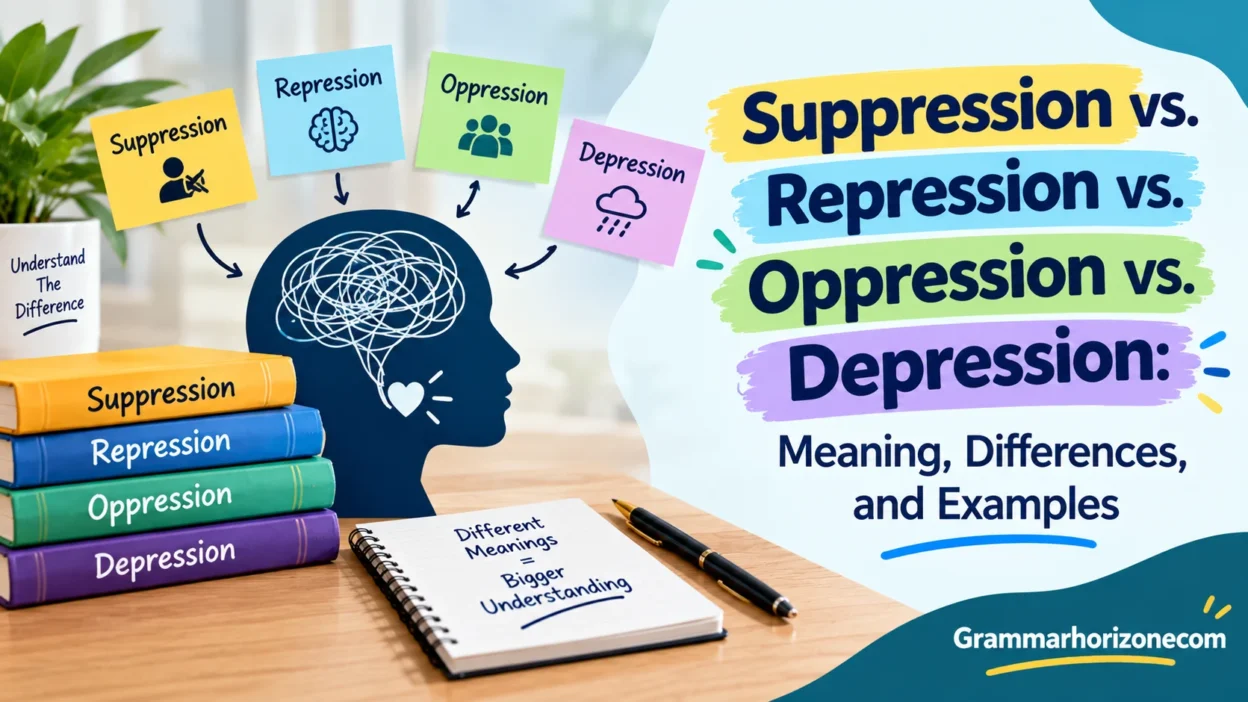
Suppression vs. Repression vs. Oppression vs. Depression explains how similar words have different meanings and describe different situations involving emotions, control, suffering, and difficult experiences. Understanding these differences helps you choose the correct word in everyday conversations, academic writing, psychology, and discussions about society. For example, a person who deliberately hides anger to avoid an argument or remain calm may be practicing suppression. In contrast, repression, in the traditional psychological sense, involves unconsciously keeping distressing thoughts or feelings outside conscious awareness. These psychological processes can influence emotional experiences, even when a person doesn’t fully recognize them.
Oppression occurs when a government or powerful group unfairly restricts people’s rights, limits freedom, or treats people unjustly. It often involves social injustice, unfair treatment, government restrictions, individual rights, and social control. Depression, however, is a mental health condition that can affect a person’s mood, thoughts, behavior, and daily life. Although emotional suffering may occur in different situations, it doesn’t make these terms interchangeable. Emotional control, conscious control, and anger management are closely related to suppression, while unconscious processes, distressing feelings, and psychological awareness help explain repression. Learning these word meanings and understanding their use in different contexts can help you avoid common mistakes.
In everyday language, academic contexts, and psychological terminology, choosing the right term depends on what you want to describe. Clear word usage and attention to contextual meaning support vocabulary development and language learning. They also improve communication and sentence structure, helping readers understand the semantic differences between these related terms. A simple way to remember them is that suppression means deliberately holding something back, repression traditionally involves keeping something outside conscious awareness without deliberate intent, oppression involves unfair power over people, and depression concerns mental health. Understanding these distinctions helps you explain emotions, psychological experiences, and social problems more accurately.
Quick Answer: Suppression vs. Repression vs. Oppression vs. Depression
The main difference between suppression, repression, oppression, and depression lies in what each word describes.
- Suppression: The deliberate act of holding back, stopping, or restraining something, such as an emotion, thought, reaction, or protest.
- Repression: An unconscious process in traditional psychoanalytic theory in which distressing thoughts, feelings, or memories are kept outside conscious awareness.
- Oppression: The prolonged or systematic unfair treatment and control of a person or group, often involving the abuse of power or restriction of rights.
- Depression: A low or reduced state, or a mental health condition that can cause persistent low mood, loss of interest, and other symptoms.
Here’s a simple way to remember the four terms: suppression is deliberate restraint, repression is unconscious exclusion from awareness, oppression is unjust external control, and depression is a state of lowered mood or functioning.
What Does Suppression Mean?
Suppression means deliberately holding back, controlling, or preventing something, such as an emotion, thought, reaction, or action.
Suppression Definition and Meaning
Suppression means deliberately preventing, restraining, or holding back something. It can refer to emotions, thoughts, physical reactions, information, or activities. In psychology, suppression often describes a conscious effort to keep an upsetting thought out of mind or stop an emotion from showing outwardly.
For example, imagine that a coworker makes a rude comment during a meeting. You feel angry, but you decide not to respond because you want to keep the discussion professional. You recognize your anger and intentionally control your reaction. This is an example of emotional suppression.
Suppression can also describe actions involving information, activities, or public expression. A person might suppress a laugh, a government might suppress a protest, or an organization might attempt to suppress important information.
Is Suppression a Conscious or Unconscious Process?
Suppression is generally considered a conscious process in psychological discussions of defense mechanisms. A person recognizes a thought, feeling, or impulse and intentionally tries to manage it.
Common examples include:
- Holding back tears during a formal event.
- Choosing not to argue with someone who has insulted you.
- Putting aside worries to finish an important assignment.
- Avoiding an angry response while speaking with a customer.
- Deciding to discuss a painful subject later rather than during a stressful moment.
Suppression isn’t always harmful. Sometimes it helps you manage your behavior, respect other people, and handle a difficult situation calmly.
However, continually hiding emotions without addressing their causes may create additional stress. There’s a difference between choosing an appropriate time to express a feeling and refusing to acknowledge that feeling indefinitely.
Examples of Suppression in Everyday Life
Consider these sentences to understand how suppression works in different situations.
- Emotional suppression: “She suppressed her anger and finished the conversation politely.”
- Suppression of a reaction: “He suppressed a laugh during the serious presentation.”
- Suppression of information: “The investigation examined the alleged suppression of important evidence.”
- Suppression of a protest: “The authorities attempted to suppress the peaceful demonstration.”
These examples share the idea of holding something back or preventing it from being expressed, released, or continued. The exact meaning depends on the context.
Suppression in Psychology and Emotional Regulation
In psychology, emotional suppression often refers to controlling the outward signs of an emotion. A person might feel frightened while keeping a calm expression or feel disappointed while congratulating someone else.
The important distinction is that controlling an emotional expression doesn’t necessarily remove the emotion itself. Someone can look calm while still feeling anxious, angry, or hurt.
Suppression may be useful in a temporary situation, such as waiting until a private conversation to discuss a disagreement. However, recognizing emotions and finding healthy ways to respond to them are also important parts of emotional regulation.
What Does Repression Mean?
Repression is an unconscious psychological process in which distressing thoughts, feelings, or memories are kept out of conscious awareness.
Repression Definition and Meaning
Repression refers to the unconscious exclusion of distressing thoughts, feelings, memories, or impulses from conscious awareness. The term is especially associated with psychoanalytic theory, which describes repression as a psychological defense mechanism.
Unlike suppression, repression doesn’t usually involve a deliberate decision to push a thought away. In the traditional psychological explanation, the process happens outside a person’s conscious control.
For example, psychoanalytic theory might describe a person who struggles to recognize certain painful feelings as experiencing repression. However, an ordinary difficulty remembering an event doesn’t automatically prove that repression has occurred.
How Repression Differs From Suppression
The central difference between suppression and repression is awareness and intention.
With suppression, you recognize the feeling or thought and choose to control it. With repression, the thought or feeling is described as being kept outside conscious awareness without a deliberate choice.
For example:
- Suppression: You remember an embarrassing mistake but decide to focus on your work instead.
- Repression: In a psychoanalytic interpretation, an upsetting experience may be described as being kept outside conscious awareness without the person intentionally avoiding it.
These examples illustrate the traditional distinction rather than provide a way to diagnose someone’s mental processes. Repression is a theoretical concept, and a person’s behavior alone cannot establish that a particular memory or feeling has been repressed.
Examples of Repression in Psychology and Daily Life
Repression is more difficult to identify in everyday life because it is defined as an unconscious process. Therefore, examples are usually hypothetical illustrations of the concept.
- A person struggles to recognize hostility toward someone they depend on, even though the conflict appears in their behavior.
- Someone repeatedly avoids acknowledging an uncomfortable emotional conflict without consciously understanding why.
- In a psychoanalytic account, a therapist explores feelings that a client has difficulty recognizing or discussing.
These situations shouldn’t be treated as proof of repression. Forgetting, avoiding a subject, or having trouble describing emotions can happen for many reasons.
Repression in Psychoanalytic Theory
Repression is an important concept in the work of Sigmund Freud and the development of psychoanalysis. In classical psychoanalytic theory, repression was proposed as a way the mind protects itself from anxiety associated with distressing experiences or unacceptable impulses.
The concept remains influential in discussions of defense mechanisms. However, it is important to distinguish a historical or theoretical explanation from an established explanation for every memory problem or emotional difficulty.
Key point: Repression describes an unconscious psychological process in its traditional clinical meaning. It isn’t simply another word for deliberately ignoring a problem.
What Does Oppression Mean?
Oppression means the unjust or cruel use of power to control, mistreat, or deny rights and freedoms to individuals or groups.
Oppression Definition and Meaning
Oppression means the unjust or cruel exercise of power over individuals or groups. It often involves restricting freedom, denying rights, enforcing unequal treatment, or maintaining a system that benefits one group at the expense of another.
Unlike psychological suppression and repression, oppression generally focuses on relationships of power between people, institutions, or social groups.
For example, if a government systematically denies a minority group access to education, voting, or equal legal protection, the situation may constitute oppression. Similarly, a workplace that consistently threatens or discriminates against employees because of their identity may create an oppressive environment.
Oppression isn’t simply disagreement or an ordinary restriction. The word usually implies unfair control, abuse of power, or persistent disadvantage.
Causes and Forms of Oppression
Oppression can appear in many settings. It may result from laws, social customs, institutional practices, discrimination, or the actions of people who hold power over others.
Common forms include:
- Political oppression: Restricting political participation, freedom of expression, or opposition to those in power.
- Racial oppression: Maintaining unequal treatment or limiting opportunities based on race.
- Gender-based oppression: Denying people equal rights or opportunities because of their gender.
- Religious oppression: Restricting religious practices or targeting people because of their beliefs.
- Economic oppression: Using unequal power or exploitative arrangements to restrict people’s choices and opportunities.
These categories can overlap. For example, a person may experience both economic disadvantage and discrimination based on their identity.
Examples of Oppression in Society and History
Historical and contemporary examples help explain how oppression differs from an individual’s emotional response.
- A government imprisons peaceful critics to prevent opposition.
- A legal system denies a particular group equal rights.
- An employer systematically pays workers less because of their identity while denying them fair opportunities for advancement.
- A dominant group uses intimidation to prevent another group from participating in public life.
In each case, the central issue is unfair power over people, rather than an individual’s decision to control an emotion.
Oppression vs. Suppression: Who or What Is Being Controlled?
Suppression and oppression share the idea of holding something back, but their meanings differ significantly.
Suppression can refer to a person controlling their own reaction. Oppression usually refers to one person, institution, or group unfairly controlling another.
Compare these sentences:
- “He suppressed his frustration during the interview.” The person deliberately controls his emotional response.
- “The regime suppressed political opposition.” The authorities actively prevent opposition.
- “The regime oppressed its citizens.” The statement emphasizes unjust control and mistreatment of people.
Notice that suppress can also describe an external authority’s actions. For example, a government can suppress a protest. Oppression, however, places greater emphasis on injustice, unequal power, and the treatment of those affected.
What Does Depression Mean?
Depression is a mental health condition that can cause persistent sadness, loss of interest, low energy, and difficulty managing everyday activities.
Depression Definition and Meaning
Depression can refer to a low or reduced state in several contexts. In mental health, it commonly refers to a group of conditions characterized by persistent depressive symptoms that interfere with everyday functioning.
Unlike suppression and repression, depression isn’t defined as a process of holding thoughts back. Unlike oppression, it doesn’t necessarily require an outside person or institution to control someone.
In everyday conversation, people sometimes use “depressed” to describe feeling disappointed or sad. In clinical contexts, depression is more complex than temporary sadness. It can affect a person’s emotions, energy, sleep, appetite, concentration, motivation, and ability to carry out daily responsibilities.
Depression as a Mental Health Condition
Depression can affect people in different ways. Someone may feel sad or empty, while another person may mainly notice exhaustion, irritability, difficulty concentrating, or a loss of interest in activities they previously enjoyed.
Common symptoms can include:
- Persistent sadness, emptiness, or hopelessness.
- Reduced interest or pleasure in activities.
- Low energy or ongoing fatigue.
- Changes in sleeping patterns.
- Changes in appetite or weight.
- Feelings of guilt, worthlessness, or helplessness.
- Difficulty concentrating or making decisions.
- Withdrawing from family, friends, or social activities.
A person doesn’t need to experience every symptom to have depression. A qualified health professional can assess symptoms, their duration, their severity, and their impact on everyday life.
Common Signs and Symptoms of Depression
One important distinction is the difference between a temporary low mood and a possible depressive disorder.
Everyone experiences sadness, disappointment, or stress at times. These feelings may improve as circumstances change. Depression can persist and interfere with work, education, relationships, self-care, or other daily activities.
Professional support can help people understand their symptoms and explore appropriate treatment. Many people benefit from evidence-based treatment, including psychotherapy, medication when appropriate, or a combination of approaches.
Depression should not be interpreted as weakness or a failure to control emotions. It is a mental health concern that deserves understanding and appropriate care.
Examples of Depression in Everyday Contexts
The word depression has several uses depending on the context.
- Mental health: “She sought professional support after experiencing symptoms of depression for several weeks.”
- General emotional state: “He described a period of depression after losing his job.” This wording may describe low mood, but more information is needed to determine whether it refers to a clinical condition.
- Economics: “The country experienced a severe economic depression.”
- Geography and physical features: “The rainwater collected in a shallow depression in the ground.”
These meanings are related to the broader idea of a low, reduced, or diminished state. Context determines which meaning applies.
Depression vs. Repression: Low Mood vs. Unconscious Emotional Processes
Depression and repression are different concepts, even though both can appear in psychological discussions.
Repression describes a proposed unconscious process involving thoughts, feelings, or memories. Depression refers to a low emotional state or, in clinical use, a depressive disorder.
For example, a person may experience depression without there being any reason to conclude that they are repressing memories or feelings. Likewise, discussing repression in a psychoanalytic setting does not automatically mean that a person has depression.
Researchers and clinicians consider many factors when understanding depression. It is not accurate to assume that repressed emotions are the single cause of every case.
Suppression vs. Repression vs. Oppression vs. Depression: Key Differences
The easiest way to distinguish these four words is to examine what each one describes, whether the process is conscious, and who or what is affected.
Differences in Meaning and Definition
Suppression and repression are closely related because both can involve keeping thoughts or feelings from expression or awareness. Oppression focuses on unfair control, while depression commonly refers to a mental health condition or a low state.
| Word | Main meaning | Typical context | Example |
| Suppression | Deliberately holding something back | Emotions, behavior, information | She suppressed her anger. |
| Repression | Unconsciously keeping something outside awareness | Psychology and psychoanalytic theory | The therapist explored a possible emotional conflict. |
| Oppression | Unjust or systematic control | Society, politics, institutions | The community protested against oppression. |
| Depression | A low state or depressive mental health condition | Mental health, economics, physical descriptions | He sought help for depression. |
Differences in Causes and Processes
Each word points toward a different process.
- Suppression may happen because someone wants to avoid conflict, stay professional, or postpone an emotional reaction.
- Repression, in psychoanalytic theory, is described as an unconscious defense mechanism.
- Oppression may arise from unequal power, discriminatory rules, coercion, or institutional practices.
- Depression can involve multiple biological, psychological, and social factors. Its causes and contributing factors vary from person to person.
These distinctions matter because the same situation can involve more than one concept without making the words synonyms.
Differences in Conscious Awareness
Awareness is especially important when comparing suppression with repression.
A person who suppresses anger generally knows they’re angry. They choose not to show it or decide to address it later. Repression, by contrast, is defined in classical psychoanalytic theory as operating outside conscious awareness.
Oppression and depression don’t fit neatly into this conscious-versus-unconscious distinction. A person can be aware of oppressive treatment, and someone experiencing depression may clearly recognize their symptoms. Neither term is defined by a lack of awareness.
Differences in Who or What Is Affected
Another useful way to understand the terms is to ask what is being controlled or affected.
- Suppression: A thought, feeling, reaction, activity, or expression.
- Repression: A thought, feeling, memory, or impulse in the psychological sense.
- Oppression: A person or group experiencing unjust control or disadvantage.
- Depression: A person’s mood and functioning, or a low state in a nonclinical context.
This simple distinction can help you choose the right word when writing an essay, describing a personal experience, or explaining a social issue.
Suppression vs. Repression
Suppression is the conscious act of holding back thoughts or emotions, while repression is the unconscious process of keeping distressing thoughts or feelings outside conscious awareness.
Conscious Control vs. Unconscious Blocking
Suppression vs. repression is one of the most important comparisons because the two terms have closely related meanings.
Suppression involves a conscious decision to control or set aside a thought or feeling. Repression traditionally describes an unconscious process that keeps distressing material outside awareness.
Consider this example: a student remembers a disappointing exam result but decides to stop thinking about it until after completing another assignment. This is suppression. By contrast, describing a person’s difficulty recognizing a painful emotional conflict as repression would involve a psychological interpretation, not simply an observable action.
Examples That Show the Difference
- “I suppressed my frustration because I wanted to finish the meeting calmly.”
- “The psychoanalyst considered whether unconscious emotional conflicts might explain the patient’s behavior.”
The first sentence describes an intentional action. The second describes a possible interpretation within a psychological framework.
Remember: Suppression is something a person consciously tries to do. Repression is traditionally understood as something that happens outside conscious awareness.
Suppression vs. Oppression
Suppression means deliberately holding back or preventing something, while oppression refers to the unjust or cruel treatment and control of individuals or groups.
Personal Restraint vs. External Control
Suppression and oppression can both involve restriction, but they differ in their usual focus.
Suppression may be a personal decision. For example, you might suppress a laugh during a serious event. Oppression, however, generally describes unjust control imposed on someone by another person, group, institution, or system.
The word suppress can also describe actions by powerful authorities. A government may suppress free speech or suppress a protest. When those actions form part of a broader pattern of unjust treatment, they may also contribute to oppression.
Examples in Emotional and Social Contexts
Compare these examples:
- Suppression: “The employee suppressed his anger after receiving unfair criticism.”
- Oppression: “The employees challenged an oppressive workplace policy that denied them equal treatment.”
- Suppression and oppression: “The government suppressed peaceful demonstrations as part of a wider campaign of political oppression.”
The third example shows that the words can describe different aspects of the same situation. Suppression identifies the act of preventing or restricting something, while oppression emphasizes the injustice and power relationship involved.
Repression vs. Oppression
Repression is the unconscious suppression of thoughts or feelings in psychology, while oppression refers to the unjust or cruel treatment and control of individuals or groups.
Psychological Process vs. Systematic Unfair Treatment
Repression and oppression may look similar because both words can relate to keeping something out or restricting something. Their primary meanings, however, differ.
Repression in psychology concerns unconscious mental processes. Oppression concerns the unjust treatment or control of people.
For example, a psychologist might discuss repression when exploring a person’s difficulty recognizing an uncomfortable feeling. A historian might discuss oppression when examining laws that denied a population equal rights.
Examples That Clarify the Difference
- “The discussion focused on repression as a defense mechanism in psychoanalytic theory.”
- “The movement sought to end political oppression and secure equal rights.”
- “The government used repression to restrict political opposition.”
The third example uses repression in a social and political sense rather than its narrow psychological meaning. This is an important detail: repression has more than one accepted meaning, including the restriction of political activity or individual liberties.
Conclusion
Understanding suppression vs. repression vs. oppression vs. depression helps you use each word correctly in writing and everyday conversations. Suppression involves deliberately holding back thoughts or emotions, while repression traditionally refers to unconsciously keeping distressing thoughts outside conscious awareness. Oppression describes unfair control over people and restrictions on their rights. Depression is a mental health condition that can affect mood, thoughts, behavior, and daily activities. Although these terms may relate to control or suffering, their meanings are different. Learning these distinctions helps you improve your vocabulary, avoid common mistakes, and communicate your ideas more clearly.
Frequently Asked Questions
Q1. What is the main difference between suppression and repression?
Suppression usually involves consciously choosing to hold back a thought, feeling, or reaction. Repression traditionally refers to keeping distressing thoughts or feelings outside conscious awareness without deliberately choosing to do so.
Q2. What does oppression mean?
Oppression means treating people unfairly through the abuse of power, restrictions on freedom, or denial of basic rights. It can affect individuals and entire communities.
Q3. How is depression different from suppression?
Depression is a mental health condition that can cause persistent sadness, loss of interest, low energy, and difficulty with daily activities. Suppression is the deliberate act of holding back thoughts, feelings, or reactions.
Q4. Can suppression and repression happen with the same emotion?
Yes. A person might consciously hide anger during a conversation, which is suppression. Repression, in the traditional psychological sense, involves distressing feelings remaining outside conscious awareness. These terms describe different processes, even when they relate to the same emotion.
Q5. How can I remember the differences between suppression, repression, oppression, and depression?
Remember each word’s main idea:
- Suppression: Deliberately holding something back.
- Repression: Unconsciously keeping something outside awareness.
- Oppression: Unfairly controlling or restricting people.
- Depression: A mental health condition that affects mood and daily life.