The Christmas, Christmases, or Christmass spelling confusion is common among English learners, students, bloggers, and writers. These similar words have different uses, so understanding their word meaning and word forms helps you choose the correct word. In modern standard English, Christmas is the correct spelling of the holiday, while Christmases is the correct plural form of the singular noun Christmas. Christmass is generally an incorrect spelling and a misspelling in modern writing. Learning these grammar rules and understanding singular and plural forms can improve English grammar, grammar knowledge, and spelling accuracy.
In everyday writing, written English, and holiday messages, the right word choice makes your meaning clear. For example, “We celebrate Christmas with our family” uses the singular form, while “We remember our childhood Christmases” uses the correct plural. These examples relate to Christmas traditions, Christmas celebrations, Christmas memories, family gatherings, and seasonal traditions during the Christmas holiday and holiday season. You can also use the correct form in holiday greetings and Christmas messages, such as “Merry Christmas!” Checking the contextual meaning of a sentence helps improve correct usage, clear writing, and writing clearly while avoiding mistakes.
Recognizing Christmas spelling, Christmases spelling, and Christmass spelling makes spelling correction easier for students and writers. These related words demonstrate pluralization, grammatical usage, spelling differences, and word distinction. Although historical texts may contain a spelling variation such as Christmass, standard English, standard usage, and language accuracy favor Christmas for the holiday and Christmases for multiple celebrations. This knowledge strengthens English spelling, improves communication and written communication, and helps writers use Christmas-related vocabulary and other holiday-related words correctly.
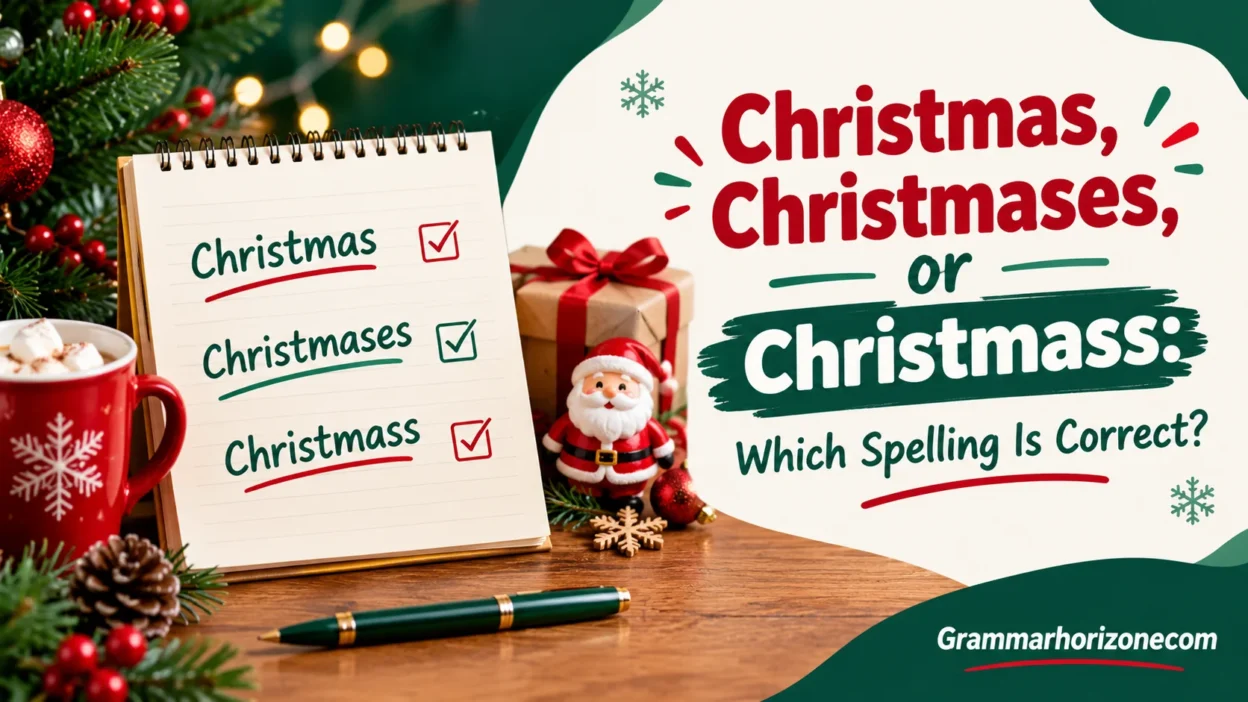
Quick Answer: Christmas, Christmases, or Christmass?
Christmas is correct when referring to the holiday celebrated on December 25. Christmases is the plural form used when discussing multiple Christmas celebrations. Christmass is not the standard modern spelling.
| Word | Correct or Incorrect | Meaning | Example |
| Christmas | Correct | The holiday or one Christmas celebration | We celebrate Christmas with our family. |
| Christmases | Correct | Multiple Christmas celebrations | We spent three Christmases abroad. |
| Christmass | Incorrect in standard modern English | A nonstandard spelling of Christmas | Incorrect: Merry Christmass! |
Remember this simple rule: use Christmas for one holiday, Christmases for multiple celebrations, and avoid Christmases in standard writing.
Christmas or. Christmases or. Christmass: Comparison Overview
The difference between Christmas, Christmases, and Christmass mainly involves spelling and grammatical numbers. Two forms are correct in standard English, while the third is generally a spelling mistake.
Christmas is a singular noun and the standard name of the holiday. You can use it when talking about holiday plans, family gatherings, decorations, gifts, and seasonal traditions.
Christmases is the plural form of Christmas. It refers to more than one Christmas celebration, often across different years. For example, someone might remember the Christmases they spent with their grandparents during childhood.
Christmass is not the standard modern spelling. Adding another s doesn’t create the correct singular or plural form.
| Feature | Christmas | Christmases | Christmass |
| Standard spelling | Yes | Yes | No |
| Grammatical form | Singular | Plural | Nonstandard spelling |
| Main use | One holiday or the holiday generally | Multiple celebrations | Not recommended in modern standard English |
| Example | Christmas is approaching. | We remember our childhood Christmases. | Incorrect: We enjoyed Christmass. |
Knowing these differences helps you choose the right spelling when writing holiday messages, school assignments, professional emails, or blog posts.
What Does Christmas Mean?
Christmas is a holiday celebrated by Christians to commemorate the birth of Jesus Christ. Many Christian traditions observe it on December 25. The holiday is also widely celebrated as a cultural occasion involving family gatherings, gift-giving, decorations, and special meals.
People use the word Christmas in many everyday expressions, including Merry Christmas, Christmas Day, Christmas dinner, and Christmas season. Although traditions vary between families and countries, the spelling remains the same.
For example, someone might say, “We are going home for Christmas.” Another person might write, “Our office will close for the Christmas holiday.” Both sentences use the word correctly because they refer to the holiday or an event associated with it.
Examples of Christmas in Sentences
Here are some examples showing how to use Christmas correctly:
- We are visiting our grandparents this Christmas.
- Christmas is one of our family’s favorite holidays.
- She decorated the house for Christmas.
- The children are excited about Christmas morning.
- I hope you have a wonderful Christmas.
- Our office will close for the Christmas holiday.
- They started buying Christmas presents in early December.
- We always prepare a special dinner on Christmas Day.
In each example, Christmas refers to the holiday or something connected with it. You don’t need to add another s simply because the word already ends in that letter.
Is Christmas Capitalized?
Yes. Christmas should be capitalized because it is the name of a holiday. Standard English capitalizes proper names, including Christmas, Easter, Thanksgiving, and Halloween.
Correct examples include:
- Merry Christmas!
- We celebrate Christmas with our relatives.
- Our Christmas party is scheduled for December 20.
- The children received their gifts on Christmas Day.
Writing christmas with a lowercase c is generally incorrect when referring to the holiday in standard English prose. However, lowercase styling may appear intentionally in informal branding, usernames, or artistic designs.
The same capitalization rule applies to the plural form Christmases. For example, “Those Christmases were unforgettable” is correct because the word still refers to the named holiday.
What Does Christmases Mean?
Christmases is the plural form of Christmas. It refers to two or more Christmas celebrations, usually taking place in different years or under different circumstances.
Although Christmas happens every year, people don’t always need to count individual celebrations in everyday conversation. That’s why Christmases appears less frequently than Christmas. However, the plural form is useful when discussing family memories, travel experiences, childhood traditions, or several holiday seasons.
Consider this example:
“We spent five Christmases in Canada before returning home.”
In this sentence, Christmases refers to five separate holiday celebrations. Using the singular Christmas would not express the same meaning.
Examples of Christmases in Sentences
These examples show how to use Christmases naturally:
- We spent several Christmases with our grandparents before they moved abroad.
- Those were the happiest Christmases of my childhood.
- Our family has celebrated many Christmases together.
- I remember the Christmases when everyone gathered at our old house.
- We have spent the last three Christmases traveling overseas.
- The photographs capture different Christmases throughout the decades.
- Their first few Christmases together were especially memorable.
Each sentence refers to multiple celebrations. The plural form helps readers understand that the writer is talking about several occasions rather than one holiday.
Why Is the Plural of Christmas Christmases?
The plural of Christmas is Christmases because English commonly adds -es to nouns ending in certain sounds, including those represented by s, ss, sh, ch, x, and z.
This spelling pattern helps form a pronounceable plural. Consider these examples:
| Singular | Plural |
| Bus | Buses |
| Class | Classes |
| Glass | Glasses |
| Box | Boxes |
| Watch | Watches |
| Christmas | Christmases |
The same general spelling pattern explains why Christmas becomes Christmases. You keep the original word and add es to the end.
A simple way to remember the rule is:
Christmas + es = Christmases
Don’t replace the correct plural ending with an extra s. Although Christmass might look reasonable at first glance, it isn’t the standard modern spelling.
Is Christmass a Correct Spelling?
In modern standard English, Christmass is not the spelling you should use for the holiday. The correct standard spelling is Christmas.
This confusion often happens because Christmas already ends in s. Writers may mistakenly add another s when typing quickly or trying to create the plural form. However, English spelling doesn’t work that way in this case.
Older English texts have sometimes used Christmas as a variant spelling. However, that historical usage doesn’t make it the preferred spelling today.
For modern writing, use Christmas for the singular and Christmases for the plural.
Examples of incorrect and correct usage include:
- Incorrect: We are preparing for Christmass.
- Correct: We are preparing for Christmas.
- Incorrect: We spent three Christmass together.
- Correct: We spent three Christmases together.
- Incorrect: Merry Christmass to everyone!
- Correct: Merry Christmas to everyone!
These examples show why context matters. If you’re referring to one holiday, write Christmas. If you’re referring to multiple celebrations, write Christmases.
Main Differences Between Christmas, Christmases, and Christmass
Understanding the differences becomes easier when you consider the meaning and grammatical function of each form.
Christmas Is the Singular Form
Use Christmas when referring to the holiday generally or to one particular Christmas celebration.
For example:
- Christmas is only a few weeks away.
- We always decorate our house for Christmas.
- My family is planning a special Christmas dinner.
- I received a wonderful gift last Christmas.
- We are spending Christmas with our relatives this year.
In these sentences, the word refers to one holiday or the holiday in general. The standard spelling contains one final s.
Christmases Is the Plural Form
Use Christmases when you need to refer to multiple Christmas celebrations.
For example:
- We spent two Christmases in different countries.
- I will always remember those Christmases.
- They have celebrated many Christmases together.
- Our childhood Christmases were full of family traditions.
The plural form is especially useful when comparing celebrations across different years. It also works when describing several Christmas occasions in someone’s life.
Christmass Is a Spelling Mistake in Modern English
Christmass is generally a spelling mistake in contemporary English. It isn’t the normal singular or plural form of the holiday name.
For example:
- Incorrect: Our Christmass celebration was wonderful.
- Correct: Our Christmas celebration was wonderful.
- Incorrect: We enjoyed several Christmass.
- Correct: We enjoyed several Christmases.
If you encounter Christmass in an older historical source, its meaning may depend on the document’s date and context. In modern emails, school assignments, and professional documents, use the standard forms instead.
Christmases or. Christmas’s: Understanding the Difference
Another common source of confusion is the difference between Christmases and Christmas’s. Although these forms look similar, they serve different grammatical purposes.
Christmases is the plural form. It refers to more than one Christmas.
Christmas’s is a singular possessive form. It can indicate something associated with a particular Christmas.
Compare these examples:
| Form | Function | Example |
| Christmas | Singular | Christmas is my favorite holiday. |
| Christmases | Plural | We remember our childhood Christmases. |
| Christmas’s | Singular possessive | Christmas’s arrival brought excitement to the children. |
| Christmases’ | Plural possessive | The Christmases’ traditions differed from year to year. |
The final example is grammatically possible, but it sounds awkward because celebrations don’t usually possess things in a literal sense. A clearer alternative is, “The traditions associated with those Christmases differed from year to year.”
Remember that an apostrophe doesn’t normally make a noun plural. Use Christmases when you mean multiple celebrations, not Christmas’.
Conclusion
Choosing between Christmas, Christmases, or Christmass becomes easier when you understand the correct spelling and grammatical rules. Christmas is the standard spelling for the holiday, while Christmases is the correct plural form for multiple celebrations. Christmass is a misspelling in modern standard English. Remember to use Christmas in holiday greetings, personal messages, and everyday writing. When discussing celebrations from different years, use Christmases to express the plural meaning. Understanding these spelling differences will improve your English grammar, spelling accuracy, and confidence in written communication.
Frequently Asked Questions
Q1. Is Christmas or Christmass Correct?
Christmas is the correct standard spelling. Christmass is generally considered a misspelling in modern English.
Q2. What Is the Plural of Christmas?
The plural of Christmas is Christmases. For example, “We spent three Christmases with our grandparents.”
Q3. Why Is Christmases Spelled With an Extra E?
The -es ending forms the plural of Christmas. English commonly adds this ending to nouns that finish in certain sounds, including s and sh.
Q4. Can I Write Merry Christmases?
You can use Christmases when referring to multiple celebrations, but “Merry Christmas!” is the standard greeting for the holiday.
Q5.Is Christmases a Real Word?
Yes, Christmases is a correct English word. It refers to more than one Christmas celebration, often across different years.