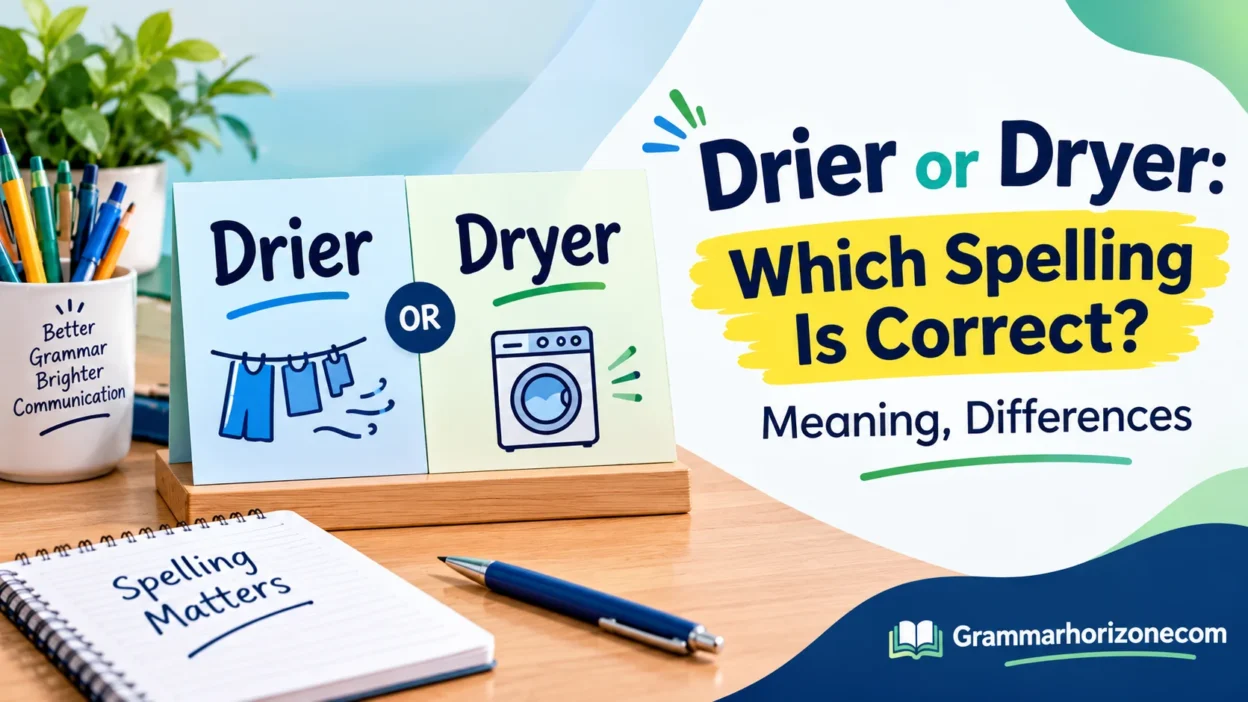
Drier or Dryer is a common English spelling confusion among writers, students, bloggers, and non-native English speakers. Both words appear in dictionaries, but they have different meanings and aren’t interchangeable. In both British English and American English, the spelling rules remain the same. Drier is the comparative form of dry, meaning more dry or less wet, while dryer is a noun for a machine or device that removes moisture. Understanding this difference helps you avoid a grammar mistake and improve your English writing skills. Whether you’re writing an email, article, or social media post, choosing the correct spelling makes your message clearer.
The main difference comes from the -ier ending in drier and the -er ending in dryer. Drier describes a change in dryness, while dryer commonly refers to a household appliance, such as a clothes dryer or hair dryer. For example, dry weather may leave damp clothes and towels drier after sitting in the sun. However, you might put those clothes in the dryer to remove moisture quickly. These real-life examples show how context determines the correct word choice. Learning these grammar rules helps language learners understand comparative forms, word meanings, spelling conventions, and the difference between British and American English usage.
To improve your spelling accuracy, focus on word usage, grammatical roles, and common mistakes. When reviewing an email, article, or social media post, ask yourself whether you’re describing something that is less wet or naming a machine that dries things. This simple spelling guide can help non-native writers, students, and bloggers strengthen their English vocabulary and avoid spelling mistakes. Although the words look and sound similar, their meanings and common uses make them easy to distinguish. By practicing correct usage and checking dictionary definitions when necessary, you can improve writing accuracy, make clearer word choices, and communicate more confidently in everyday situations.
Quick Answer: Drier or Dryer?
Both drier and dryer are correct English words, but they usually have different meanings.
- Drier: The comparative form of dry. Use it when something has less moisture than something else.
- Dryer: A noun that usually refers to a machine or device used to remove moisture.
Consider these examples:
- The air is drier today than it was yesterday.
- I put my wet clothes in the dryer.
- My skin becomes drier during the winter.
- She bought a new hair dryer last week.
A simple way to remember the difference is this: drier means more dry, while dryer usually means a machine that dries something.
Although some dictionaries also recognize drier as an alternative noun spelling for a drying device, dryer is the more familiar choice for common appliances in American English.
What Does Drier Mean?
Drier is the comparative form of the adjective dry. It describes something that contains less moisture than another thing or has become less wet than before.
You can use drier when talking about weather, soil, skin, hair, clothing, food, and other things that contain moisture. The word helps you compare two conditions or describe a change over time.
For example:
- The desert air is drier than the air near the coast.
- This towel is drier than the one on the bathroom floor.
- My skin feels drier after using that soap.
- The soil became drier after several sunny days.
- Today’s weather feels drier than yesterday’s.
In each sentence, drier describes a condition rather than a machine. It tells the reader that something contains less moisture or feels less wet than a comparison point.
Drier as the Comparative Form of Dry
English uses comparative adjectives to compare two people, objects, places, or conditions. Many short adjectives form their comparative by adding -er. However, adjectives ending in a consonant followed by y often change that y to i before adding the ending.
The word dry follows this spelling pattern.
| Form | Word | Example |
| Base adjective | Dry | The towel is dry. |
| Comparative adjective | Drier | This towel is drier than that one. |
| Superlative adjective | Driest | This is the driest towel of the three. |
The same pattern appears in other familiar English words:
- Happy → happier → happiest
- Easy → easier → easiest
- Busy → busier → busiest
- Heavy → heavier → heaviest
- Dry → drier → driest
Notice that drier compares two conditions, while driest identifies the item with the least moisture within a group or comparison.
For example, if three towels have different moisture levels, you might describe one as dry, another as drier, and the last as the driest. The exact choice depends on the comparison you want to make.
Examples of Drier in Sentences
The easiest way to understand drier is to see how it works in everyday situations.
Weather: The air feels drier in the desert than it does near the ocean.
Here, drier compares the moisture conditions of two places.
Clothing: My jeans are drier now than they were an hour ago.
The sentence describes a change in the jeans’ condition. It doesn’t name the equipment used to dry them.
Skin care: Her skin became drier after she switched to a different soap.
The word compares her skin’s condition before and after the change.
Gardening: The soil near the wall is drier than the soil beneath the tree.
The comparison describes the amount of moisture in two areas of soil.
Food and beverages: This wine tastes drier than the sweeter variety we tried last night.
In this context, drier describes the wine’s taste. In wine terminology, dryness generally relates to residual sugar rather than the amount of water in the wine.
These examples show that drier describes a comparative condition. Whenever you want to express more dry or less wet, it is usually the right spelling.
When Should You Use Drier?
Use drier when your sentence compares the dryness of something or describes a reduction in moisture.
A useful test is to replace drier with more dry. If the sentence still makes sense, drier is probably the appropriate choice.
For example:
- The climate is drier this year. → The climate is more dry this year.
- My hands feel drier today. → My hands feel more dry today.
- The ground is getting drier. → The ground is getting more dry.
The revised sentences may sound less natural, but their meanings remain clear. That’s a good sign that drier is functioning as a comparative adjective.
What Does Dryer Mean?
Dryer is a noun that usually refers to a machine or device designed to remove moisture from something. It appears frequently in everyday American English, particularly when people discuss laundry, personal care, and household appliances.
For example, a clothes dryer removes moisture from washed clothing, while a hair dryer blows heated or unheated air to help dry hair.
You might encounter dryer in these sentences:
- The dryer stopped working halfway through the laundry cycle.
- She packed her hair dryer before leaving for vacation.
- The hotel bathroom has a wall-mounted hand dryer.
- We bought a new clothes dryer for the laundry room.
In each example, dryer names an object or piece of equipment. It doesn’t compare the moisture levels of two things.
Common Types of Dryers
Dryers come in different forms, depending on what they dry and how they work.
- Clothes dryer: An appliance that removes moisture from laundry, usually through heated air or another drying process.
- Hair dryer: A handheld electrical device that directs air toward wet hair to speed up drying.
- Hand dryer: A device found in public restrooms that blows air onto wet hands.
- Food dryer: Equipment used to remove moisture from foods such as fruit, vegetables, and herbs.
- Grain dryer: Agricultural equipment that reduces moisture in harvested grain to support safe storage and help prevent spoilage.
Although these devices serve different purposes, the noun dryer identifies equipment associated with drying.
Examples of Dryer in Sentences
Here are several examples showing how to use dryer correctly.
- I put the wet towels in the dryer before going to bed.
- The new hair dryer has several heat settings.
- Our washing machine works well, but the dryer needs repairs.
- The restaurant installed a faster hand dryer in the restroom.
- Farmers use a grain dryer when harvested grain needs additional moisture removal.
In these examples, you can replace dryer with a more specific phrase such as drying machine or drying device. The meaning remains largely the same.
That substitution is a useful spelling test when you’re unsure which word belongs in your sentence.
When Should You Use Dryer?
Use dryer when you mean a machine or device that dries something.
Common phrases include:
- Clothes dryer
- Hair dryer
- Hand dryer
- Electric dryer
- Tumble dryer
- Industrial dryer
For example, consider the sentence, “The dryer is making an unusual noise.”
Here, dryer identifies the appliance that is making the noise. Writing drier is possible as an alternative noun spelling in some contexts, but dryer is the more familiar choice for standard American usage.
You should also distinguish dryer from drying. The word dryer names the equipment, while drying can describe the process itself.
Compare these examples:
- The dryer is running.
- The drying process takes about an hour.
The first sentence identifies a machine. The second describes an activity.
Main Differences Between Drier and Dryer
The difference between drier and dryer becomes clearer when you compare their meanings, grammatical roles, and typical uses.
| Feature | Drier | Dryer |
| Main meaning | More dry or less wet | A machine or device that dries |
| Usual part of speech | Comparative adjective | Noun |
| Primary purpose | Compares moisture levels | Names drying equipment |
| Common example | The air is drier today. | The dryer is running. |
| Common contexts | Weather, soil, skin, hair, clothes | Laundry, hair care, food processing |
| Memory clue | More dry | Something that dries |
The table highlights the main distinction. However, English usage isn’t entirely rigid because drier can also function as a noun referring to drying equipment. The overlap is worth knowing, but it doesn’t change the most practical rule for everyday writing.
For ordinary writing, use drier for comparisons and dryer for common appliances.
Drier or. Dryer: Grammar and Sentence Structure
The grammatical role of a word often tells you which spelling to choose.
Consider these examples:
- The towels are drier after sitting in the sun.
- The towels are in the dryer.
In the first sentence, drier describes the towels. It functions as a comparative adjective.
In the second sentence, dryer identifies the machine holding the towels. It functions as a noun.
You can also use drier after linking verbs such as become, feel, look, and seem.
For example:
- The air feels drier today.
- My hair became drier after swimming.
- The ground looks drier than it did yesterday.
By contrast, dryer commonly appears after articles and possessive words when naming an appliance.
- The dryer needs cleaning.
- Our dryer stopped working.
- A new dryer arrived this morning.
These patterns aren’t absolute rules for every possible sentence, but they provide a practical guide for most everyday writing.
Why Are Drier and Dryer So Often Confused?
The words drier and dryer are easy to mix up because they share the same base word and look almost identical. In many accents, they also sound the same.
When you speak, listeners usually rely on context to understand which meaning you intend. Writing requires an additional decision because you must choose the spelling that best communicates your meaning.
Similar Pronunciation
In common American English pronunciation, drier and dryer are generally homophones. Homophones are words that sound alike but differ in spelling or meaning.
Other familiar examples include:
- There, their, and they’re
- To, too, and two
- Hear and here
- Brake and break
Like these word pairs, drier and dryer require attention to meaning rather than sound alone.
For example, saying “The weather is drier” and “The weather is dryer” may sound nearly identical. However, drier is the standard spelling for the comparative adjective in conventional edited writing.
The Relationship Between Dry and Dryer
Both words connect to the adjective dry, but their endings serve different purposes.
The comparative form follows this spelling pattern:
Dry → Drier
The noun follows a different pattern:
Dry → Dryer
In drier, the final y changes to i before the comparative ending. In dryer, the -er ending forms a noun that refers to something used for drying.
This distinction explains why both spellings exist. The words may look similar, but they serve different grammatical purposes.
Drier or Dryer in Different Contexts
Sometimes a sentence becomes easier to understand when you examine the subject. The same word pair can appear in discussions about laundry, weather, hair, skin, and gardening.
Drier or Dryer for Clothes
When you describe clothing that has lost moisture, use a dryer.
For example:
- My shirt is drier than yours.
- The towels are getting drier in the sunshine.
- These jeans feel drier after hanging outside.
However, when you name the appliance that dries clothing, use a dryer.
- Put the towels in the dryer.
- The clothes dryer needs a new filter.
- We bought a larger dryer for our family.
The distinction is straightforward: clothes become drier, but a dryer dries clothes.
Drier or Dryer for Hair
The same rule applies to hair care.
Use drier when describing hair that has less moisture than before.
- My hair feels drier after swimming in the pool.
- Her hair became drier during the winter.
- This shampoo leaves my hair drier than usual.
Use a dryer when naming the appliance.
- I need a new hair dryer.
- He used a dryer to style his hair.
- The hotel provided a wall-mounted hair dryer.
Remember that a hair dryer doesn’t automatically make hair healthier. Excessive heat can damage hair, even though the appliance helps remove moisture more quickly.
Drier or Dryer for Weather
Weather descriptions often use drier because they compare moisture levels or humidity.
For example:
- The air is drier in the mountains.
- This summer has been drier than last summer.
- The region experiences drier conditions during certain months.
In these sentences, the drier describes atmospheric conditions. No drying machine is involved.
If you’re writing about climate or weather, you can often make the meaning more precise by identifying what is drier. For instance, lower humidity, less rainfall, and drier soil describe different conditions. Lower humidity doesn’t necessarily mean a location receives less rain, so choose the phrase that matches the facts.
Drier or Dryer for Skin
Skin care provides another common example.
Use drier when comparing skin conditions.
- My skin feels drier in cold weather.
- Her hands became drier after frequent washing.
- This lotion helps my skin feel less dry.
Here, the drier describes a change in the skin’s moisture or condition.
The word dryer would normally refer to a device. It isn’t the standard choice for describing skin that has less moisture.
Drier or Dryer for Soil and Plants
Gardeners use drier when comparing soil moisture.
For example:
- The soil near the fence is drier than the soil under the tree.
- The plants need watering because the ground is getting drier.
- Sandy soil often drains faster than clay-rich soil, although actual moisture depends on several conditions.
A soil dryer, meanwhile, would be equipment used to remove moisture from soil or another material in a specialized setting.
This distinction matters in gardening, agriculture, and environmental writing. Use a dryer for the condition of the soil and a dryer for equipment.
Drier, Dryer, Dry, and Driest: Understanding the Differences
Although these words share the same root, they don’t all perform the same job. Understanding the four forms helps you choose the right one without relying on guesswork.
Dry: The Base Adjective
Dry describes something that contains little moisture or has no noticeable wetness.
Examples:
- The towel is dry.
- The soil feels dry.
- My skin becomes dry in winter.
The adjective doesn’t necessarily compare one thing with another. It simply describes a condition.
Drier: The Comparative Form
Drier compares two things or describes a change toward a condition with less moisture.
Examples:
- This towel is drier than the other one.
- The air feels drier today.
- The ground became drier after the rain stopped.
Driest: The Superlative Form
Driest identifies the item or condition with the least moisture within a group or comparison.
Examples:
- This is the driest towel in the basket.
- August was the driest month in the period being discussed.
- That corner of the garden has the driest soil.
Dryer: The Equipment Noun
Dryer names a device that removes moisture.
Examples:
- The dryer needs maintenance.
- She bought a compact dryer for her apartment.
- The industrial dryer processes grain before storage.
The difference is easier to remember when you keep each word’s role in mind.
Common Mistakes With Drier and Dryer
Even experienced writers can mix up these spellings. The following examples show common errors and how to correct them.
Mistake: Using Dryer for the Standard Comparative Adjective
Less preferred in conventional edited writing:
“The weather is dryer than it was last week.”
Preferred:
“The weather is drier than it was last week.”
The sentence compares weather conditions. Therefore, drier is the standard comparative form.
Although dryer appears as a variant comparative spelling in some references, drier is the clearer choice for most formal and everyday American writing.
Mistake: Assuming Drier Is Always Wrong for an Appliance
A sentence such as “The drier is broken” isn’t necessarily incorrect. Some dictionaries recognize drier as an alternative noun spelling for a drying device.
However, dryer is the more familiar spelling for common appliances in American English.
For example:
- Preferred everyday usage: The clothes dryer is broken.
- Alternative noun usage: The clothes drier is broken.
When writing for a broad audience, choose dryer for the appliance unless a specific publication, product name, or established terminology calls for another form.
Mistake: Ignoring the Meaning of the Sentence
Consider these two sentences:
- The towels are drier now.
- The towels are in the dryer now.
Both sentences are correct, but they communicate different information. The first describes the towels’ condition. The second tells you where the towels are.
Always consider the intended meaning before choosing the spelling.
A Practical Case Study: Choosing Drier or Dryer
Imagine that Alex is writing a short message to a roommate about laundry after a rainy afternoon.
Alex first writes:
“The towels are dryer now, so put them in the closet.”
The sentence is understandable, but the comparative adjective should conventionally be spelled drier.
A clearer version would be:
“The towels are drier now, so put them in the closet.”
Later, Alex writes:
“I left the towels in the drier for another ten minutes.”
Here, Alex means the appliance. In standard everyday American English, the clearer version is:
“I left the towels in the dryer for another ten minutes.”
This small example shows why context matters. The same subject, towels, appears in both sentences, but the word serves a different purpose each time.
The practical lesson is simple: identify whether you’re describing a condition or naming a device before choosing the spelling.
How to Remember the Difference Between Drier and Dryer
A simple memory trick can save you from repeatedly checking the spelling.
A dryer makes things drier.
The sentence uses both words in their usual roles:
- Dryer: The machine that removes moisture.
- Drier: The condition of having less moisture.
Here are three additional ways to check your choice.
Use the “more dry” test. If you can replace the word with more dry, choose drier for standard comparative usage.
Use the “drying machine”
Conclusion
Understanding the difference between drier or dryer helps you avoid common spelling mistakes and improve your English writing. Drier is the comparative form of dry, meaning more dry or less wet, while dryer is a noun for a machine that removes moisture, such as a clothes dryer or hair dryer. Both spellings are correct, but they serve different grammatical purposes. Whether you’re writing an email, school assignment, article, or social media post, consider the meaning and context before choosing a word. With regular practice, you can use both words correctly and communicate more clearly.
Frequently Asked Questions
Q1. Is drier or dryer the correct spelling?
Both drier and dryer are correct spellings. Drier means more dry or less wet, while dryer usually refers to a machine that removes moisture.
Q2. What is the difference between drier and dryer?
Drier is a comparative adjective derived from dry. Dryer is a noun commonly used for appliances such as clothes dryers and hair dryers.
Q3. Is drier correct in American English?
Yes, drier is correct in American English when comparing dryness. For example, “The weather is drier today” is grammatically correct.
Q4. Should I write clothes drier or clothes dryer?
Clothes dryer is the standard spelling when referring to an appliance that dries clothes. Although clothes drier may occasionally appear, clothes dryer is the usual choice.
Q5. How can I remember when to use drier or dryer?
Remember that drier describes something that is less wet, while dryer names a machine. For example, “My clothes are drier now” describes their condition, whereas “I put my clothes in the dryer” refers to an appliance.