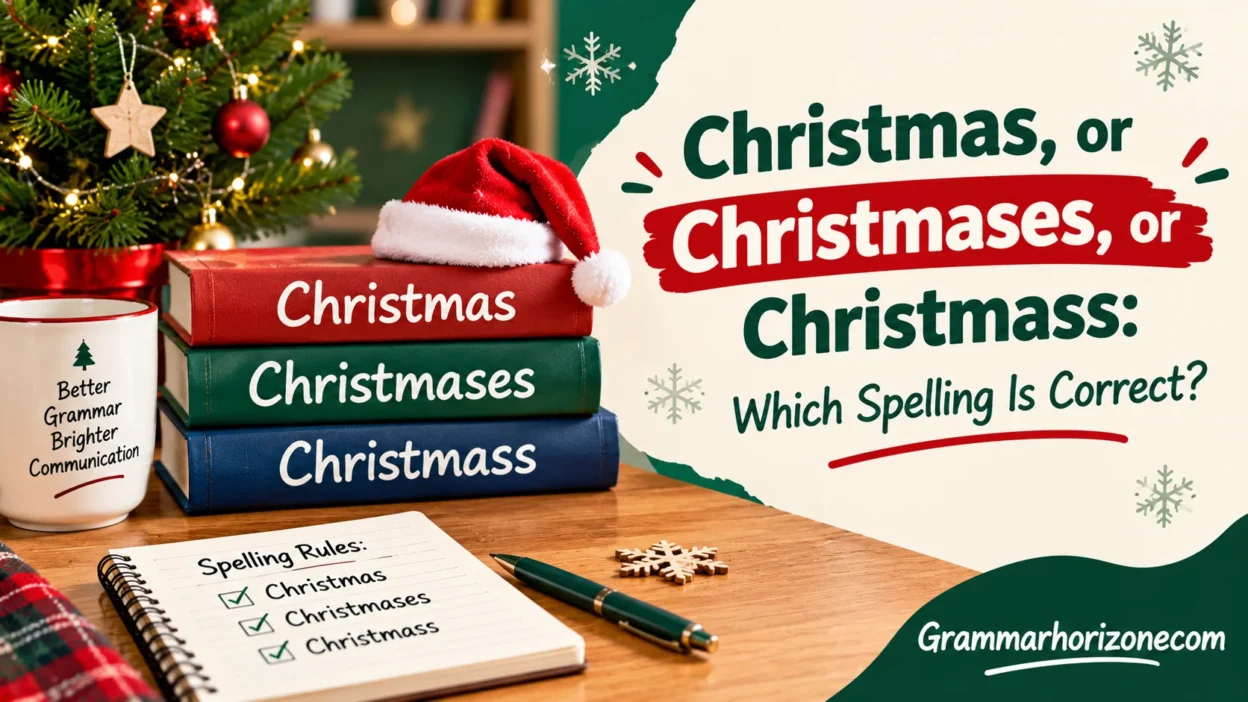
Choosing between Christmas,or Christmases, or Christmass can be confusing, but TITLE spelling rules help you write clearly and avoid common mistakes. Christmas is the standard spelling and singular form, while Christmases is the plural form used for more than one celebration. Christmass is an incorrect spelling in standard English. Although Christmas ends with the letter s, it remains a singular noun. Understanding this grammatical distinction improves your English grammar and helps you avoid spelling confusion in everyday writing.
During the holiday season, correct word choice makes written communication clearer. For example, “We celebrate Christmas every year” refers to an annual celebration, while “We spent three wonderful Christmases together” describes several celebrations. These examples show the difference between a singular noun and a plural noun. Whether you’re writing a holiday greeting, seasonal greetings, a blog post, or blog writing about family memories, Christmas memories, and family celebrations, correct spelling improves writing clarity. The same rule applies to holiday traditions, Christmas celebrations, Christmas traditions, and Christmas greetings.
To improve spelling accuracy, learn the basic grammar rules, language rules, and spelling conventions for these noun forms. Proper pluralization adds -es to Christmas to form Christmases, while Christmass remains a common spelling error rather than a standard English form. Good writing depends on correct usage, recognizing incorrect usage, understanding word endings, and considering contextual meaning. Strong grammar awareness, a broad vocabulary, and knowledge of semantic relationships support natural writing and clear written expression. Careful proofreading and editing also strengthen language accuracy and help you make the correct word selection whenever you encounter these spelling differences.
Quick Answer: Christmas,or Christmases, or Christmass?
- Christmas: The correct spelling of the holiday celebrated on December 25 by many Christians and observed culturally by many others.
- Christmases: The correct plural form when referring to multiple Christmas celebrations.
- Christmass: A nonstandard spelling that you should avoid in ordinary English writing.
Here are three examples:
- Christmas: We decorate our house before Christmas.
- Christmases: We have spent many Christmases together.
- Christmass: We look forward to Christmass every year. This spelling is incorrect in standard modern English.
Easy rule to remember: Use Christmas for one holiday, Christmases for multiple celebrations, and avoid Christmass in standard writing.
What Is the Difference Between Christmas, Christmases, and Christmass?
The main difference between these words involves spelling and grammatical number. Christmas refers to the holiday, Christmases describes multiple celebrations, and Christmass is generally a spelling mistake.
| Word | Correct or Incorrect? | Meaning | Example |
| Christmas | Correct | The holiday or holiday season | Christmas is approaching. |
| Christmases | Correct | Multiple Christmas celebrations | We remember our childhood Christmases. |
| Christmass | Generally incorrect | Nonstandard spelling of the holiday | Use Christmas instead. |
Understanding these differences helps you choose the right word for your sentence. The final s in Christmas belongs to its established spelling. You don’t add another s to make the word plural.
Christmas: The Correct Singular Form
Christmas is the standard spelling of the holiday associated with the birth of Jesus Christ. Many Christians celebrate it on December 25, while people from different backgrounds also enjoy its cultural traditions.
The word can refer to the holiday itself, the surrounding season, or activities associated with the celebration. For example, you might talk about Christmas dinner, Christmas decorations, Christmas shopping, or Christmas vacation.
Although Christmas ends in s, it can refer to a single holiday. That final letter is part of the word rather than a marker of plurality.
Here are some examples:
- We will visit our grandparents at Christmas.
- The children decorated the tree before Christmas.
- Christmas falls on December 25 for churches that follow the Gregorian calendar.
- She bought a new dress for the Christmas party.
- Our office will close for the Christmas holiday.
Each sentence refers to the holiday or a related event. You don’t need to add another s to the word.
Capitalization rule: Always capitalize the C in Christmas because it is the name of a holiday. The same rule applies to Christmas Day and Christmas Eve.
Christmases: The Correct Plural Form
Christmases is the standard plural form of Christmas. Use it when referring to multiple Christmas celebrations, usually across different years.
For example, someone might compare the Christmases they spent with their grandparents to those they celebrate with their own children. The plural form highlights separate occasions rather than one holiday.
It can also describe family customs, personal memories, and celebrations in different places. The word is especially useful when discussing experiences that happened over several years.
Examples include:
- We spent five Christmases together before moving abroad.
- Her childhood Christmases were filled with homemade cookies and family games.
- Those were the happiest Christmases of my life.
- Our family has enjoyed many memorable Christmases in the mountains.
- We will remember these Christmases for years to come.
Each sentence describes multiple celebrations. The plural form makes that meaning clear.
Why Does Christmas Become Christmases?
English forms the plural of Christmas by adding -es to the singular word.
- Singular: Christmas
- Plural: Christmases
The ending may look unusual, but it follows an established English plural pattern. Similar examples include:
| Singular | Plural |
| Bus | Buses |
| Class | Classes |
| Glass | Glasses |
| Christmas | Christmases |
You don’t need an apostrophe to create this plural. The correct spelling is Christmases, not Christmas’s, when you simply mean more than one celebration.
One important detail: Christmases count as separate holiday celebrations, not the number of people attending one celebration. If twenty relatives gather on December 25, they are celebrating one Christmas together.
Christmass: The Incorrect Spelling
Christmass is generally considered a misspelling in modern standard English. When referring to the holiday, write Christmas instead.
The mistake may occur because the word contains mass, which ends in two s’s. Writers sometimes assume the entire word should end with an additional s. However, the accepted spelling is Christmas, with one final s.
Consider these corrections:
- Incorrect: We bought gifts for Christmass.
- Correct: We bought gifts for Christmas.
- Incorrect: Merry Christmass to everyone!
- Correct: Merry Christmas to everyone!
- Incorrect: Our family dinner is on Christmass Eve.
- Correct: Our family dinner is on Christmas Eve.
In schoolwork, professional communication, blog posts, and everyday messages, use the standard spelling. Historical texts may contain older spelling variations, but those don’t change the modern recommendation.
Why Is Christmas Spelled With an S?
The word’s history helps explain its unusual spelling. Christmas developed from the Old English expression Cristes mæsse, meaning “Christ’s Mass.” The expression referred to the Christian religious service associated with the holiday.
Over time, English speakers combined the two parts into one word. The spelling gradually developed into the familiar modern form, Christmas.
The word’s structure also explains why some people make mistakes. The second part relates historically to Mass, but the standard spelling of the complete word doesn’t preserve the double s at the end.
In other words, you shouldn’t spell the holiday by joining Christ and mass while keeping every letter unchanged. The accepted modern spelling is Christmas.
Does the Final S in Christmas Make It Plural?
No. The final s in Christmas doesn’t make the word plural.
English has many singular nouns that end in s. For example, glass, class, and bus are all singular words despite their final letters.
The same rule applies to Christmas.
- Singular: Christmas is approaching.
- Plural: We remember several Christmases at our old home.
The first sentence refers to one upcoming holiday. The second describes multiple celebrations from different years.
Adding another s doesn’t create the correct plural. The standard plural form is Christmases.
When Should You Use Christmas or Christmases?
Choosing between Christmas and Christmases depends on what you want to describe. Use the singular form for one holiday, an upcoming celebration, or the season in general. Use the plural form when discussing several celebrations across different years.
The easiest way to choose is to focus on the meaning of your sentence.
Examples of Christmas in Sentences
Use Christmas when referring to the holiday, its season, or an event associated with one celebration.
- Holiday plans: We’re traveling to Texas for Christmas this year.
- Family traditions: Our family watches the same movie every Christmas.
- Decorations: The stores put up Christmas decorations in November.
- Religious observance: Many Christians attend church services on Christmas.
- Work schedules: The company gives employees Christmas Day off.
- Holiday greetings: I hope you have a wonderful Christmas.
Each example uses the singular form correctly. Even if a celebration includes several days of activities, the word doesn’t automatically become plural.
For instance, “We spend Christmas with our relatives” is correct. The visit might last a week, but the sentence still refers to one Christmas occasion.
Examples of Christmases in Sentences
Use Christmases when you want to describe several holiday celebrations.
- Past memories: I spent many Christmases visiting my grandparents.
- Family history: Our best Christmases were the ones we celebrated together.
- Travel experiences: We have enjoyed two Christmases overseas.
- Changing traditions: Our Christmases became quieter after the children grew up.
- Future celebrations: We hope to spend several more Christmases in our family home.
- Personal reflection: Those Christmases taught me the value of spending time together.
The plural form emphasizes separate experiences over time.
However, you don’t always need the plural when discussing a recurring tradition. Compare these sentences:
- We exchange gifts every Christmas.
- We have exchanged gifts during many Christmases together.
Both are correct. The first describes a recurring habit, while the second emphasizes the individual celebrations.
Common Christmas and Christmases Mistakes to Avoid
Several common mistakes can make holiday writing look unpolished. Fortunately, you can avoid them by understanding the difference between singular, plural, and possessive forms.
Mistake: Adding an extra s
Incorrect: We are excited about Christmass.
Correct: We are excited about Christmas.
Mistake: Using the plural for one celebration
Incorrect: Merry Christmases to you on December 25!
Correct: Merry Christmas to you on December 25!
Christmases can appear in a greeting when you genuinely mean multiple celebrations, but it isn’t the usual greeting for one holiday.
Mistake: Adding an unnecessary apostrophe
Incorrect: We remember our childhood Christmas’s.
Correct: We remember our childhood Christmases.
An apostrophe doesn’t create a standard plural. It generally marks possession or appears in contractions.
Mistake: Confusing Christmas with Christmases
Incorrect: We spent three Christmas with our relatives.
Correct: We spent three Christmases with our relatives.
The plural form is necessary because the sentence refers to three separate celebrations.
Christmas or. Christmases or. Christmass: Comparison Table
This table summarizes the differences between the three spellings.
| Feature | Christmas | Christmases | Christmass |
| Standard spelling | Yes | Yes | No, not in ordinary modern usage |
| Grammatical form | Singular noun | Plural noun | Usually a misspelling |
| Main meaning | The holiday or season | Multiple celebrations | No standard meaning as the holiday’s name |
| Capitalization | Capital C | Capital C | Avoid this spelling for the holiday |
| Example | Christmas is almost here. | We remember our childhood Christmases. | Use Christmas instead. |
The key takeaway is simple: Christmases is a genuine plural form, not a spelling mistake. By contrast, Christmass isn’t the standard spelling used in modern everyday English.
Is Christmases Grammatically Correct?
Yes. Christmases is grammatically correct and is the standard plural form of Christmas.
The plural is useful when the number or variety of celebrations matters. For example, someone might write about Christmases spent abroad, childhood Christmases, or celebrations held in different family homes.
Consider this sentence:
“After moving to another country, Maya spent three Christmases away from her family.”
The sentence describes three separate Christmas holidays. Replacing Christmases with Christmas would make the sentence grammatically incorrect in this context.
When Does Christmases Sound Natural?
The plural works best when a sentence emphasizes separate occasions.
Natural examples include:
- We spent several Christmases with our cousins.
- The family celebrated many Christmases in the same house.
- Those Christmases remain some of my favorite memories.
- They have experienced Christmases in different parts of the world.
By contrast, the plural can sound awkward when you simply mean a tradition happens every year.
For example, “We decorate the tree every Christmas” is more direct than “We decorate the tree during every one of our Christmases.”
Writing tip: Use Christmases when counting or comparing celebrations. Use Christmas when discussing the holiday in general.
Is Christmass Ever Correct?
For everyday modern English, Christmas is the correct spelling of the holiday. However, older English texts sometimes contain spelling variations that differ from today’s standard form.
A historical spelling doesn’t automatically make a word appropriate for modern writing. If you’re quoting an old document, you may preserve its original spelling. Otherwise, use the accepted form.
There are also situations in which a person or business might deliberately use Christmass as a name, username, brand, or creative spelling. In those cases, the spelling may be intentional within that specific context. It still isn’t the normal spelling of the holiday.
Use this guide:
- School assignments: Write Christmas.
- Professional emails: Write Christmas.
- Holiday cards: Write Merry Christmas.
- Blog posts: Use Christmas or Christmases, depending on the meaning.
- Historical quotations: Preserve the original spelling when necessary.
- Specific brands or names: Follow the official spelling of that name.
Unless you’re discussing a historical variation or reproducing an intentional name, avoid Christmass.
Conclusion
Choosing between Christmas, Christmases, and Christmass becomes easier when you understand their spelling and grammar rules. Christmas is the correct singular form, Christmases is the correct plural form, and Christmass is a misspelling. Whether you’re writing holiday greetings, sharing family memories, or preparing a blog post, using the correct spelling improves clarity and makes your writing more professional. Remember to proofread your work to catch common spelling mistakes.
Frequently Asked Questions
Q1. Is Christmas or Christmases correct?
Both are correct. Christmas is the singular form, while Christmases is the plural form used when referring to multiple Christmas celebrations.
Q2. Is Christmass a correct spelling?
No, Christmass is an incorrect spelling in standard English. The correct spelling is Christmas, with one final s.
Q3. Why does Christmas end with an s?
Christmas ends with the letter s because of its historical development and spelling. However, the final s does not make it a plural noun.
Q4. How do you make Christmas plural?
Add -es to Christmas to form Christmases. For example, “We spent three Christmases together.”
Q5. When should I use Christmases in a sentence?
Use Christmases when referring to more than one Christmas celebration or holiday season. For example, “We have celebrated many Christmases with our grandparents.”