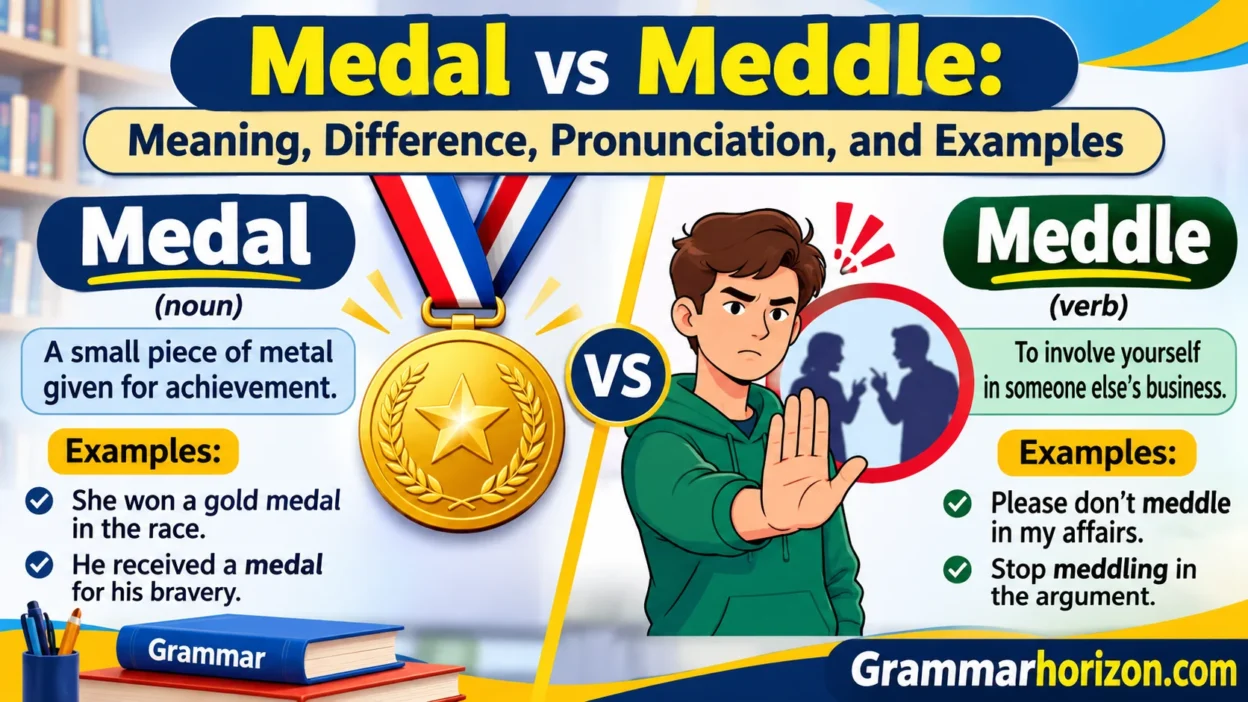
Medal vs Meddle are commonly confused English words because they have a similar pronunciation and sound alike across different English accents. However, their spelling, grammatical functions, word usage, and sentence usage have different meanings. A medal is an award given to someone for an achievement, while meddle means interfering in another person’s affairs without being invited. Understanding these differences helps you use both words correctly and avoid spelling mistakes in everyday writing.
A medal is usually connected with sports competitions, military honors, academic achievements, and other special awards. It represents recognition for a person’s effort or success. In contrast, meddle describes unwanted involvement or interference in personal relationships, family matters, workplace decisions, and business matters. For example, receiving a medal celebrates someone’s success, but meddling in another person’s decisions means getting involved without permission. These examples make the distinction easier to understand through everyday reading and writing.
For correct usage, always consider the situation and the intended meaning instead of relying only on pronunciation. When a sentence discusses honors, competitions, sports, military, or academic success, medal is generally the appropriate choice. However, when it describes relationships, family, workplace, personal affairs, or someone’s choices and decisions, meddle is more suitable. This simple approach improves understanding and helps you choose the right word in different contexts.
Quick Answer: Medal vs Meddle
Medal is a noun that refers to a metal award given to recognize someone’s achievement, bravery, or exceptional performance. For example, an athlete may receive a gold medal after winning a competition.
Meddle is a verb that means interfering in someone else’s affairs, decisions, or activities without permission. For example, someone who tries to control another person’s relationship may be meddling.
Here is the simple difference:
- Medal: An award or honor given for an achievement.
- Meddle: To interfere in another person’s business or personal matters.
Examples:
- My sister won a gold medal in the swimming competition.
- You should not meddle in other people’s personal affairs.
Remember that medal is connected with achievement, while meddle is connected with interference.
What Does Medal Mean?
The word medal means a small, usually flat piece of metal awarded to someone as recognition for an achievement, victory, bravery, or special contribution. It is commonly used in sports, education, military service, and public recognition.
Medals often contain special designs, inscriptions, symbols, or images that represent the achievement being recognized. They may be made from gold, silver, bronze, or other materials. However, their importance is not always based on their material value. The recognition and effort behind receiving a medal often make it meaningful.
For example, an athlete who finishes first in a competition may receive a gold medal. Similarly, a student may earn a medal for outstanding academic performance, while a soldier may receive one for bravery or exceptional service.
Examples of medal in sentences:
- She received a gold medal for winning the national championship.
- My grandfather proudly displayed his military medals.
- The student earned a medal for excellent academic performance.
- The athlete placed his Olympic medal inside a glass case.
- The school organized a special ceremony to present the medals.
In all these examples, medal refers to an award or recognition.
Medal as a Noun
Medal is a countable noun. It means you can use it in singular and plural forms depending on the number of awards.
- Singular: Medal
- Plural: Medals
You can use medal as the subject or object of a sentence.
Medal as a subject:
- The medal represents years of dedication and hard work.
- A gold medal was presented to the winner.
- The medals were displayed in the school hall.
Medal as an object:
- She won a silver medal in the competition.
- The coach presented him with a special medal.
- He received a medal for his outstanding performance.
You can also combine medal with descriptive adjectives to explain the type or purpose of an award.
Examples include:
- Gold medal
- Silver medal
- Bronze medal
- Military medal
- Achievement medal
- Commemorative medal
Different Situations in Which People Receive Medals
Medals are awarded in different fields to recognize achievement, dedication, bravery, and valuable contributions.
Sports competitions: Athletes receive medals for their performance in sporting events. Gold, silver, and bronze medals commonly represent first, second, and third place.
Military service: Military organizations and governments award medals to recognize bravery, dedication, exceptional service, and participation in important operations.
Academic achievements: Schools, colleges, and universities may present medals to students who achieve excellent results or demonstrate outstanding academic performance.
Public service: People who make important contributions to their communities or countries may receive medals as a form of appreciation.
Special events: Organizations sometimes create commemorative medals to celebrate historical occasions, anniversaries, and important achievements.
What Is the Difference Between a Medal and a Trophy?
A medal and a trophy both recognize achievement, but they have different forms and uses.
| Medal | Trophy |
| Usually a small, flat award | Usually a standing decorative award |
| Often made from metal | May be made from metal, glass, or other materials |
| Commonly worn around the neck or displayed | Usually placed on a shelf or displayed |
| Frequently awarded in individual competitions | Often awarded in team and individual competitions |
| Example: Gold medal | Example: Championship trophy |
For example, a runner may receive a gold medal after winning a race, while a football team may receive a trophy after winning a tournament.
What Does Meddle Mean?
The word meddle means to interfere in someone else’s affairs, activities, or decisions without being invited or having a valid reason to become involved. It generally has a negative meaning because it suggests unwanted interference.
When someone meddles, they involve themselves in a situation that does not concern them. This behavior can cause misunderstandings, disagreements, and unnecessary problems between people.
For example, if someone constantly tries to control their friend’s relationship or makes decisions about another family’s personal matters, that person is meddling.
Meddle is commonly used when discussing family relationships, workplace behavior, personal boundaries, and social situations.
Examples of meddle in sentences:
- Please don’t meddle in my personal affairs.
- My neighbor always tries to meddle in other people’s business.
- Parents should avoid meddling in their adult children’s decisions.
- He told his brother not to meddle in the disagreement.
- Some coworkers meddle in matters that are not their responsibility.
These examples show that meddle describes unnecessary interference rather than an award or achievement.
Meddle as a Verb
Unlike medal, meddle is a verb. It describes an action performed by someone.
The word has different forms depending on the tense and grammatical structure of a sentence.
| Verb form | Word | Example |
| Base form | Meddle | Don’t meddle in their affairs. |
| Third-person singular | Meddles | She meddles in every discussion. |
| Present participle | Meddling | He is meddling in our plans. |
| Past tense | Meddled | They meddled in the decision. |
| Past participle | Meddled | She has meddled in their business before. |
Learning these forms helps you use meddle correctly when describing present, past, and ongoing actions.
Common Situations Involving Meddling
Meddling can happen in everyday life. It often occurs when someone ignores personal boundaries or becomes involved in decisions that belong to another person.
Family matters: A relative may interfere in another family member’s marriage, parenting choices, or household decisions without being asked.
Personal relationships: Someone might meddle in a friend’s romantic relationship by spreading opinions, creating misunderstandings, or trying to influence the couple.
Workplace decisions: An employee may interfere with another person’s responsibilities instead of focusing on their own assigned tasks.
Unwanted advice: Giving advice is not always meddling. However, repeatedly pushing opinions after someone has declined help can become unwanted interference.
Financial decisions: A person may meddle in someone else’s financial matters by trying to control how they spend, save, or manage their money without permission.
The main idea is that meddling involves unnecessary interference. Offering help when someone requests it is different from interfering without an invitation.
Key Differences Between Medal vs Meddle
Although medal and meddle look and sound similar, they have different meanings and grammatical functions. Comparing their definitions, parts of speech, and examples makes the distinction easier to understand.
| Feature | Medal | Meddle |
| Meaning | An award or honor | To interfere |
| Part of speech | Noun | Verb |
| Main purpose | Recognizing achievement | Describing unwanted involvement |
| Spelling | M-E-D-A-L | M-E-D-D-L-E |
| Plural form | Medals | No regular plural form |
| Past tense | Not applicable as a noun | Meddled |
| Present participle | Not applicable as a noun | Meddling |
| Common context | Sports, education, military service | Family, relationships, workplace |
| Example | She won a medal. | Don’t meddle in my affairs. |
The most important difference is that medal represents something a person receives, while meddle describes something a person does.
Difference in Spelling
The spelling difference between these words is small but important.
- Medal: M-E-D-A-L
- Meddle: M-E-D-D-L-E
Medal contains one D and ends with AL. Meddle contains two Ds and ends with LE.
Because the words have similar sounds, people sometimes confuse their spelling when writing quickly. Remembering their meanings makes it easier to identify the correct word.
Difference in Pronunciation
In many varieties of English, medal and meddle are pronounced the same way. Both are generally pronounced /ˈmed.əl/.
This makes them examples of homophones, which are words that share the same pronunciation but have different spellings and meanings.
For example:
- The athlete won a medal.
- Don’t meddle in my business.
Although both words sound alike, their meanings are completely different. Listeners usually understand the intended meaning through the context of a conversation.
Medal vs Meddle: How to Use Them Correctly
Choosing between medal and meddle becomes easier when you understand the purpose of each word. Instead of focusing only on pronunciation, consider what the sentence is trying to communicate.
When to Use Medal
Use medal when talking about an award, honor, or recognition given to someone for an achievement.
It is appropriate in sentences about sports, education, military service, and public recognition.
Examples:
- The swimmer received a gold medal for her performance.
- My father keeps his military medals in a special box.
- The student earned a medal for academic excellence.
- The school organized a ceremony to present the medals.
- Winning a national medal was his biggest achievement.
In each example, medal refers to something awarded to a person.
When to Use Meddle
Use meddle when describing someone who interferes in another person’s affairs or becomes involved without being invited.
It is especially common in sentences about relationships, family matters, and workplace situations.
Examples:
- You should not meddle in their relationship.
- My sister always meddles in my personal decisions.
- He was accused of meddling in the company’s business.
- I don’t want anyone to meddle with my plans.
- They meddled in a discussion that did not concern them.
In these sentences, meddle describes an action involving unnecessary interference.
Medal vs Meddle in Different Sentence Structures
Understanding how these words function in sentences can help you avoid grammatical mistakes.
Medal Used as a Subject
When medal acts as the subject, it is the thing being discussed or performing the action described by the verb.
Examples:
- The medal represents an important achievement.
- A gold medal was awarded to the champion.
- The medals were displayed at the school ceremony.
Medal Used as an Object
Medal can also appear as the object of a sentence. In this structure, someone receives, wins, earns, or displays the award.
Examples:
- She won a silver medal.
- The coach presented him with a medal.
- He placed his medal inside a glass case.
Medal With Descriptive Adjectives
Adjectives provide more information about the type, appearance, or importance of a medal.
Examples:
- The athlete received a prestigious gold medal.
- He proudly displayed his military medal.
- The school presented a beautiful achievement medal.
Meddle Used With the Preposition “In”
One of the most common grammatical patterns is meddle in. It describes interfering in a situation, activity, or matter.
Examples:
- Don’t meddle in my family affairs.
- She should not meddle in their marriage.
- He always meddles in workplace discussions.
You may also encounter meddle with, which often means interfering with, changing, or tampering with something.
Examples:
- Don’t meddle with the computer settings.
- Someone has been meddling with the equipment.
The choice between “in” and “with” depends on the context.
Meddling as the Present Participle
Use meddling when describing an ongoing action or behavior.
Examples:
- Stop meddling in other people’s business.
- He is always meddling in family decisions.
- Their meddling behavior caused unnecessary arguments.
Meddled as the Past Tense
Use meddled when describing interference that happened in the past.
Examples:
- My neighbor meddled in our disagreement yesterday.
- They meddled in the company’s internal affairs.
- She regretted that she had meddled in their relationship.
Common Expressions and Word Forms
Both words appear in common English expressions. Learning these expressions helps you understand their meanings in everyday conversations.
Common Expressions With Medal
| Expression | Meaning | Example |
| Gold medal | An award for first place | He won a gold medal. |
| Silver medal | An award for second place | She received a silver medal. |
| Bronze medal | An award for third place | The runner earned a bronze medal. |
| Medal winner | Someone who receives a medal | The medal winner thanked her coach. |
| Medal ceremony | An event where medals are presented | The medal ceremony began at noon. |
| Medalist | A person who has won a medal | The Olympic medalist returned home. |
A medalist is someone who has received a medal, especially in a competition. The term is particularly common in sports reporting.
Medal vs Meddle: Examples in Everyday English
The following examples show how both words appear in common situations. Comparing them side by side makes their different meanings easier to remember.
| Medal | Meddle |
| My sister won a gold medal in athletics. | My sister likes to meddle in my affairs. |
| The soldier received a bravery medal. | He tried to meddle in the military decision. |
| The student earned a medal for excellent results. | The teacher told the students not to meddle in the discussion. |
| She keeps her first medal in a wooden box. | She keeps meddling in her friend’s relationship. |
| The athlete proudly displayed his medal. | The neighbor meddled in our family matters. |
Examples From Sports and Competitions
In sports, medal is the correct word because athletes receive awards for their performance.
Examples:
- The runner won a gold medal in the national championship.
- Our school team received three bronze medals.
- The swimmer hopes to earn another Olympic medal.
- The coach congratulated every medal winner.
Using meddle in these sentences would be incorrect because they discuss awards rather than interference.
Examples From Family and Personal Relationships
Meddle is appropriate when someone interferes in another person’s personal life.
Examples:
- My aunt always tries to meddle in my marriage.
- Please don’t meddle in my relationship with my friends.
- His parents stopped meddling in his personal decisions.
- She asked her relatives not to meddle in family matters.
These sentences describe unwanted involvement, which is the central meaning of meddle.
Examples From the Workplace
Both words can appear in professional situations, but their meanings remain different.
Examples:
- The employee received a medal for outstanding public service.
- Managers should not unnecessarily meddle in every employee’s routine task.
- The organization presented a special medal to its retiring director.
- One department should not meddle in another department’s responsibilities without a valid reason.
Conclusion
Understanding the difference between medal vs meddle helps you avoid common English spelling and word usage mistakes. A medal is an award given to someone for an achievement, while meddle means interfering in another person’s affairs without permission. Although both words have a similar pronunciation, their meanings and grammatical uses are completely different. Remembering their connection to awards and unwanted interference will help you use both words correctly in everyday writing.
Frequently Asked Questions
Q1. What is the difference between medal and meddle?
Medal means an award given for an achievement, while meddle means interfering in someone else’s affairs without permission.
Q2. Is medal or meddle the correct spelling?
Both medal and meddle are correct English spellings. However, they have different meanings and cannot be used interchangeably.
Q3. What does medal mean in English?
A medal is a physical award given to someone to recognize an achievement in sports, academics, military service, or another field.
Q4. What does meddle mean in a sentence?
Meddle means getting involved in someone else’s personal matters without being asked. For example, you should not meddle in other people’s family affairs.
Q5. Are medal and meddle pronounced the same?
Yes, medal and meddle are homophones in standard English pronunciation. They sound alike but have different spellings, meanings, and uses.