All Ready vs Already is a common spelling confusion among English learners because both English expressions have a similar appearance and similar pronunciation but different meanings and different uses. They also have a clear grammatical difference. All ready means everyone prepared, everything prepared, or someone is fully prepared and ready to do something. It relates to preparation, while already refers to time and describes something that happened before now or earlier than expected. Understanding their word usage, sentence usage, and sentence meaning helps you make the correct word choice.
When I check these expressions in everyday writing, I find it useful to focus on the context instead of their spelling. For example, you can say that you are all ready when you are prepared to leave. However, use already when something has happened before a particular time. This simple method improves understanding and helps you remember the difference between preparation versus time. It also prevents common mistakes, including spelling differences, meaning differences, and usage differences. Paying attention to these details improves writing accuracy and reduces word confusion.
These expressions often appear in emails, text messages, school assignments, workplace documents, and everyday conversations. Whether you are working on written communication or improving your spoken English, using the right expression makes your message clearer. Learning this distinction also strengthens your English grammar, vocabulary, and language learning skills. Proper sentence structure and communication skills help you express ideas naturally, while choosing the correct expression improves your English writing and overall English usage.
Quick Answer: All Ready vs Already
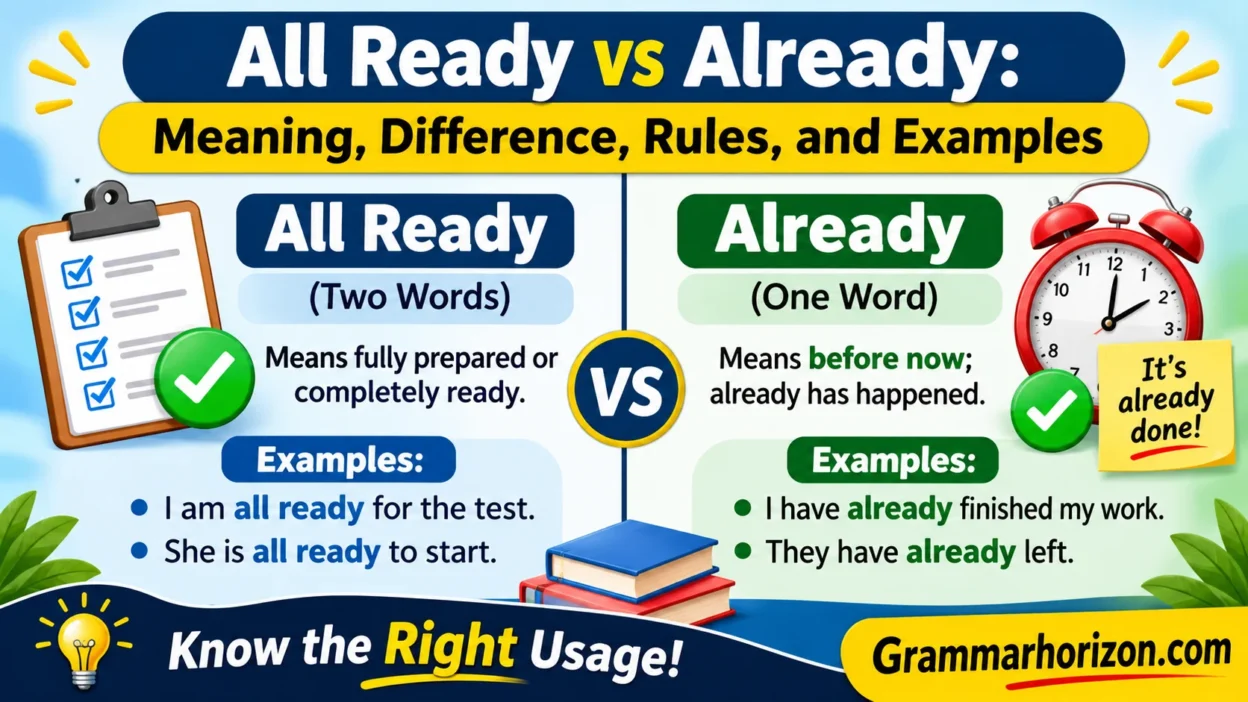
- All ready (two words): Means everyone or everything is fully prepared. Example: We are all ready for the trip.
- Already (one word): Means something has happened before now or sooner than expected. Example: We have already booked our tickets.
Both expressions are correct English. The difference is not about spelling preference or American versus British English. It is about the meaning you want to communicate.
| Expression | Meaning | Example |
| All ready | Completely prepared | We are all ready to leave. |
| Already | Before now or earlier than expected | We have already left. |
What Does All Ready Mean?
All ready is a two-word expression that means everyone or everything is fully prepared for something. It describes a state of readiness rather than the timing of an action.
The word all refers to the whole group or the entire amount, while ready describes a condition of being prepared. When these words appear together, they emphasize that every person, item, or part is prepared.
For example, if a family has packed its bags, checked the car, and gathered everything needed for a vacation, you can say, “We are all ready for our vacation.”
How All Ready Works in a Sentence
The expression all ready often appears with the verb be, including am, is, are, was, and were. It can also appear in sentences describing preparation for an activity, event, journey, or task.
Examples:
- The children are all ready for school.
- We are all ready to start the meeting.
- The food is all ready for the guests.
- My tools are all ready for the repair job.
- She got all ready before leaving the house.
In these sentences, all ready shows that the people or things have completed their preparation.
When All Ready Means Everyone Is Prepared
You can use all ready when talking about a group of people who are prepared to do something. It emphasizes that the entire group is ready, not just one person.
For example, a teacher might ask students whether they are ready for a test. If every student has their books, pencils, and other supplies, the teacher could say, “You are all ready for the test.”
Here, the expression focuses on the readiness of the group.
When All Ready Means Everything Is Prepared
The phrase also works when referring to objects, materials, food, equipment, or arrangements.
For example:
- The decorations are all ready for the party.
- Our documents are all ready for submission.
- The ingredients are all ready for cooking.
- Everything is all ready for the presentation.
These sentences indicate that the necessary items or arrangements are prepared and can be used immediately.
What Does Already Mean?
Already is a single-word adverb that refers to something that has happened before now or earlier than someone expected. It often expresses completion, timing, or surprise about how soon an event has happened.
Unlike all ready, already does not describe a state of preparation. It tells the reader or listener that an action or event has taken place.
For example, if someone asks whether you have finished your homework and you completed it an hour ago, you can say, “I have already finished my homework.”
The word already makes it clear that the action is complete.
How Already Works in a Sentence
Already is an adverb, so it modifies a verb or helps describe when an action occurred. It commonly appears with present perfect, past perfect, simple past, and simple present verbs.
Examples:
- I have already completed the assignment.
- She already knows the answer.
- They had already arrived when we called.
- He already paid for the tickets.
- We are already late for the meeting.
In each sentence, already indicates that something has happened, is true, or has reached a particular point sooner than expected.
Already for Actions Completed Before Now
One of the most common uses of already is to describe completed actions. It often appears in conversations when someone wants to explain that a task has been finished.
For example:
- I have already sent the email.
- She has already cleaned her room.
- They have already eaten lunch.
- We have already discussed the problem.
These sentences tell the listener that the actions are complete, so there is no need to repeat them.
Already for Something Happening Earlier Than Expected
Already can also express surprise when something happens sooner than anticipated.
For example, if you expected a package to arrive next week but it arrives today, you might say, “The package has already arrived.”
Similarly:
- Is the movie already over?
- Have you already finished reading the book?
- He is already working on the next project.
- They already moved into their new house.
In these examples, already can suggest that the event happened sooner than the speaker expected.
All Ready vs Already: Key Differences
The biggest difference between all ready and already is what they communicate. One describes preparation, while the other describes time. Their spelling, grammatical roles, and sentence structures also differ.
| Feature | All Ready | Already |
| Spelling | Two words | One word |
| Meaning | Completely prepared | Previously or before now |
| Grammar | Phrase containing all and ready | Adverb |
| Purpose | Describes a state of readiness | Describes timing or completion |
| Common use | Before an activity begins | When an action has happened |
| Example | We are all ready for dinner. | We have already eaten dinner. |
You can remember this distinction by asking whether the sentence is about being prepared or about something happening earlier.
All Ready Describes Preparation
When you write all ready, you are talking about a person, group, or thing that is prepared for something. The expression often appears before an activity begins.
For example, The players are all ready for the match means the players have prepared themselves and are ready to play.
Already Describes Time
When you use already, you are talking about an action, event, or situation that has happened before now or before a particular point.
For example, The players have already started the match means the game has begun before now or before the expected time.
The difference becomes clear when you compare these two sentences:
- The players are all ready for the match. (They are prepared.)
- The players have already started the match. (The game has begun.)
Both sentences are grammatically correct, but they communicate different information.
When to Use All Ready in a Sentence
Use all ready when you want to describe complete preparation. It is useful in conversations about plans, travel, work, school, cooking, events, and other situations where someone or something is prepared.
When Everyone Is Prepared
Use all ready when every person in a group is prepared for an activity.
Examples:
- We are all ready to go on vacation.
- The students are all ready for their final exams.
- The guests are all ready for dinner.
- The players were all ready to enter the field.
- Are you all ready to begin the discussion?
In these sentences, the expression refers to the readiness of everyone involved.
When Everything Is Prepared
You can also use all ready to describe things that are prepared and available for use.
Examples:
- The documents are all ready for approval.
- The equipment is all ready for installation.
- Our meals are all ready to serve.
- The decorations are all ready for the wedding.
- Everything is all ready for tomorrow’s event.
This usage is particularly common when discussing arrangements, supplies, equipment, and tasks.
When You Want to Emphasize Complete Readiness
Sometimes, the word ready is enough. However, adding all places extra emphasis on the fact that everything is prepared.
Compare:
- The team is ready.
- The team is all ready.
Both are correct. The second sentence may emphasize that the whole team is prepared, especially when readiness is important or someone is waiting to begin.
When to Use Already in a Sentence
Use already when an action has happened before now, before a specific point, or earlier than someone expected. It is commonly used in statements and questions.
When an Action Has Been Completed
Already often appears in sentences about completed work, activities, or events.
Examples:
- I have already finished the report.
- She has already submitted her application.
- We already paid the bill.
- They have already cleaned the house.
- He had already called the manager.
The word tells the reader that the action has been completed by the time being discussed.
When Something Happens Sooner Than Expected
Already is also useful when an event happens earlier than you thought it would.
Examples:
- You are already home? I thought you would be late.
- The baby is already asleep.
- They have already opened the store.
- Has she already graduated?
- It is already getting dark.
In these sentences, already can express surprise because the situation has occurred sooner than expected.
When Asking Questions
Already can appear in questions to express curiosity, surprise, or a desire to confirm that something has happened.
Examples:
- Have you already finished your work?
- Is dinner already prepared?
- Did they already leave?
- Are we already at the destination?
- Has the meeting already started?
These questions ask whether something has happened by this point. Depending on the tone, they can also express surprise at how quickly it happened.
All Ready vs Already in Different Sentence Contexts
Looking at both expressions in similar situations is one of the easiest ways to understand how their meanings differ. The surrounding words often make the correct choice obvious.
All Ready to Go vs Already Gone
- We are all ready to go. Everyone is prepared to leave.
- We have already gone. We left before now.
The first sentence describes preparation, while the second describes an action that has happened.
All Ready for the Meeting vs Already Attended the Meeting
- We are all ready for the meeting. We have prepared everything we need.
- We have already attended the meeting. The meeting took place, and we participated.
The first sentence refers to a future activity. The second refers to a completed event.
All Ready to Start vs Already Started
- The workers are all ready to start. They can begin now.
- The workers have already started. They began earlier.
This difference matters in workplace communication because it tells someone whether an activity is about to begin or is already underway.
All Ready for Dinner vs Already Eaten Dinner
- We are all ready for dinner. We are prepared to eat.
- We have already eaten dinner. The meal is finished.
These expressions are especially useful in everyday conversations because they describe two different stages of an activity.
All Ready vs Already: Sentence Examples
The following examples show how both expressions work in different situations.
Examples of All Ready
- My family is all ready for the road trip.
- The students are all ready to take their test.
- The office is all ready for the new employees.
- We got all ready before the guests arrived.
- Are the documents all ready for printing?
- The food is all ready, so everyone can sit down.
- The players are all ready for the final game.
- Everything is all ready for the launch.
Examples of Already
- I have already completed my homework.
- She already knows what happened.
- We have already booked the hotel.
- He had already left before I arrived.
- They are already waiting outside.
- The store has already closed.
- Have you already read this book?
- It is already five o’clock.
Notice how all ready usually describes a condition of preparation, while already tells you that something has happened or is true by a certain time.
Common Mistakes When Using All Ready and Already
Because the expressions sound similar, writers often choose the wrong spelling without noticing. These mistakes are easy to fix once you understand what each expression means.
Using Already When You Mean Prepared
Incorrect: We are already on a school trip.
Correct: We are all ready for the school trip.
The sentence is about preparation, so all ready is correct. Already cannot replace it because the sentence is not talking about something that happened earlier.
Using All Ready When You Mean Previously
Incorrect: She has all ready completed the assignment.
Correct: She has already completed the assignment.
The sentence refers to a completed action. It does not describe whether she is prepared to do something.
Confusing Readiness With Completion
Being ready to do something does not mean you have done it. This is one of the most important differences between the expressions.
For example:
- We are all ready to cook dinner. (We have prepared to cook.)
- We have already cooked dinner. (We finished cooking.)
Someone can be all ready to start an activity without having started it. Likewise, someone can already have completed an activity without being prepared to do it again.
Choosing the Spelling Based on Sound
Both expressions can sound very similar in ordinary speech. This makes pronunciation an unreliable way to decide which spelling to use.
Instead, look at the meaning of the sentence. If it describes preparation, write all ready. If it refers to something happening before now, write already.
How to Remember the Difference Between All Ready and Already
You don’t need to memorize complicated grammar rules to distinguish the two expressions. A couple of simple tests can help you choose the correct spelling whenever you write.
The Preparation Test
Can you replace the expression with completely prepared?
If yes, use all ready.
We are all ready for the meeting.
This means we are completely prepared for the meeting.
The Time Test
Does the sentence mean before now, by this time, or sooner than expected?
If yes, use already.
We have already started the meeting.
This means we started the meeting before now.
A Simple Memory Trick
Remember that all ready contains the separate word ready. If you are talking about people or things being prepared, keep the two words separate.
On the other hand, already is a single word connected with time. Use it when you want to explain that an event has happened by now or earlier than expected.
This quick trick works in most everyday situations and can help you avoid spelling errors without stopping to think about grammar rules.
All Ready vs Already in Everyday English
Both expressions appear frequently in spoken and written English. However, they are used in different situations depending on what the speaker wants to say.
All Ready vs Already at Work
Workplace communication often involves preparation and completed tasks. Both expressions can be useful when giving updates to coworkers, managers, or clients.
- The team is all ready for the presentation.
- We have already sent the proposal to the client.
- The files are all ready for review.
- The manager has already approved the budget.
The first and third sentences describe preparation. The second and fourth report completed actions.
All Ready vs Already at School
Students and teachers use both expressions when discussing assignments, exams, lessons, and classroom activities.
- We are all ready for the exam.
- I have already studied these chapters.
- The students are all ready to present their projects.
- The teacher has already explained the instructions.
Using the correct expression makes it easier to understand whether a student is prepared or has completed a task.
All Ready vs Already in Travel and Daily Life
Travel plans and everyday activities also provide plenty of opportunities to use these expressions.
- We are all ready to board the plane.
- They have already checked into the hotel.
- My bags are all ready for the trip.
- The train has already arrived.
- Are you all ready to leave?
- Have you already packed your clothes?
These examples show why the difference matters in everyday conversations. One expression describes preparation, and the other describes timing.
All Ready vs Already in American and British English
The difference between all ready and already is the same in American English and British English. Neither expression is a regional spelling variant of the other.
Both forms are standard in the United States, the United Kingdom, Canada, Australia, and other English-speaking regions.
| Expression | American English | British English |
| All ready | Correct | Correct |
| Already | Correct | Correct |
For example, an American writer might say, “We are all ready to leave,” and a British writer can use the same sentence with the same meaning.
Likewise, “They have already arrived” is correct in both varieties of English.
The spelling depends on the intended meaning, not the country or regional style.
All Ready vs Already: A Practical Example
Imagine a group of coworkers preparing for an important business presentation. They have arranged the chairs, checked the projector, printed the reports, and opened the presentation slides. Their manager asks whether they can begin.
They could answer:
“We are all ready for the presentation.”
This means the group has completed its preparation and can begin the presentation.
Now imagine the manager returns ten minutes later and asks whether the presentation has started. One coworker replies:
“We have already started the presentation.”
This means the presentation began before the manager returned.
The difference in this situation:
- All ready = prepared to begin.
- Already the activity has begun or happened before now.
This example shows how choosing the correct expression makes a message more precise. A small spelling difference can communicate a completely different stage of an activity.
Conclusion
Understanding the difference between All Ready vs Already makes your English writing clearer and more accurate. Remember that all ready means everyone or everything is prepared, while already refers to something that happened before now or earlier than expected. Although these expressions look and sound similar, their meanings and uses are different. Paying attention to context and sentence structure will help you avoid common mistakes in emails, conversations, school assignments, and workplace writing. With regular practice, choosing the correct expression becomes easier.
Frequently Asked Questions
Q1. What is the difference between all ready and already?
All ready means completely prepared, while already means something has happened before now or earlier than expected.
Q2. Is all ready one word or two words?
All ready is written as two separate words. It describes a person or group that is fully prepared for something.
Q3. When should I use already in a sentence?
Use already when something has happened before the present time or sooner than expected. For example, “She has already finished her homework.”
Q4. Is already the same as all ready?
No. Already refers to time, whereas all ready refers to preparation. They are not interchangeable.
Q5. How can I remember the difference between all ready and already?
Remember that all ready means everyone or everything is prepared. Already means something has happened before now. Thinking about preparation versus time makes the difference easier to remember.