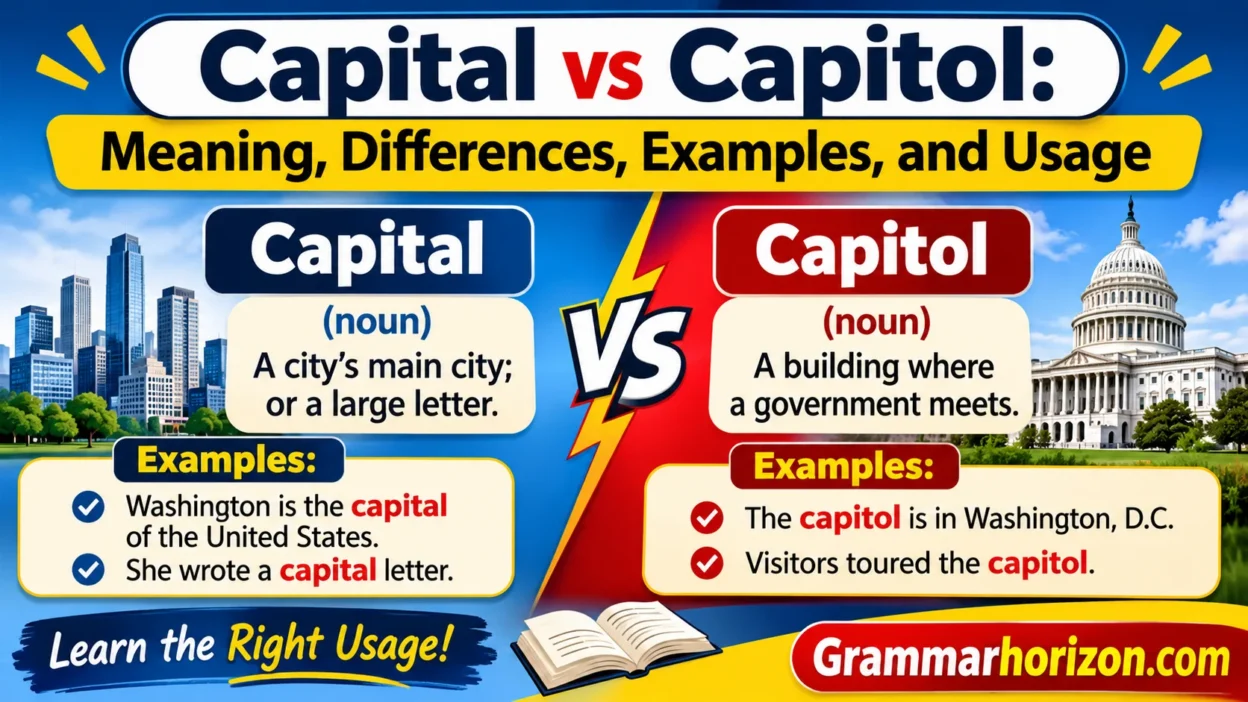
Capital vs Capitol are easily confused words because they have similar spelling and similar pronunciation, but different meanings and usage. In English grammar, capital refers to a city, money, an uppercase letter, or something important. For example, Washington, D.C., is the capital of the United States. In geography, it is a capital city, while in business and finance, capital means money or resources used to run a company.
A capitol is a government building where lawmakers meet to discuss laws. The U.S. Capitol in Washington, D.C., is where Congress and the U.S. Congress meet. It represents the legislative branch of the federal government. Remember the simple difference: capital means a city or money, while capitol means a legislative building.
These words are not interchangeable, so choosing the correct word usage matters. For example, “Paris is the capital of France” and “Lawmakers entered the capitol for a meeting.” These sentence examples show the difference clearly. A useful memory trick is to associate capital with cities and money and capitol with buildings. This simple word choice helps avoid common mistakes and improves your English writing.
Quick Answer: Capital vs Capitol
Capital refers to a city that serves as a seat of government, money or financial resources, an uppercase letter, or something important. Capitol refers to a building where a legislative body meets, such as the U.S. Capitol in Washington, D.C.
| Word | Meaning | Example |
| Capital | A city where the government is based | Paris is the capital of France. |
| Capital | Money or financial resources | The company needs more capital. |
| Capital | An uppercase letter | Write your name with a capital letter. |
| Capital | Something important or excellent | That’s a capital idea. |
| Capitol | A legislative building | Congress meets at the U.S. Capitol. |
The easiest way to remember the difference is that capital has several meanings, while capitol refers to a legislative building.
What Does Capital Mean?
The word capital has several meanings in English. It can refer to a city where a government operates, money used for business, an uppercase letter, or something considered important or excellent.
The meaning depends on the context in which the word appears. You may see capital in geography, economics, grammar, government, business, and everyday conversation.
Capital as a City
A capital is a city where a country’s central government operates or where important government institutions are located. Capital cities often serve as political and administrative centers, housing government offices, official residences, embassies, and other public institutions.
For example, Washington, D.C., is the capital of the United States. London is the capital of the United Kingdom, Paris is the capital of France, and Tokyo is the capital of Japan.
A capital city is not necessarily the largest or most populated city in a country. Its main purpose is to serve as the center of government.
Examples of capital cities include:
| Country | Capital City |
| United States | Washington, D.C. |
| United Kingdom | London |
| France | Paris |
| Japan | Tokyo |
| Canada | Ottawa |
| Australia | Canberra |
| Italy | Rome |
| Germany | Berlin |
The word capital refers to the city itself, not the legislative building located within it.
For example:
- Washington, D.C., is the capital of the United States.
- Ottawa is the capital of Canada.
- Canberra is the capital of Australia.
- Berlin is the capital of Germany.
Whenever you are referring to a city that serves as a country’s government center, capital is the correct word.
Capital as Money or Financial Resources
In business and economics, capital refers to money, financial assets, or resources used to start, operate, or expand a business. Companies use capital to purchase equipment, hire employees, develop products, invest in projects, and manage daily expenses.
Capital is an important part of business growth because companies need financial resources to turn their plans into actual operations.
For example, a small business owner may need capital to rent a store, purchase inventory, buy equipment, or hire workers. A large company may raise capital by borrowing money, selling shares, or reinvesting profits.
Common types of capital include:
- Financial capital: Money and financial assets available to support business activities.
- Working capital: Funds used to manage daily expenses, such as payroll, bills, and inventory.
- Investment capital: Money invested in a business, project, or asset to generate future returns.
- Human capital: The knowledge, skills, experience, and abilities that employees bring to an organization.
Examples of capital in sentences:
- The company raised additional capital to expand its operations.
- Investors provided capital to help the startup develop its product.
- The business needs more working capital to pay its monthly expenses.
- The entrepreneur used personal capital to open a new restaurant.
In these sentences, capital refers to money or financial resources. It has no connection to a government building.
Capital as an Uppercase Letter
In grammar and writing, capital refers to an uppercase letter. Capital letters are the larger forms of letters, such as A, B, C, and D, that writers use in specific situations.
Capitalization helps readers recognize names, understand sentence structure, and identify important words. It is a basic rule of English writing.
You use capital letters in the following situations:
- At the beginning of a sentence.
- In people’s names, such as Sarah, James, and Michael.
- In the names of countries, cities, and places, such as Canada, London, and Texas.
- In the names of days and months, such as Monday and November.
- In titles when capitalization rules require it.
- For the pronoun I.
Examples:
- A dog was sleeping near the door.
- My name is John.
- We moved to California last year.
- She was born in March.
- I will call you tomorrow.
In these examples, capital refers to an uppercase letter. It does not mean a city or legislative building.
Capital as Something Important or Excellent
The word capital can also describe something excellent, outstanding, or important. This meaning is less common in everyday modern English, but it still appears in certain expressions.
For example, capital idea means an excellent or very good idea. It can express approval, enthusiasm, or agreement.
- That’s a capital idea for improving the business.
- We had a capital time during our vacation.
- The manager thought it was a capital plan.
The word capital also appears in the legal expression capital offense, which refers to a crime punishable by death in jurisdictions that allow capital punishment.
In this context, capital refers to the most severe punishment under a legal system. It does not refer to a city or a government building.
These examples show that capital has several meanings, and its correct use depends on the sentence.
What Does Capitol Mean?
The word capitol refers to a building where a legislative body meets to debate, discuss, and make laws. In the United States, the term is commonly used for buildings where federal or state lawmakers conduct legislative business.
The most famous example is the U.S. Capitol in Washington, D.C. It houses the United States Congress, which consists of the Senate and the House of Representatives. State governments also have capitol buildings where their legislatures meet.
Unlike capital, the word capitol does not refer to money, an uppercase letter, or a city. It specifically refers to a legislative building.
The U.S. Capitol Building
The U.S. Capitol is one of the most recognizable government buildings in the United States. Located in Washington, D.C., it serves as the meeting place of the nation’s Congress.
The building contains chambers for both the Senate and the House of Representatives. Members of Congress meet there to debate bills, vote on legislation, hold hearings, and perform other constitutional duties.
The Capitol is a building, while Washington, D.C., is the capital city. This distinction is one of the clearest ways to understand the difference between the two words.
For example:
- Congress held a meeting inside the Capitol.
- Washington, D.C., is the capital of the United States.
- Tourists photographed the Capitol dome.
- Government offices are located throughout the nation’s capital.
The word Capitol is capitalized when referring to the specific U.S. Capitol building in Washington, D.C. It identifies a particular structure rather than the entire city.
Capitol Buildings in State Governments
In the United States, state capitol buildings serve as workplaces for state legislatures. These buildings often contain legislative chambers, committee rooms, offices for elected representatives, public galleries, and other spaces used for government activities.
For example, California has its State Capitol in Sacramento, while Texas has its State Capitol in Austin. These buildings are associated with state lawmaking rather than the federal Congress.
A state capitol is not the same as a state capital. The state capital is the city where the state government is based, while the state capitol is the legislative building located within that city.
Consider these examples:
- Sacramento is the capital of California, and the California State Capitol is located there.
- Austin is the capital of Texas, and the Texas State Capitol is located there.
- Albany is the capital of New York, and the New York State Capitol is located there.
This distinction is useful when writing about state government, legislative meetings, elections, public demonstrations, or political events.
Capital vs Capitol: Key Differences
The main difference between capital and capitol is their meaning. Although both words can appear in government-related writing, they refer to different things.
| Feature | Capital | Capitol |
| Meaning | A government city, money, uppercase letter, or something important | A legislative building |
| Part of speech | Noun or adjective | Primarily a noun |
| Government use | City where the government is based | Building where lawmakers meet |
| Financial use | Money or financial resources | Not used for financial resources |
| Writing use | Uppercase letter | Not related to letter capitalization |
| Example | Denver is the capital of Colorado. | Lawmakers met at the Capitol. |
The word capital has a much broader range of meanings. It appears in geography, finance, grammar, law, and general English. The word capitol is more specific and generally refers to a legislative building.
A simple way to choose the correct spelling is to ask yourself what you are describing. If you mean a city, money, or a letter, use capital. If you mean a building where lawmakers meet, use capitol.
Capital vs Capitol Examples in Sentences
Looking at examples is one of the easiest ways to understand how these words work in everyday English. Their meanings become clearer when you see them used in different contexts.
Examples of Capital in Sentences
The following sentences use capital correctly to refer to cities, money, uppercase letters, or something important.
- The capital of France is Paris. Here, capital refers to the principal city where the national government is based.
- The business needs more capital to expand its operations. In this sentence, capital refers to financial resources.
- Always use a capital letter when writing someone’s name. Here, capital means an uppercase letter.
- The company invested capital in new equipment. The word refers to money or assets used for business purposes.
- Safety is a capital concern for the construction company. In this context, capital means a major or important concern.
- She moved to the state capital to work for the government. The word refers to the city that serves as the center of state government.
These examples show that capital can be used in several ways. The context tells readers which meaning applies.
Examples of Capitol in Sentences
The following sentences use capitol correctly when referring to legislative buildings.
- The senator delivered a speech at the Capitol. The word refers to the legislative building where government officials meet.
- Tourists visited the Capitol during their trip to Washington, D.C. Here, Capitol refers to the specific U.S. government building.
- Protesters gathered outside the state capitol. The word refers to the building where state lawmakers conduct legislative business.
- The governor attended a ceremony inside the Capitol building. The sentence describes a government building.
- The lawmakers returned to the Capitol to discuss the proposed bill. Here, Capitol refers to the legislative workplace.
- The Capitol dome was visible from several streets nearby. The word identifies the building and its architectural features.
These sentences use capitol to describe a legislative building rather than a city. A specific building’s name usually takes a capital C, while generic references to a state capitol may use lowercase depending on the sentence and style guide.
Capital vs Capitol in U.S. Government and Politics
The words capital and capitol frequently appear in political news, government reports, election coverage, and discussions about public policy. Their meanings are closely connected to government, but they describe different things.
A capital city is the location of a government. It may contain the offices of the president, governors, government departments, courts, and other public institutions. A capitol is a legislative building where lawmakers meet to debate and pass laws.
For example, a news report might say:
- The president addressed the nation from the capital.
- Members of Congress returned to the Capitol after the recess.
- The state legislature introduced a new bill at the capitol.
- Demonstrators marched through the capital city.
- Lawmakers held a hearing inside the Capitol building.
The distinction matters in political writing because a sentence may refer to an entire city, a legislative building, or government officials as a group.
What Does Capitol Hill Mean?
Capitol Hill is a neighborhood in Washington, D.C., where the U.S. Capitol is located. The phrase is also commonly used in American political writing as a reference to Congress, congressional activity, or the legislative branch.
For example:
- Negotiations continued on Capitol Hill.
- Lawmakers faced pressure from groups across the country.
- A new spending bill became a major topic on Capitol Hill.
In these sentences, Capitol Hill may refer to the political environment or congressional activity rather than the physical hill or building alone. It is a common expression in U.S. news and political discussions.
The word capital would not be correct in the expression Capitol Hill because the phrase refers to a specific location associated with the legislative branch.
Common Mistakes to Avoid When Using Capital and Capitol
Although the difference between capital and capitol is easy to learn, writers sometimes use the wrong spelling, especially when discussing government.
Here are common mistakes and how to correct them.
| Incorrect Sentence | Correct Sentence | Reason |
| Austin is the capitol of Texas. | Austin is the capital of Texas. | Austin is a city, not a legislative building. |
| Congress meets at the capital building. | Congress meets at the Capitol. | The legislative building is called the Capitol. |
| Ottawa is the capitol of Canada. | Ottawa is the capital of Canada. | Ottawa is the country’s government city. |
| The company needs more capitol. | The company needs more capital. | Money and financial resources are called capital. |
| Use a capitol letter at the beginning. | Use a capital letter at the beginning. | Uppercase letters are called capital letters. |
Using Capitol for a Capital City
One common error is using capitol when referring to a city where the government is based.
Incorrect: Denver is the capitol of Colorado.
Correct: Denver is the capital of Colorado.
Denver is a city, so the correct word is capital. The word capitol would refer to the building where the Colorado legislature meets.
Writing Capital Building Instead of Capitol Building
Writers sometimes use capital building when they mean a legislative building.
Incorrect: The lawmakers gathered at the capital building.
Correct: The lawmakers gathered at the Capitol building.
The word capitol identifies a legislative building. However, not every government building is a capitol. A courthouse, city hall, ministry, or administrative office does not automatically qualify as a capitol.
Confusing Financial Capital With a Government Building
The word capital is commonly used in business, banking, investment, and economics. Replacing it with capitol is incorrect.
Incorrect: The startup raised capitol from investors.
Correct: The startup raised capital from investors.
Capital refers to money or resources used to support the business. Capitol has no financial meaning in this sentence.
Capitalizing Capitol Unnecessarily
The word Capitol is capitalized when referring to a specific named building, such as the U.S. Capitol. Generic references to legislative buildings are often lowercase, depending on the style guide and whether the building’s formal name is being used.
For example:
- The protesters gathered outside the Capitol. (Specific U.S. Capitol)
- The state capitol is open to visitors. (Generic reference)
- We toured the Texas State Capitol. (Formal name)
When writing about a named building, follow its official name and your publication’s capitalization rules.
Easy Ways to Remember Capital vs Capitol
If you frequently confuse capital vs capitol, a simple memory trick can help you remember which spelling to use.
Remember the O in Capitol
The word Capitol contains an O. You can associate that O with the round dome often seen on capitol buildings.
Think of it this way:
- CapitOl = O for a building (think of the dome).
- Capital = A for all the other common meanings, including cities, money, uppercase letters, and importance.
This is a spelling trick, not a formal grammar rule, but it makes the difference easier to recall.
Remember Capital for Cities
When you think about a country’s capital, imagine a city with government offices, embassies, public institutions, and administrative buildings.
For example:
- London is the capital of the United Kingdom.
- Tokyo is the capital of Japan.
- Ottawa is the capital of Canada.
- Washington, D.C., is the capital of the United States.
If you are naming a city, use capital.
Remember Capitol for Legislative Buildings
When you think about a capitol, picture a building with legislative chambers, elected lawmakers, public galleries, and a dome.
A capitol is where legislators meet to debate and pass laws. It is a physical building, not the city surrounding it.
A quick question can help you choose the correct word:
Am I talking about a city or a building?
- If it is a city, use capital.
- If it is a legislative building, use capitol.
Capital vs Capitol: A Real-Life Example
Imagine a news report about a political event in the United States. The report describes lawmakers meeting in Washington, D.C., to discuss a new bill.
A writer might use both words in the same paragraph:
Lawmakers traveled to the nation’s capital to discuss the proposed legislation. The representatives met inside the Capitol to debate the bill and consider changes before voting.
In this example, capital refers to Washington, D.C., the city where the federal government is based. Capitol refers to the building where Congress meets.
Using the wrong word could confuse readers about whether the event happened in the city or inside a specific legislative building.
This example also shows why the words are not interchangeable, even though both are related to government
Conclusion
Understanding Capital vs Capitol is easy when you remember their different meanings. Capital refers to a city, money, or an uppercase letter, while capitol means a government building where lawmakers meet. Using the correct word makes your English writing clearer and helps you avoid common spelling mistakes.
Frequently Asked Questions
Q1. What is the difference between capital and capitol?
Capital refers to a city, money, or an uppercase letter. Capitol refers to a building where lawmakers meet.
Q2. Is Washington, D.C., a capital or capitol?
Washington, D.C., is the capital of the United States. The U.S. Capitol is the building where Congress meets.
Q3. Is the U.S. Capitol a building?
Yes, the U.S. Capitol is a government building in Washington, D.C., where the U.S. Congress meets.
Q4. Does capital mean money?
Yes, capital can mean money or financial resources used to start, operate, or grow a business.
Q5. How can I remember capital vs capitol?
Remember that capital can mean a city or money, while capitol refers to a government building. Use this simple difference to choose the correct spelling..