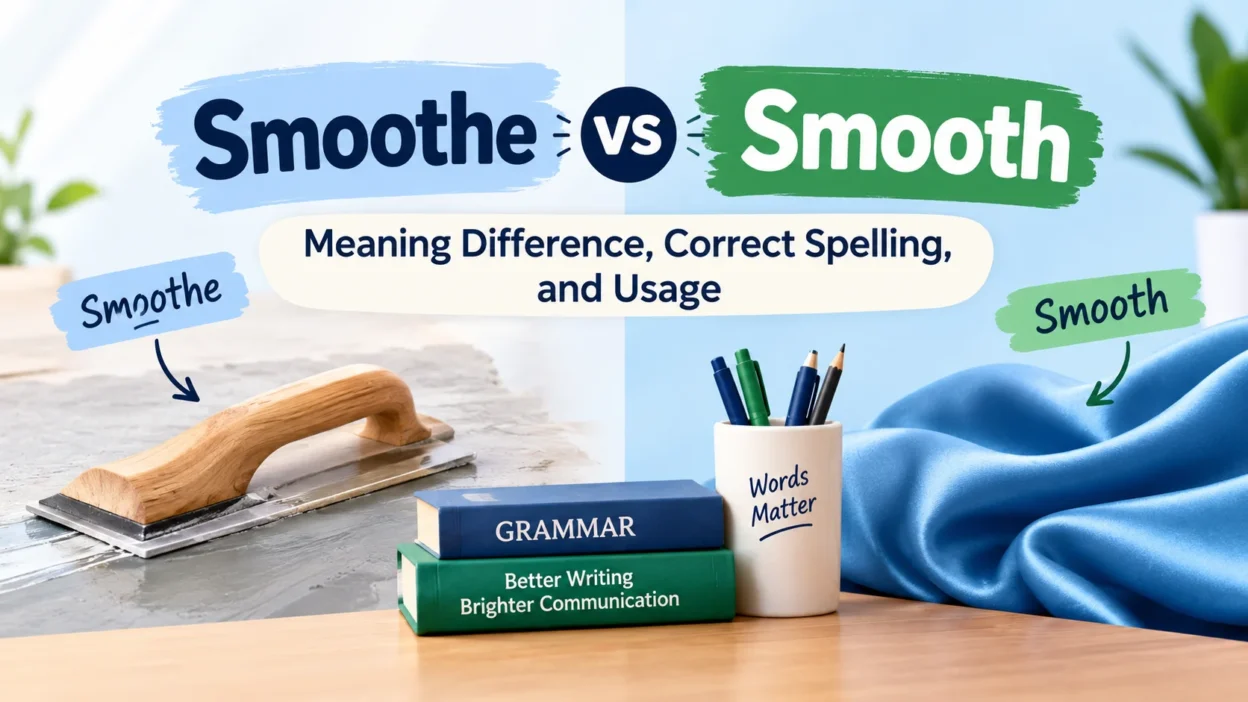
Smoothe vs Smooth can be confusing because both forms look almost identical, but smooth is the correct spelling in standard English. Smooth is an established English word that can work as an adjective, verb, and sometimes a noun. You might describe a smooth surface, a smooth process, or something that feels polished and even. Smoothe, on the other hand, is generally considered a misspelling. The extra e often appears because writers expect the word to follow another familiar spelling pattern. However, standard English does not require that final letter.
In everyday writing, academic writing, professional writing, and creative writing, you should use smooth. The word has a clear and established meaning and usage, so there is little reason to choose the incorrect form. You may see smoothe in online posts, casual messages, articles, or other informal content, but its appearance doesn’t make it a standard spelling. This small difference can cause unnecessary confusion, especially when you’re writing an email, essay, resume, or professional document. Once you connect smooth with its correct spelling, the choice becomes much easier. You won’t need to rely on pronunciation or guess whether the word needs an extra letter.
If you’ve ever wondered whether smoothe might be acceptable, you’re not alone. Many writers make the same mistake because smooth doesn’t follow the spelling pattern they expect. A simple way to remember it is to think of the extra e as something you can throw away. Smooth already gives you the complete word. Whether you’re talking about a smooth surface, a smooth conversation, a smooth process, or making something smooth, the standard spelling stays the same. Remembering this simple rule can help you avoid common spelling mistakes and write with greater clarity and confidence.
Quick Answer: Smoothe vs Smooth Meaning
Smooth is the correct standard English spelling. It can describe something even or free from roughness, a movement without sudden changes, or a situation that happens easily. It can also work as a verb meaning to make something even or to make a difficult situation less troublesome.
Smoothe isn’t the standard spelling for these meanings. You may occasionally see it as part of a brand name, business name, username, surname, or other proper name. In those cases, the unusual spelling can be intentional. That doesn’t make it the normal spelling of the English word.
| Spelling | Standard English word? | Main use |
| smooth | Yes | Describes evenness, ease, movement, behavior, or improvement |
| smoothe | Generally no | Usually a misspelling, unless used as a proper name or intentional name |
The simplest rule is this: When you mean the ordinary English word, write smooth.
Smooth Meaning and Definition
The word smooth has several related meanings. At its core, it suggests a lack of roughness, interruption, difficulty, or sudden change.
For example, smooth glass has an even surface. A smooth ride has little shaking or jolting. A smooth conversation flows naturally without awkward interruptions. A smooth process happens with few problems.
This flexibility explains why the word appears so often in English.
Smooth as an Adjective
As an adjective, smooth describes something even, polished, gentle, consistent, or effortless.
Consider these examples:
- The table has a smooth surface.
- This lotion leaves your skin smooth.
- We enjoyed a smooth ride home.
- She gave a smooth presentation.
- The machine runs smoothly after the repair.
The physical meaning often provides the foundation for the figurative meaning. Think about a freshly polished wooden table. Your hand moves across it without catching on anything. English extends that same idea to experiences, conversations, and processes.
Smooth as a Verb
Smooth also functions as a verb. In this form, it means to make something even, flat, calm, or less difficult.
For instance:
- She smoothed the wrinkles from the fabric.
- He smoothed the paper before writing.
- The manager tried to smooth tensions between the teams.
- They changed the schedule to smooth the transition.
Notice that the spelling remains smooth. The verb doesn’t require an extra e.
The figurative use is especially common. To smooth over a disagreement means to reduce tension and help restore a more peaceful situation.
Smooth as a Noun
The noun use of smooth is less common but still legitimate in specific contexts. It can refer to a smooth part, movement, or surface depending on the context.
However, most everyday uses involve the adjective or verb. Therefore, learners generally encounter smooth as a description rather than a noun.
Smooth as an Adverb
In informal English, smooth can also appear as an adverb, especially in expressions such as “play it smooth.” Standard English more commonly uses smoothly when describing how an action happens.
For example, “The project went smoothly” is the safest choice in formal writing.
Smoothe Meaning and Usage
The spelling smoothe creates a tricky situation because people can encounter it in real-world text. Seeing a word online doesn’t automatically mean it represents standard spelling.
For the ordinary adjective and verb, smoothe isn’t the accepted modern spelling. If you write “smoothe surface” or “smoothe the edges,” standard English requires smooth instead.
There are exceptions in names. A company, product, username, or organization may deliberately choose Smoothe as its official name. Proper names don’t always follow ordinary dictionary spelling conventions.
That distinction matters. If you’re discussing a specific brand called Smoothe, preserve its official spelling. If you’re describing a surface as even, choose smooth.
Why Do People Spell Smooth as Smoothe?
The extra e probably feels natural because English has many spelling patterns involving final letters. Writers sometimes assume that smooth needs an additional vowel marker.
Pronunciation can also create uncertainty. English spelling doesn’t always provide a perfectly predictable guide to pronunciation. When a word looks unusual, people often adjust its spelling based on familiar patterns.
Another source of confusion comes from words such as breathe, bathe, and clothe, where a final e plays an important role. That pattern doesn’t transfer to smooth, however.
The word has its own established spelling. Adding an e doesn’t make it more grammatically complete.
Smoothe vs Smooth: Main Differences
The key difference isn’t meaning. It’s standard spelling and usage.
| Feature | Smooth | Smoothe |
| Standard spelling | Yes | No, for the ordinary word |
| Common adjective | Yes | No |
| Common verb | Yes | No |
| Meaning | Even, easy, polished, calm, or to make even | Usually intended to mean smooth |
| Formal writing | Recommended | Avoid |
| Proper names | Possible | Possible |
If you’re writing an essay, business email, product description, or article, smooth is the dependable choice.
Smooth in Different Contexts
The word becomes easier to understand when you see how widely it applies.
Smooth Surfaces and Textures
The physical meaning describes something without noticeable bumps, roughness, or irregularity.
Common combinations include:
- smooth skin
- smooth glass
- smooth fabric
- smooth wood
- smooth stone
- smooth road
Here, the word describes a physical quality that you can often feel or observe.
Smooth Movement and Performance
Smooth can describe movement that doesn’t contain sudden stops, jerks, or interruptions.
You might talk about a smooth landing, smooth acceleration, or smooth dance routine. The word suggests controlled movement that flows naturally from one stage to another.
Smooth Communication and Behavior
The same idea applies to people and communication.
A smooth speaker communicates confidently and naturally. A smooth negotiation progresses without major friction. A smooth explanation helps listeners follow an idea without getting lost.
The metaphor is simple: good communication behaves like a smooth road. Nothing constantly gets in the way.
Smooth as “Easy or Trouble-Free”
English speakers also use smooth for events that happen without serious complications.
For example:
- The installation went smooth.
- We had a smooth transition to the new system.
- Everything went smoothly during the event.
In formal writing, remember the distinction between the adjective and adverb. Smooth transition is correct. Going smoothly is generally the better construction.
Smooth Word Forms and Related Words
One reason smooth remains easy to recognize is its consistent family of forms.
- smooth
- smoothed
- smoothing
- smoothly
- smoothness
These forms develop naturally from the base word. None requires smoothe.
For example, the past tense is smoothed, not smootheed. The present participle is smoothing, not smoothing. The adverb is smooth, while the noun is smooth.
This consistency provides a useful spelling clue.
Common Mistakes With Smoothe vs Smooth
Several mistakes appear repeatedly when writers confuse these forms.
- Writing smoothe surface instead of smooth surface.
- Writing smoothe the edges instead of smooth the edges.
- Assuming every adjective needs a final e.
- Treating an unusual brand spelling as standard dictionary spelling.
- Using smooth as an adverb where smoothly would sound more natural.
A quick proofreading trick can help. When you see smoothe, ask whether you’re referring to a specific name. If you aren’t, smooth is almost certainly the form you need.
How to Use Smooth Correctly
Use smooth when describing texture, movement, quality, behavior, or an uncomplicated experience.
Use it as a verb when you mean make even or reduce difficulty or tension.
For example:
Adjective: The surface feels smooth.
Verb: Please smooth the paper before printing.
Figurative verb: She helped smooth the disagreement.
Adverb: The meeting went smoothly.
These examples show why replacing smooth with smoothe doesn’t improve the sentence. It simply introduces a spelling error.
Smoothe vs Smooth Examples
Here are several practical corrections:
| Incorrect | Correct |
| The wall feels smoothe. | The wall feels smooth. |
| Please smoothe the surface. | Please smooth the surface. |
| We need a smoothe transition. | We need a smooth transition. |
| The machine runs smoothe. | The machine runs smoothly. |
| She smoothed the fabric. | She smoothed the fabric. |
The fourth example highlights an important point. Sometimes the problem isn’t simply smoothe versus smooth. Writers may also need to choose the correct grammatical form.
Smoothe vs Smooth in Formal Writing
Formal writing rewards standard spelling because readers expect consistency. In resumes, reports, academic assignments, workplace emails, and published articles, use smooth for the ordinary word.
An intentional proper name is different. If a business officially spells its name Smoothe, changing it to Smooth could make the reference inaccurate.
That distinction can be summarized easily:
Use standard spelling for ordinary words. Preserve official spelling for proper names.
How to Remember Smoothe vs Smooth
Remember one simple rule: smooth doesn’t need an extra e.
Picture the word as a polished surface. The spelling itself should stay clean and uncomplicated: smooth.
When you’re unsure, check the sentence. If you’re describing something even, easy, flowing, polished, or free from difficulty, smooth is the standard choice.
Read Also: https://grammarhorizon.com/excel-or-excell/
Conclusion
When choosing between Smoothe vs Smooth, remember that smooth is the correct and standard spelling. It can describe something even, polished, easy, or free from difficulty, and it can also function as a verb. Smoothe is generally a spelling mistake caused by adding an unnecessary e. Whether you’re writing an email, essay, article, or resume, stick with smooth for clear and professional writing. Once you remember the correct form, this small spelling confusion becomes easy to avoid.
FAQs
Q1. Is smooth the correct spelling?
Yes, smooth is the correct and standard spelling in English. Smoothe is generally considered a misspelling.
Q2. Is smoothe a word?
Smoothe is not the standard modern English spelling of the word. In normal writing, use smooth instead.
Q3. What is the difference between smooth vs smoothe?
Smooth is the established English word, while smoothe usually results from adding an unnecessary e.
Q4. How do you use smooth in a sentence?
You can say, “The table has a smooth surface.” You can also use it as a verb, such as “Please smooth the fabric.”
Q5. Why do people spell smooth as smoothe?
People may add the final e because they associate the word with other English spelling patterns. However, smooth does not need it.
Q6. Is smooth an adjective or a verb?
Smooth can be both an adjective and a verb. As an adjective, it describes something even or effortless. As a verb, it means to make something even or less rough.
Q7. Should I use smooth in formal writing?
Yes. Use smooth in academic, professional, formal, and everyday writing. It is the standard spelling and keeps your writing clear.