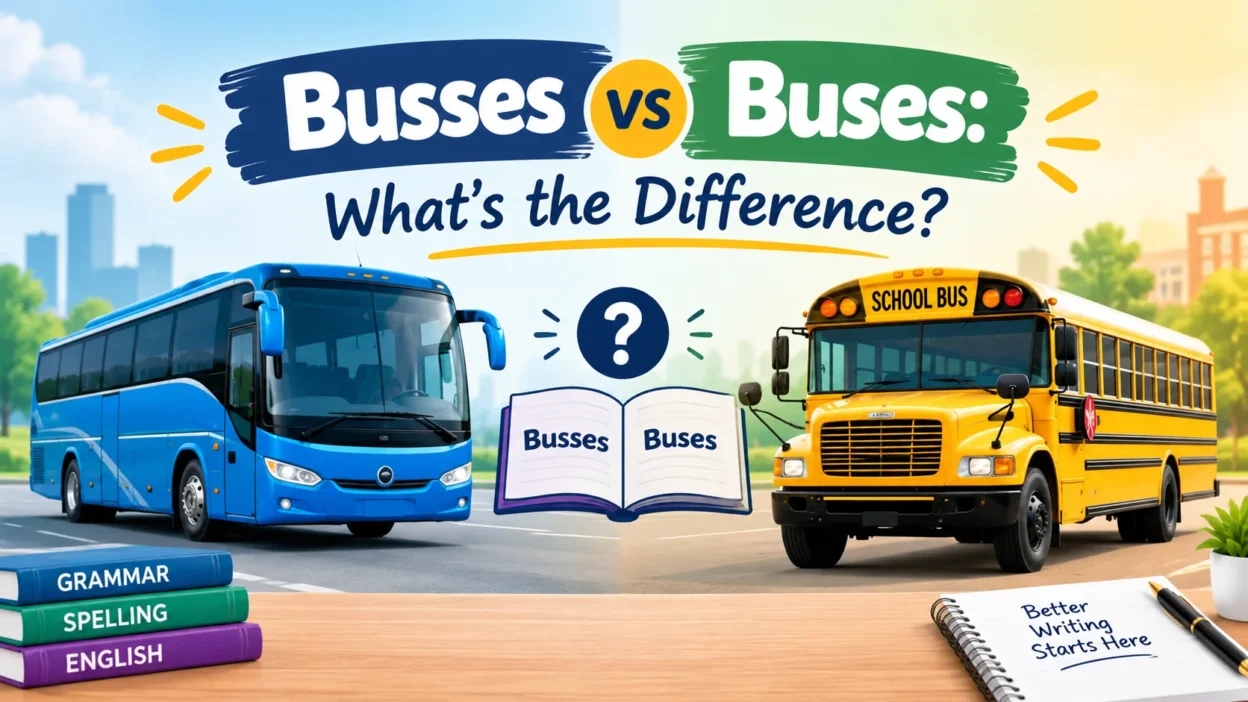
Busses vs Buses can create confusion for English learners, native speakers, and writers because both forms look similar and are connected to English spelling. In modern English usage, buses is the correct and standard plural of bus when you mean vehicles used for public transport, public transportation, or school transportation. The spelling follows familiar plural rules, where a word ending in -s commonly takes -es to form its plural form. This makes buses the preferred choice in everyday writing, schoolwork, emails, websites, business writing, and social media posts.
The form busses has a different use and can be a real English word, but it is much less common when compared with buses. It is connected with buss, a word meaning to kiss, and its appearance in older texts or certain contexts can cause further confusion. The extra s creates a difference in the word form and can change the meaning completely. This is one reason English spelling rules can seem tricky when two spellings appear almost identical. Dictionaries may record both forms because of the history and development of English orthography, but that does not mean they have the same correct usage.
For clear writing and effective communication, use buses when talking about several passenger vehicles. A simple guide is to remember that bus becomes buses, just as other words ending in -s, -sh, -ch, or -x may require -es under common plural rules. This familiar pattern makes the right spelling easier to remember and reduces common mistakes. English usage, grammar, and written English all support choosing the form that matches the intended situation. Once you understand the meaning, differences, and word forms, you can choose the right word more confidently instead of relying only on how the spellings look.
Busses vs Buses: Quick Answer
The correct spelling for more than one passenger vehicle is buses.
Busses is also a legitimate English word, but it has a different meaning. It’s the plural form of buss, a noun meaning a kiss. It can also function as a verb meaning kisses.
For example:
- Buses carry passengers around the city.
- Several buses arrived at the station.
- The novel describes several affectionate busses.
- He busses his child on the cheek.
So, if you’re discussing transportation, choose buses. If you’re using the uncommon word buss, then busses can be correct.
Buses Meaning and Definition
The word buses has several grammatical uses, although the transportation meaning is by far the most familiar.
Buses as the Plural of Bus
A bus is a large road vehicle designed to transport multiple passengers. Its standard plural form is buses.
This spelling appears in everyday writing about public transportation, school transportation, tourism, and many other forms of travel.
For example:
- The city operates hundreds of buses every day.
- School buses arrived before the first bell.
- Several buses were waiting outside the terminal.
- Tourists boarded the buses after lunch.
The rule is straightforward: when you mean more than one vehicle, use buses.
Buses as a Verb
Buses can also be a verb. In restaurant settings, to bus means to clear dishes, glasses, and other items from tables.
For example:
She buses tables during the evening shift.
Here, buses have nothing to do with transportation. The sentence describes someone’s restaurant duties.
The related forms include bus, bussed, and bussing. However, usage can vary depending on the style guide or dictionary being followed.
Busses Meaning and Definition
The word busses has a legitimate place in English. Its meaning becomes clear when you identify the less common base word buss.
Busses as a Plural Noun
A bus means a kiss. The word has a somewhat old-fashioned, literary, or playful feel in modern English.
Therefore, busses can mean multiple kisses.
For example:
- The poem mentions several busses exchanged between the lovers.
- The children received warm busses from their grandmother.
Most modern writers would simply use kisses instead. Still, busses isn’t automatically a spelling mistake when the writer genuinely means multiple kisses.
Busses as a Verb
Busses can also serve as the third-person singular present form of buss.
For example:
He busses his daughter on the cheek before leaving.
In this sentence, busses means kisses.
The verb buss isn’t common in everyday American English. Kissing is the normal modern choice. However, you may encounter buss in older literature, dictionaries, historical writing, or deliberately playful language.
Busses vs Buses: Main Differences
The easiest way to understand busses vs buses is to compare their meanings directly.
| Word | Meaning | Typical context | Example |
| buses | Plural of bus | Transportation | The buses arrived early. |
| buses | Third-person form of bus | Restaurant work | She buses tables. |
| busses | Plural of buss | Kisses | The story mentions several busses. |
| busses | Third-person form of buss | Kissing | He busses her cheek. |
The important point is that buses and busses aren’t simply two interchangeable spellings.
They can represent different words. Context tells you which meaning applies.
Buses vs Busses for the Plural of Bus?
When you’re talking about transportation, buses is the standard modern spelling.
Suppose you’re writing about five passenger vehicles. The natural sentence is:
Five buses waited outside the school.
Writing busses in this sentence can distract readers because it doesn’t match the standard plural spelling used for the vehicle.
Consider these examples:
- Correct: The city added ten new buses.
- Correct: Our school has twelve buses.
- Correct: The airport buses run every hour.
- Incorrect for the intended meaning: The airport busses run every hour.
The final example isn’t the normal way to spell the plural of bus.
Why Is the Plural of Bus “Buses”?
The singular noun is bus, while the standard plural is buses.
The spelling follows the familiar English plural pattern in which certain nouns ending in s take -es.
Think of the basic transformation:
bus → buses
The extra e helps create the standard plural form. This is similar to other common nouns that take -es in their plural spelling.
The pronunciation also changes slightly between the singular and plural forms. In ordinary speech, buses have two syllables.
This matters because English spelling doesn’t always mirror pronunciation perfectly. Learning the written form alongside the word’s sound helps prevent mistakes.
When Should You Use Busses?
Use busses when you’re actually using the word buss, meaning a kiss.
For most modern writing, however, kiss and kisses will sound more natural.
For example:
- More common: She gave him two kisses.
- Less common: She gave him two busses.
The second sentence isn’t necessarily grammatically impossible. It simply uses a much less common word.
This distinction matters when editing older texts or reading literature. A writer who uses busses may be intentionally choosing an old-fashioned or distinctive word rather than making a spelling error.
Common Mistakes With Busses vs Buses
Writers often confuse busses vs buses by using busses for vehicles or assuming busses is always incorrect.
Using Busses for Multiple Vehicles
This is the most important mistake to avoid.
If you mean passenger vehicles, write buses.
The buses left the terminal at noon.
Don’t add the second s simply because the singular word already ends in s.
Assuming Busses Is Always Wrong
The opposite mistake also happens.
Some people see busses and assume it’s always incorrect. That’s not quite right.
Busses can be valid when it comes from buss, meaning a kiss.
The meaning depends on the context. English contains many words that look similar while serving different grammatical or semantic roles.
Confusing Buses With Bus’s
Another common problem involves the apostrophe.
Buses normally means more than one bus.
Bus’s can indicate possession by one bus.
Compare these sentences:
- The buses are crowded.
- The bus’s engine needs repair.
The first sentence discusses multiple vehicles. The second describes something belonging to one bus.
That tiny apostrophe carries real grammatical weight.
Busses vs Buses in a Sentence
Seeing the words in context makes the difference much easier to remember.
Examples With Buses
- The buses arrived before sunrise.
- Several school buses parked outside.
- Public buses serve the downtown area.
- We waited for the next two buses.
- The company operates modern buses across the region.
Examples With Busses
- The poem describes affectionate busses.
- The children received playful busses on the cheek.
- He busses his partner before leaving.
The first group concerns transportation. The second uses buss in the sense of kissing.
How to Remember Busses vs Buses
Here’s a simple memory trick: buses carry people, while busses can mean kisses.
When you’re writing about roads, passengers, schools, terminals, or public transportation, choose buses.
When you’re dealing with the rare word buss, busses can be its plural or verb form.
A quick substitution test can also help:
- If you can replace the word with vehicles, use buses.
- If you can replace it with kisses, busses may fit.
This trick takes only a second, yet it prevents most spelling mistakes.
Buses vs Busses: Which Is More Common?
In contemporary English, buses are overwhelmingly more familiar because buses are common transportation vehicles.
You encounter the word in news reports, transportation schedules, school notices, travel information, and everyday conversation.
Busses have a much narrower role. Its connection to buss makes it grammatically legitimate, but the underlying word itself is uncommon today.
That’s why a modern reader is far more likely to interpret buses as the intended spelling when transportation is involved.
Buses vs Busses: Final Verdict
The difference between busses vs buses comes down to meaning.
Use buses when you mean more than one bus, especially when discussing public or private transportation. You may also see buses as a verb related to clearing restaurant tables.
Use busses when you’re using the less common word buss, which means a kiss. In everyday American English, though, kisses are usually the more natural choice.
The rule worth remembering is simple: vehicles are buses. If the word means kisses, busses can be correct.
Read Also: https://grammarhorizon.com/author/alyan-ashraf/
Conclusion
The main difference between Busses vs Buses is their meaning and usage. Buses is the standard plural form of bus when referring to public transportation, school transportation, or multiple passenger vehicles. Busses is a much less common word connected with buss, meaning to kiss. For modern English writing, schoolwork, business writing, and everyday communication, buses is the correct spelling when you mean more than one vehicle. Knowing this simple difference can help you avoid common mistakes and choose the right word confidently.
FAQs
Q1. Is “buses” or “busses” correct?
Buses is correct when you mean more than one bus or multiple passenger vehicles.
Q2. Is “busses” a correct English word?
Yes. Busses can be a real English word, but it is uncommon and is associated with buss, meaning to kiss.
Q3. What is the plural of bus?
The standard plural of bus is buses.
Q4. Why is the plural of bus “buses”?
English spelling rules commonly add -es to words ending in -s, so bus becomes buses.
Q5. Is “busses” used in British English?
Buses is the standard spelling in British English for multiple transportation vehicles. Busses has a different and much less common use.
Q6. Is “busses” accepted in American English?
It can appear as a form related to buss, but buses is the normal spelling for multiple transportation vehicles in American English.