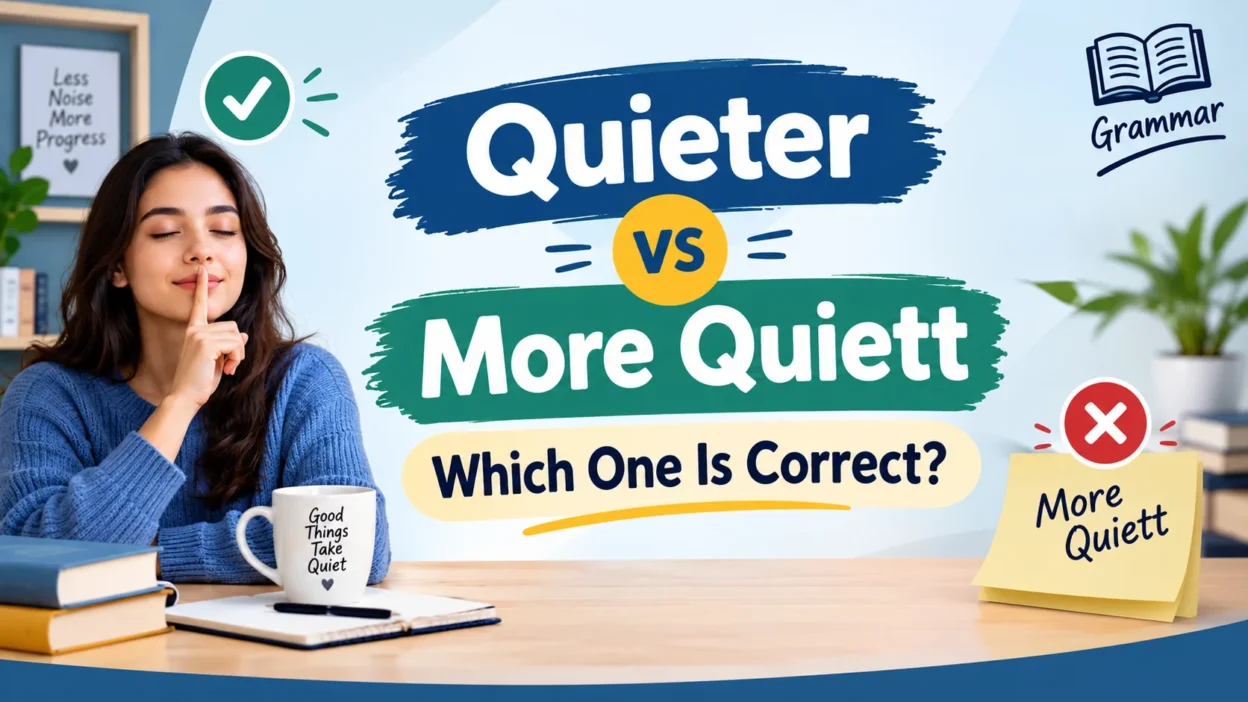
When you compare sounds or places, Quieter vs More Quiett can seem confusing, but quieter is usually the more natural comparative choice. Quiet is an adjective with one syllable, so English grammar normally adds -er to create its comparative form. For example, “The library is quieter than the cafe” sounds smooth and clear. Although more quiet is acceptable and technically understandable, it is less common in everyday writing and speaking. This simple grammar rule helps English learners make the right language choice with greater confidence.
The preferred comparative form is quieter, especially in ordinary situations where you want clear communication. Still, more quiet can appear because English allows some variation and flexibility in grammatical forms. Its use may depend on context, tone, or style, particularly when a writer wants emphasis. In my experience, many native speakers, writers, and speakers understand both forms, but quieter usually feels more natural. Learning these usage patterns, exceptions, and nuances makes the distinction easier to recognize.
A strong understanding of comparative structure, syntax, vocabulary, and linguistic usage can improve your phrasing and meaning. You may also see the superlative form quietest when comparing more than two things. This comparison brings clarity to your application of the rule and supports better decision making, explanation, and guidance. When you are paused mid-sentence and wondering which form to choose, remember the basic truth: quieter is the modern standard, while more quiet is uncommon but still correct in certain contexts.
Quieter vs More Quiett: Quick Answer
Quieter is the standard comparative form of quiet. The normal progression is:
quiet → quieter → quietest
For example:
- “This room is quieter than the kitchen.”
- “The street becomes quieter after midnight.”
- “Her new office is quieter than her old one.”
More quiet can also appear in English, although it is less common than quieter in ordinary usage. However, more quiett is incorrect because quiett is not the standard spelling.
So, if you need the safest and most natural choice, use quieter.
What Does Quieter Mean?
Quieter is the comparative form of quiet. It describes something that produces less noise or has less sound than another thing.
The comparison can involve physical noise, human speech, activity, or even a general atmosphere.
For example, you might say:
- “The library is quieter than the cafeteria.”
- “This washing machine is quieter than my old one.”
- “The neighborhood is quieter at night.”
- “He became quieter after the meeting.”
The word doesn’t always describe complete silence. A room can still have background noise while being quieter than another room.
Quieter as the Comparative Form of Quiet
English commonly forms comparatives by adding -er to shorter adjectives. Quiet is one of the adjectives that naturally accepts this ending.
The three basic forms are:
| Form | Word | Example |
| Positive | quiet | The room is quiet. |
| Comparative | quieter | This room is quieter. |
| Superlative | quietest | This is the quietest room. |
Notice the difference between a comparison of two things and a comparison involving a larger group.
If you’re comparing two offices, you can say, “Office A is quieter than Office B.” If you’re identifying the least noisy office among several, quietest works better.
Examples of Quieter in Sentences
The easiest way to understand quieter is to see it working in different contexts.
Places:
“The park is quieter early in the morning.”
People:
“She was quieter than usual during dinner.”
Machines:
“This dishwasher is quieter than the previous model.”
Animals:
“The puppy became quieter after playing outside.”
Neighborhoods:
“The suburbs are generally quieter than the city center.”
In each example, quieter establishes a comparison. Something has less noise, activity, or verbal expression than something else.
What Does More Quiet Mean?
More quiet uses a different comparative structure. Instead of adding -er, it places more before the adjective.
This construction can occur in English, but it isn’t usually the first choice when comparing something simply described as quiet.
For example, “The room is more quiet than the hallway” is understandable. Still, most readers would find “The room is quieter than the hallway” more natural.
That distinction matters. A phrase can be understandable without being the most idiomatic choice.
When More Quiet Can Be Used
There are situations where writers may choose to be more quiet deliberately. The choice can depend on rhythm, emphasis, contrast, or the structure of a sentence.
For example:
“The second location is more quiet and secluded.”
Here, more quiet may work because the writer is pairing quiet with another descriptive idea. Even then, quieter would often remain the smoother choice.
The important point is simple: more quiet isn’t automatically grammatically impossible. It is simply less common than quieter in normal comparative use.
Examples of More Quiet
Consider these sentences:
- “The countryside is more quiet than the city.”
- “The room became more quiet as the guests left.”
- “This part of the building is more quiet during the afternoon.”
Each sentence communicates a clear comparison. However, the versions with quieter usually sound more natural:
- “The countryside is quieter than the city.”
- “The room became quieter as the guests left.”
- “This part of the building is quieter during the afternoon.”
That’s why quieter should generally be your default choice.
Quieter vs More Quiett: Main Differences
The biggest issue isn’t really quieter versus more quiett. It involves three separate questions: spelling, comparative formation, and natural usage.
| Form | Status | Typical use |
| quiet | Correct | Base adjective |
| quieter | Correct and preferred | Standard comparative |
| quietest | Correct | Standard superlative |
| more quiet | Possible | Less common comparative construction |
| more quiett | Incorrect | Misspelled form |
The extra t in quiett creates the main spelling problem. Standard English spells the adjective quiet, not quiett.
Therefore, writing quieter vs more quiett as a search phrase doesn’t make quiett a legitimate English form.
Why Is Quieter More Common Than More Quiet?
English doesn’t form every comparative adjective in exactly the same way. Some adjectives commonly take -er, while others normally use more.
For example:
- fast → faster
- small → smaller
- bright → brighter
- quiet → quieter
- beautiful → more beautiful
- expensive → more expensive
The word quiet naturally fits the first pattern.
Although it has two syllables, that doesn’t prevent it from taking -er. English comparative formation depends on more than syllable count. Word length, pronunciation, usage patterns, and established convention all influence which form sounds natural.
That explains why quieter feels normal to most speakers.
Is Quieter Grammatically Correct?
Yes. Quieter is grammatically correct and widely used in standard American English.
You can use it whenever you’re comparing the degree of quietness between two things.
For example:
- “My new apartment is quieter than my old one.”
- “The classroom became quieter after lunch.”
- “This keyboard is quieter than the mechanical model.”
- “He seems quieter today.”
You don’t always need to include them. Context can make the comparison obvious.
For instance, “The house is quieter now” clearly suggests a comparison with an earlier state.
Is More Quiet Grammatically Correct?
More quiet can be grammatically acceptable, but it is generally less natural than quieter for a straightforward comparison.
This difference resembles choosing between a common road and a less traveled one. Both may reach the same destination, but one feels more natural to most speakers.
If you simply want to say that something has less noise, quieter is usually the better option.
The same principle applies to editing. If a sentence sounds unnecessarily complicated with more quiet, replacing it with quieter often improves its rhythm immediately.
Quieter vs More Quiett in American English
In everyday American English, quieter is the normal comparative form.
You’ll encounter it in conversations, product descriptions, school assignments, workplace writing, news writing, and ordinary correspondence.
For example, a manufacturer might describe a newer appliance as quieter than an older model. A teacher might ask students to find the quieter area of a building. A homeowner might say the backyard is quieter than the front yard.
More quiet still makes sense when encountered, but it isn’t usually the first choice.
Meanwhile, more quiett should be avoided completely. The spelling quiett doesn’t belong in standard English.
Quieter vs More Quiet With Examples
Both quieter and more quiet can express comparison, but quieter is usually the more natural choice in everyday American English.
Talking About Noise
When discussing sound levels, quieter is especially natural.
“The bedroom is quieter than the living room.”
“This vacuum cleaner is quieter than the older model.”
“The library became quieter after closing time.”
Talking About People
Quiet can describe someone’s amount of speech or outward behavior.
For example:
“She was quieter than usual.”
This doesn’t necessarily mean she made no sound. It can simply mean she spoke less or behaved less openly.
Talking About Machines
Product comparisons frequently use quieter.
“This air conditioner is quieter than the previous version.”
The comparison is straightforward because the newer machine produces less noticeable noise.
Talking About Places
Places can also become quieter because fewer people, vehicles, or activities occupy them.
“The downtown streets are quieter on Sunday mornings.”
This usage focuses on the overall atmosphere rather than one particular sound.
Common Mistakes With Quieter and More Quiett
Several errors appear repeatedly when people compare quiet with another thing.
- Using more quieter: “This room is quieter.”
This creates a double comparative. Use quieter instead. - Writing quiett: The standard spelling is quiet.
- Assuming more quiet is always wrong: It can appear in legitimate English, although it is less common.
- Using quietest for two things: When comparing two items, quieter normally fits better.
- Adding unnecessary words: “This room is more quiet than that room” can usually become “This room is quieter than that room.”
Quieter vs More Quiett: How to Choose the Right One
When you’re unsure, use this simple rule:
Choose quieter for ordinary comparisons.
Use more quiet only when the sentence’s wording or style makes that construction preferable. Don’t use more quiett, because the spelling is incorrect.
A quick editing test can help. Replace the phrase with quieter and read the sentence aloud. If the sentence becomes smoother, you’ve probably found the better choice.
Quieter vs More Quiett: How to Remember the Difference
Think of quiet as a three-step ladder:
quiet → quieter → quietest
The first step describes the basic quality. The second compares two things. The third identifies the highest degree of quietness within a group.
For spelling, remember one crucial detail: quiet has one final t.
So:
- quiet ✓
- quieter ✓
- quietest ✓
- quiett ✗
- more quiett ✗
That small spelling detail prevents a surprisingly common mistake.
Related Comparative Forms
Comparative adjectives don’t all follow one identical pattern.
| Base adjective | Comparative | Superlative |
| quiet | quieter | quietest |
| loud | louder | loudest |
| calm | calmer | calmest |
| fast | faster | fastest |
| simple | simpler | simplest |
| beautiful | more beautiful | most beautiful |
This comparison shows why you shouldn’t rely only on syllable counting. English has established patterns shaped by pronunciation and long-standing usage.
Read More: https://grammarhorizon.com/is-it-nosy-or-nosey/
Conclusion
Choosing between quieter and more quiet is easier once you understand the basic English grammar rule. Quieter is the usual comparative form of quiet because short, one-syllable adjectives commonly take -er. More quiet is understandable and can work in some contexts, but it sounds less natural in most everyday writing and speaking. When you want the safest and most natural choice, use quieter.
FAQs
Q1. Is quieter or more quiet correct?
Quieter is the standard and more natural comparative form of quiet. More quiet can also be understood and may appear in certain contexts.
Q2. Is quieter grammatically correct?
Yes. Quieter is grammatically correct and is the usual comparative form of the one-syllable adjective quiet.
Q3. Is more quiet wrong?
No. More quiet is not necessarily wrong, but it is less common than quieter. Writers usually choose quieter for natural everyday English.
Q4. Why do we say quieter instead of more quiet?
English usually forms comparatives of short adjectives by adding -er. Since quiet is generally treated as a short adjective, quieter is the preferred form.
Q5. Can I use quieter in formal writing?
Yes. Quieter is completely appropriate for formal writing, academic work, professional communication, and everyday conversation.
Q6. What is the superlative form of quiet?
The usual superlative form is quietest. For example, “This is the quietest room in the building.”
Q7. Which should I use: quieter or more quiet?
In most cases, choose quieter. It is more common, natural, and widely preferred in modern English.