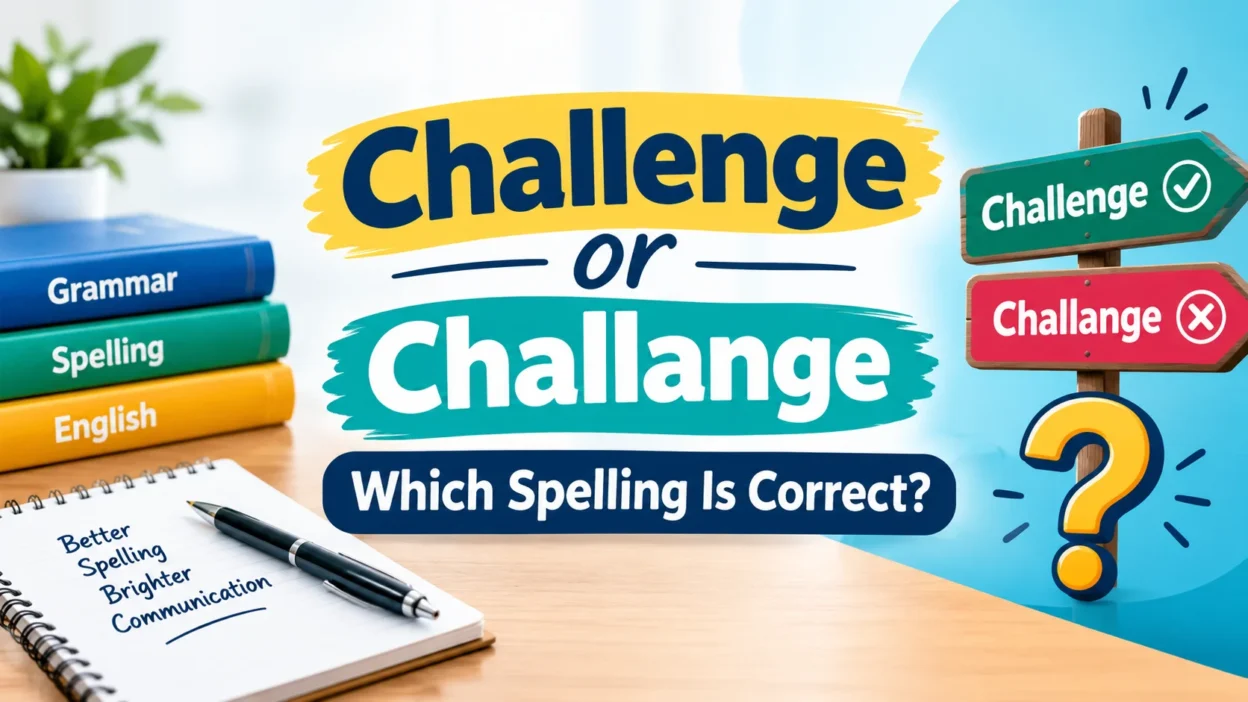
When you write “Challenge or Challange,” remember that challenge is the correct spelling, while challange is a common spelling mistake. The correct spelling is challenge, and challange is incorrect in standard English. Many English learners, students, bloggers, and non-native speakers make this mistake because of pronunciation. When the word is spoken quickly, its ending can sound less clear, making the letters easier to mix up. In particular, a and e may get confused when someone is writing quickly. This is why the two forms can look almost identical even though only one is accepted in standard written English.
The word challenge is a common word that works as both a noun and a verb. As a noun, it can describe difficult tasks, problems, competitions, personal goals, and situations that test your ability. As a verb, it can mean that someone questions something, invites another person to compete, or asks someone to prove themselves. Cambridge recognizes these noun and verb uses. The incorrect form does not describe a different word or a different meaning. Instead, challange is a spelling error caused by an extra a. Once you notice where the correct letters belong, this confusion becomes much easier to handle.
Using the correct form matters in everyday writing, especially in essays, emails, resumes, and reports. A useful way to remember it is to focus on the spelling of challenge rather than relying only on how the word sounds. English contains many unusual spelling patterns, so pronunciation cannot always tell you which letters to write. When you check the correct form before submitting important writing, you can avoid this simple mistake. With regular practice, the spelling becomes familiar, and you will be less likely to type challange when you mean challenge.
Quick Answer: Challenge or Challange?
Challenge is the correct spelling in standard English.
Challange is a misspelling and should not be used in formal or standard writing.
For example:
- Correct: Learning a new language can be a difficult challenge.
- Correct: The coach challenged the team to improve.
- Incorrect: Learning a new language can be a difficult challange.
The key difference is simple: challenge contains -enge near the end, while challange incorrectly uses -ange.
| Spelling | Correct? | Meaning |
| Challenge | Yes | A difficult task, test, competition, or act of questioning |
| Challange | No | Misspelling of challenge |
Challenge or Challange: What Is the Difference?
At first glance, challenge and challange seem like minor spelling variations. They aren’t.
Challenge is an established English word. Dictionaries recognize it as both a noun and a verb. It has several meanings depending on how you use it.
Challange, on the other hand, is not the standard spelling of that word. It doesn’t become correct simply because people sometimes type or write it. Frequent mistakes can spread quickly, especially online, but popularity doesn’t automatically create a standard spelling.
The difference comes down to one important letter pattern:
challenge → correct
challange → incorrect
Notice the ending. The correct word contains e after the l sequence: -enge. The incorrect version replaces that e with a.
Challenge Is the Correct Spelling
Challenge works as both a noun and a verb.
As a noun, it can describe something difficult that requires effort, skill, patience, or determination.
For example:
- Climbing the mountain was a serious challenge.
- Finding enough time to study can be a challenge.
- The final exam presented a difficult challenge.
As a verb, challenge can mean to test someone’s ability, question an idea, or invite someone to compete.
For example:
- The puzzle challenged my problem-solving skills.
- She challenged the decision during the meeting.
- The athlete challenged his opponent to a race.
The meaning changes with context, but the spelling remains challenge.
Challange Is a Misspelling
Challange is simply an incorrect spelling of challenge.
You may encounter it in social media posts, informal messages, comments, or other user-generated writing. That doesn’t make it an accepted alternative.
This distinction matters because English contains many words with multiple accepted spellings. Challange isn’t one of those cases. It shouldn’t be treated like a regional spelling variation.
If you’re writing something important, choose a challenge every time.
What Does Challenge Mean?
The word challenge has a surprisingly broad range of uses. Its basic idea involves difficulty, testing, opposition, or questioning.
Challenge as a Noun
A challenge can be a difficult situation or task that demands effort.
Consider these examples:
- Completing the marathon was her biggest challenge.
- Managing a busy schedule can become a daily challenge.
- Building the bridge presented several engineering challenges.
The word can also describe a competition or an invitation to prove yourself.
For example, someone might say, “I accept the challenge.” Here, the speaker agrees to attempt something difficult.
In another context, a challenge can mean an objection or dispute.
For instance:
- The lawyer issued a challenge to the evidence.
- The researcher faced a challenge to the original theory.
So, don’t assume that challenge always means a difficult physical task. Context determines its precise meaning.
Challenge as a Verb
As a verb, challenge can describe testing someone’s ability.
For example:
The demanding course challenged every student.
It can also mean questioning something that someone has said or done.
The employee challenged the accuracy of the report.
Another common use involves competition.
The young player challenged the champion for the title.
These meanings share an underlying idea: someone or something is being tested, questioned, or pushed.
Why Is “Challange” Incorrect?
The spelling mistake usually comes from the word’s appearance and pronunciation.
When people hear challenge, they may not clearly distinguish every vowel in the middle of the word. English pronunciation often compresses unstressed sounds. As a result, writers sometimes choose a familiar spelling pattern instead of the established spelling.
The incorrect form adds an a where the standard spelling uses e.
Compare them carefully:
challenge
challange
The difference is small visually. However, spelling accuracy depends on that single letter.
This is a useful reminder that English spelling doesn’t always follow pronunciation perfectly. You can’t reliably reconstruct every English word by writing exactly what you hear.
How to Spell Challenge Correctly
A useful way to remember it is to focus on the middle and ending:
challenge
The important part is -enge, not -ange.
You can also connect the spelling to related forms:
- challenge
- challenges
- challenged
- challenging
Seeing the word in several forms helps reinforce its spelling pattern.
Challenge or Challange in Sentences
Context makes the difference especially clear.
Correct examples:
- This project is a major challenge.
- She enjoys every new challenge.
- The teacher challenged the students with a difficult question.
- They faced several challenges during construction.
- The competition will challenge even experienced players.
- He found the job challenging but rewarding.
Incorrect examples:
- This project is a major challange.
- She enjoys every new challange.
- The teacher challanged the students.
Whenever you see challange, replace it with challenge.
Common Mistakes With Challenge
Even confident writers can make spelling mistakes when a familiar word contains an unexpected letter sequence.
Adding an Extra “A”
The most obvious mistake is writing challange instead of challenge.
This happens because a is common in words with similar-looking structures. The writer may unconsciously choose a familiar pattern.
The fix is straightforward: remember that challenge uses e in the middle.
Confusing Spelling With Pronunciation
English pronunciation can create spelling traps. Some sounds don’t reveal their exact written forms.
When you hear the word, you might not consciously notice the vowel represented by e. That’s why relying entirely on sound can lead to challange.
If you’re uncertain, look at the written pattern rather than guessing from pronunciation.
Using Challange in Formal Writing
A typo in a casual text may go unnoticed. The same error can look careless in a job application, academic assignment, business email, or professional report.
Before submitting important writing, check commonly confused words. A quick spelling review can remove small errors that distract readers from your actual message.
Challenge Synonyms
Depending on the context, several words can replace challenge.
| Synonym | Best Used When You Mean |
| Difficulty | Something is hard to accomplish |
| Obstacle | Something blocks progress |
| Test | Someone’s ability is being evaluated |
| Trial | Someone is experiencing a difficult situation |
| Problem | Something needs to be solved |
| Competition | People are competing against each other |
These words aren’t perfect substitutes in every sentence. For example, a challenge can feel motivating, while a problem usually emphasizes something that needs fixing.
That subtle difference makes challenge particularly useful in everyday English.
Challenge: Related Words and Forms
Once you learn challenge, you’ll see several related forms.
Challenges
Challenges is the plural noun.
- Every career has its own challenges.
- The team overcame several challenges.
Challenged
Challenged is the past-tense and past-participle form.
- The difficult question challenged the students.
- She felt challenged by the demanding assignment.
Challenging
Challenging describes something that requires considerable effort or skill.
- The course was challenging.
- We faced a challenging deadline.
Notice that none of these forms use challange. Learning the family of related words can make the correct spelling easier to recognize.
How to Remember the Correct Spelling
Spelling becomes easier when you turn a confusing word into a pattern.
For challenge, remember:
Challenge = -enge
Not:
Challange = -ange
Another useful technique is to write the word in meaningful sentences. Instead of memorizing isolated letters, connect the spelling with a real situation.
For example:
- A difficult challenge
- Accept the challenge
- Face a challenge
- Overcome a challenge
- A challenging task
Repeated exposure makes the correct form increasingly familiar.
A Simple Memory Trick
Think of the final part as “lenge”:
chal + lenge
The spelling may feel unusual at first. With repeated use, though, your visual memory starts recognizing challenge immediately.
Read More:https://grammarhorizon.com/whos-vs-whose/
Conclusion
Challenge is the correct spelling, while challange is a common spelling mistake. The confusion usually comes from pronunciation and the way the letters sound when spoken quickly. Remembering the correct spelling will help you write confidently in essays, emails, resumes, reports, and everyday English.
FAQs
Q1. Is challenge the correct spelling?
Yes. Challenge is the correct standard English spelling. Challange is incorrect.
Q2. Is challange a word?
No. Challange is not the standard spelling of the word. It is a common spelling error.
Q3. Why do people spell challenge as challange?
People often confuse the a and e because the pronunciation can make the spelling difficult to remember.
Q4. What does challenge mean?
Challenge can mean a difficult task, problem, competition, or situation that tests your ability.
Q5. Can challenge be used as a verb?
Yes. You can use challenge as a verb when you question something, invite someone to compete, or ask someone to prove something.
Q6. How can I remember the spelling of challenge?
Focus on the correct sequence of letters in challenge and practice writing the word in different sentences.
Q7. Which is correct, Challenge or Challange?
Challenge is correct. Challange is incorrect in standard English.