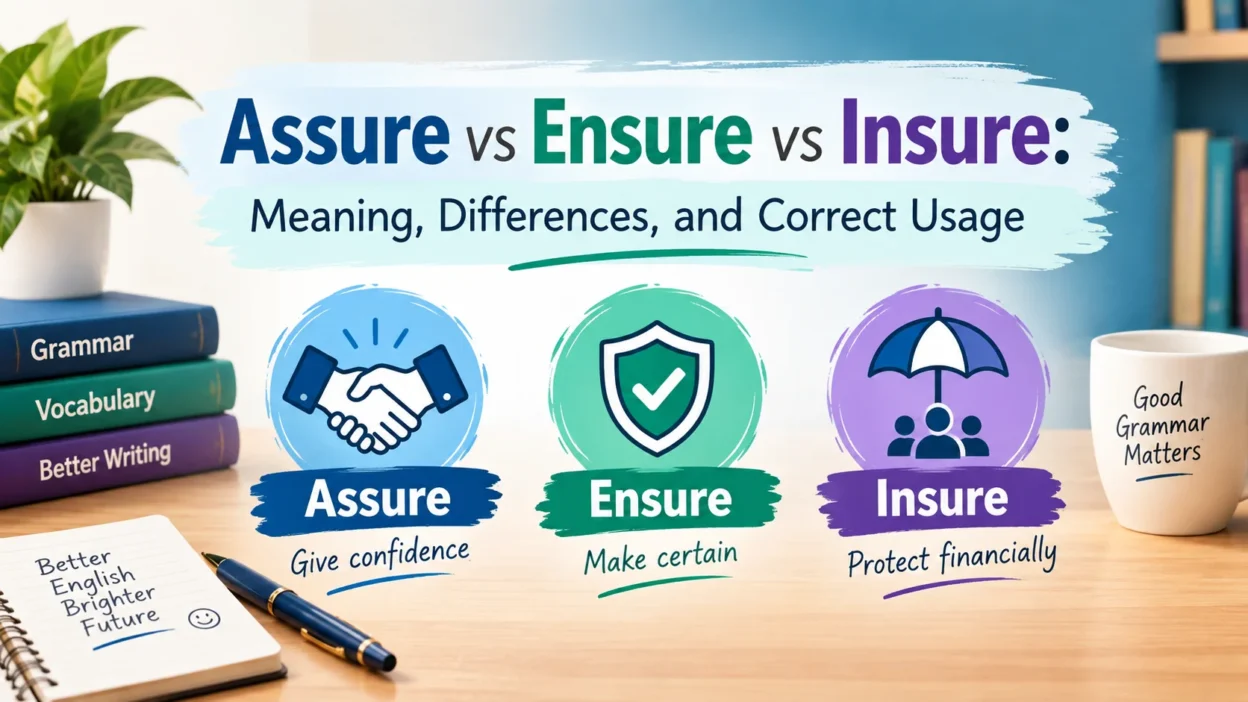
Assure vs Ensure vs Insure can confuse English learners and native speakers because these three verbs look and sound similar, but each has a distinct meaning and usage. Assure gives a person confidence or certainty, ensure means making certain that something happens, while insure usually means financial protection. Understanding this basic distinction makes the words easier to use in everyday situations, professional communication, and academic writing.
When choosing the correct usage in a sentence, focus on the purpose of each word. You can assure someone that you will write or speak honestly, ensure that your writing or speaking is accurate, or insure something against financial loss. Using the wrong word can change the meaning, so learning how to separate these terms makes communication, grammar, and vocabulary easier for learners and speakers who want to communicate accurately.
In formal, professional, and academic English, this simple rule helps prevent confusion. Assure focuses on a person and builds confidence, ensure focuses on making sure that a result occurs, and insure focuses on being protected through financial protection. Making certain that you choose the right verb can prevent a common mistake that often confuses people, while making the differences easier to understand and remember.
Quick Answer: Assure vs Ensure vs Insure
The simplest rule is:
Assure people. Ensure outcomes. Insure against risk.
| Word | Main Meaning | Common Use | Example |
| Assure | Give someone confidence or remove doubt | People and feelings | She assured me that everything was fine. |
| Ensure | Make something certain or make sure it happens | Results, conditions, actions | Check the door to ensure it is locked. |
| Insure | Protect against financial loss | Cars, homes, property, businesses | They insured their house against fire. |
There is some historical and dictionary overlap between ensure and insure. Still, modern English generally keeps insure closely connected with insurance. When you mean “make certain,” ensure is normally the clearest choice.
What Does Assure Mean?
Assure means to give someone confidence or remove their doubts and worries. It normally focuses on a person who needs reassurance.
For example, if your friend worries about an upcoming exam, you might say, “I assured her that she had prepared well.” You’re not guaranteeing the exam result. Instead, you’re giving her confidence.
How to Use Assure in a Sentence
The most common structure is:
assure + person + that-clause
Examples include:
- “The doctor assured the patient that the treatment was safe.”
- “He assured me that he would arrive on time.”
- “The manager assured customers that their information was protected.”
- “She assured her parents that everything was under control.”
Notice how a person usually receives the assurance.
You can also use assure + someone + of + noun:
- “The guide assured us of our safety.”
- “The company assured customers of its commitment to quality.”
Assure vs Reassure
Reassure is closely related to assure. Both can involve reducing someone’s worry. However, reassure often emphasizes calming someone who already feels concerned or frightened.
For example:
“The nurse reassured the nervous child.”
The nurse helped reduce the child’s fear. In contrast, assure can simply mean confidently telling someone that something is true.
What Does Ensure Mean?
Ensure means to make something certain, secure, or likely to happen. Unlike assure, it doesn’t normally focus on giving confidence to a person.
Think about a practical action that produces a desired result. That’s where ensure fits naturally.
For example:
- “Double-check the address to ensure accurate delivery.”
- “The rules ensure equal treatment.”
- “Regular maintenance helps ensure reliable performance.”
- “Arrive early to ensure you get a seat.”
In each example, ensure connects an action or condition with a desired result.
Ensure vs Make Sure
In everyday conversation, make sure often sounds more natural than ensure.
Compare these sentences:
- “Make sure the windows are closed.”
- “Ensure that the windows are closed.”
Both communicate essentially the same idea. The second version sounds more formal.
This distinction matters when you’re writing emails, reports, academic work, instructions, or business documents. Ensure you can create a polished tone without changing the basic meaning.
What Does Insure Mean?
Insure usually means to protect a person, property, or business financially against a specified risk.
The word is closely connected to insurance.
For example:
- “You should insure your car.”
- “They insured the building against fire.”
- “The business insured its equipment against theft.”
- “She insured the property against accidental damage.”
Here, insure refers to financial protection provided through an insurance arrangement.
Insure Against
A particularly common construction is:
insure + something + against + risk
Examples include:
- insure a house against fire
- insure a vehicle against theft
- insure equipment against damage
- insure a business against certain losses
The word against often makes the insurance meaning obvious.
Main Differences Between Assure vs Ensure vs Insure
The biggest difference lies in their focus.
Assure focuses on a person’s confidence. Ensure focuses on certainty or an intended result. Insure focuses on financial protection from risk.
| Feature | Assure | Ensure | Insure |
| Main idea | Give confidence | Make certain | Provide insurance protection |
| Typical focus | Person | Outcome or condition | Property, person, business, risk |
| Common question | “Who needs confidence?” | “What needs to happen?” | “What needs financial protection?” |
| Common phrase | assure someone | ensure success | insure a car |
| Memory clue | A person | An outcome | Insurance |
Assure Focuses on People
Consider this sentence:
“I assured Maria that the package would arrive.”
The speaker communicates confidence to Maria.
Now change the verb:
“I ensured that the package arrived.”
The meaning changes. The second sentence says the speaker took action to make the delivery happen.
That’s an important distinction.
Ensure Focuses on Results
Consider:
“The technician checked the system to make sure it was safe.”
The technician isn’t providing comfort about safety. Instead, the technician is taking steps to ensure that the situation remains safe.
That’s the practical heart of ensure.
Insure Focuses on Risk
Now consider:
“The company insured the warehouse against fire.”
This has nothing to do with reassuring someone. It describes financial protection against a particular risk.
Assure vs Ensure
The difference between assure vs ensure causes many mistakes because both words can involve certainty.
Compare:
- “The teacher assured the students that the test would be fair.”
- “The teacher ensured that the test was fair.”
The first sentence describes communication with students. The second describes an action that produced a fair test.
A useful test is simple:
If you’re telling someone something to remove doubt, use assure. If you’re making something happen or remain true, use ensure.
A Real-World Example
Imagine a hotel manager dealing with a worried guest.
The manager might assure the guest that the room is ready.
Meanwhile, the housekeeping team might ensure that the room meets cleanliness standards.
The hotel might also insure its building against fire and other covered risks.
One situation can naturally contain all three words.
Ensure vs Insure
Ensure vs insure is another common source of confusion.
Consider these examples:
- “The checklist will ensure accuracy.”
- “The company will insure the equipment.”
The first sentence concerns certainty and performance. The second concerns insurance protection.
A common mistake is writing insure when you simply mean “make certain.”
For example:
Less clear: “These procedures ensure that every record is accurate.”
Preferred: “These procedures ensure that every record is accurate.”
When the sentence doesn’t involve insurance, ensure is usually the better modern choice.
Assure vs Insure
The difference between assure vs insure is generally easier to recognize.
Compare:
“The agent assured the customer that the policy was valid.”
Here, the agent gives the customer confidence.
“The customer insured the vehicle.”
Here, the customer obtains insurance protection.
The words may appear in the same conversation, yet they perform completely different jobs.
Common Mistakes With Assure vs Ensure vs Insure
The most common mistakes with assure vs ensure vs insure happen when writers confuse giving confidence, making something certain, and providing insurance protection.
Using Ensure for a Person
Incorrect:
“She ensured me that the problem was fixed.”
Preferred:
“She assured me that the problem was fixed.”
The person receives confidence, so assured works naturally.
Using Assure for an Outcome
Less appropriate:
“The new system will assure accuracy.”
Better:
“The new system will ensure accuracy.”
The system makes accuracy more certain. It doesn’t communicate reassurance to a person.
Using Ensure for Insurance
Incorrect in an insurance context:
“I need to ensure my car.”
Preferred:
“I need to insure my car.”
You’re talking about obtaining insurance coverage, so insure is the right choice.
Using Insure for General Certainty
If you mean “make certain,” use ensure ” in most modern writing.
For example:
“Please ensure that all forms are complete.”
This means “make certain that all forms are complete.”
Assure vs Ensure vs Insure Examples
Here are practical examples that show the difference clearly:
Assure Examples
- “The manager assured me that my complaint would be reviewed.”
- “She assured her parents that she was safe.”
- “The doctor assured the patient that the procedure was routine.”
- “He assured us of his support.”
Ensure Examples
- “Please ensure that the door is locked.”
- “The inspection helps ensure product quality.”
- “These instructions ensure consistent results.”
- “The backup system helps ensure continued access.”
Insure Examples
- “They insured their new car.”
- “The owner insured the property against fire.”
- “The company insured its equipment against theft.”
- “Many businesses insure valuable assets against specific risks.”
How to Remember Assure vs Ensure vs Insure
A three-word memory trick makes this distinction much easier:
Assure → A person
Ensure → An outcome
Insure → Insurance
You can also use the substitution test.
If reassurance makes sense, assure is the appropriate choice.
If making sure makes sense, ensure is the better fit.
For example:
“I assured him.”
Someone receives confidence.
“I ensured the door was locked.”
A condition was made certain.
“I insured the car.”
The car received insurance protection.
Assure vs Ensure vs Insure in American English
In American English, writers generally distinguish these words by meaning.
Assure commonly concerns people and confidence. Ensure common concerns, certainty and results. Insure commonly concerns insurance.
However, the boundaries aren’t completely rigid. English developed these words from related roots, and dictionaries recognize some overlap between ensure and insure.
That doesn’t mean you should use them randomly. Clear modern usage is usually the safest approach, particularly in professional writing.
When you want to say “make certain,” choose “ensure. ” “” “When you mean “provide insurance protection,” choose insure.
Related Words and Forms
Understanding related forms can reinforce the distinction.
| Verb | Related Word | Meaning |
| Assure | Assurance | Confidence or a statement that removes doubt |
| Ensure | Ensuring | Making something certain |
| Insure | Insurance | Financial protection against specified risks |
| Insure | Insured | Covered by an insurance policy |
For example, assurance can describe confidence given to someone. Insurance refers to financial protection.
Those noun forms provide another useful memory clue.
Quick Decision Guide for Assure vs Ensure vs Insure
When you’re unsure, ask yourself one question:
Am I giving a person confidence?
Use assure.
Am I making something certain?
Use ensure.
Am I protecting something financially through insurance?
Use insure.
The three words may look like close relatives, but their everyday jobs are different.
Read More: https://grammarhorizon.com/did-you-have-or-did-you-had/
Conclusion
Understanding Assure vs Ensure vs Insure becomes easier when you remember the main difference between these three verbs. Assure is used when you give a person confidence, ensure means making certain that something happens, and insure usually relates to financial protection against loss or risk. Although the words sound similar, their meanings and purposes are different. Using the correct word improves your grammar, writing, and everyday communication.
FAQs
Q1. What is the difference between assure, ensure, and insure?
Assure means to give someone confidence, ensure means to make something certain, and insure generally means to provide financial protection against possible loss or damage.
Q2. Is it correct to say assure someone?
Yes. Assure is normally used with a person or group. For example, “I assure you that everything will be fine.”
Q3. When should I use ensure?
Use ensure when you mean make certain that something happens or remains true. For example, “Please ensure that all the information is correct.”
Q4. When should I use insure?
Use insure mainly when discussing insurance or financial protection against risks such as accidents, damage, theft, or loss. For example, “They insured their house against fire.”
Q5. Can assure and ensure be used interchangeably?
Not usually. Assure normally involves giving confidence to a person, while ensure involves making a situation or result certain. Replacing one with the other can change the meaning.
Q6. Is insure always related to insurance?
In modern standard English, insure is strongly associated with insurance and financial protection. It is the appropriate choice when talking about protecting property, people, or finances against specified risks.