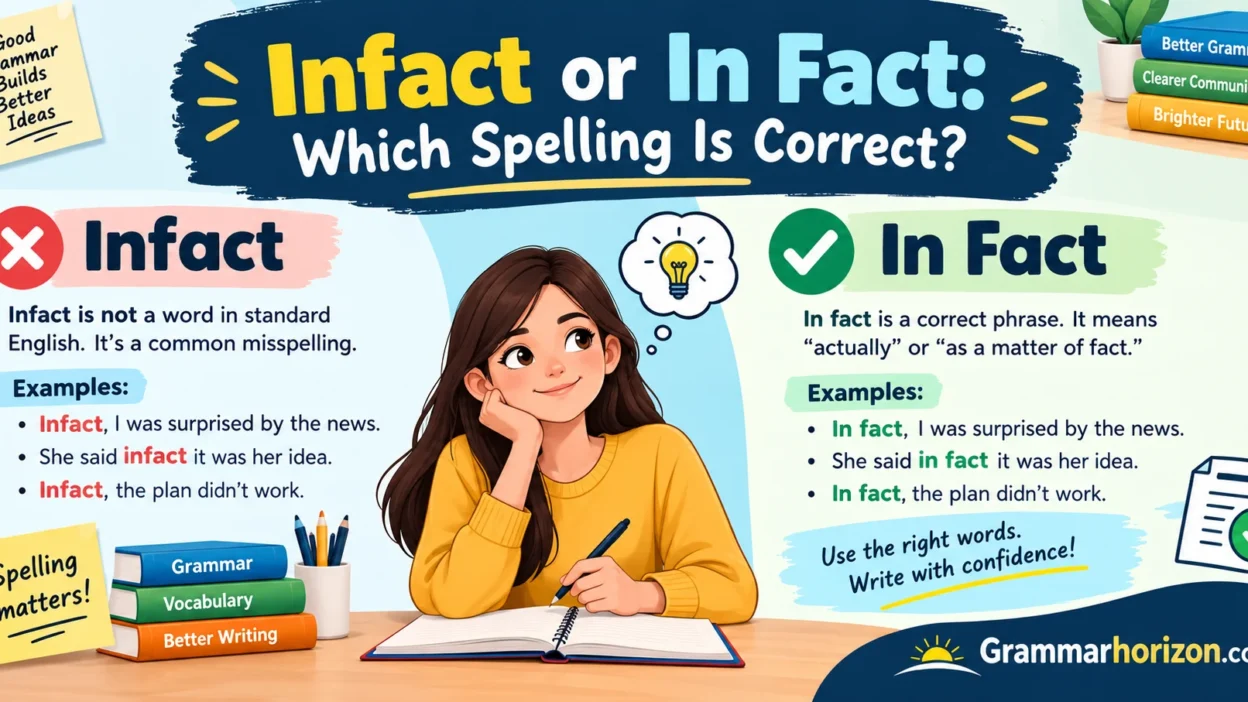
Infact or In Fact is a common spelling question that confuses many English learners because both forms look almost identical. However, in fact is the correct spelling in standard English, while infact is an incorrect, nonstandard form. The phrase in fact contains two separate words and helps introduce a fact, emphasize something true, or strengthen a previous statement. Understanding this small difference improves spelling accuracy, grammatical correctness, writing skills, and confidence. Whether you’re learning English, preparing professional reports, or handling everyday communication, choosing the correct form helps you write clearly and follow standard English grammar rules.
Many people make this spelling mistake when they type fast, hit send, and forget to check their messages later. Although infact may look harmless, incorrect spelling can affect the credibility of your writing and make brilliant ideas appear careless. This error can appear in emails, blog posts, social media posts, quick messages, and informal online writing. For example, “I thought the test was difficult. In fact, it was quite easy.” In this sentence, the phrase adds weight to the point and corrects an assumption. Remembering to keep the two words separate helps prevent spelling mistakes and builds better writing habits.
The easiest way to remember the correct spelling is to write in fact as two separate words in formal writing, everyday messages, and professional communication. This simple rule improves readability, sentence structure, and clarity while helping you avoid incorrect spelling patterns. The phrase can introduce factual information, provide clarification, support a previous point, or emphasize an important detail. Whenever you write an article, explain a fact, or communicate online, check the spacing before sending your message. With regular practice, you can improve your language learning, strengthen your communication skills, and use standard English more accurately.
Quick Answer: Infact or In Fact?
In fact is the correct form in standard English. Infact is a misspelling.
The phrase in fact consists of two words: the preposition in and the noun fact. English does not normally combine them into a single word infact.
| Form | Correct? | Meaning | Standard Usage |
| in fact | ✅ Yes | Actually, indeed, or as a matter of fact | Standard English |
| infact | ❌ No | Intended to mean “in fact” | Misspelling |
For example:
- In fact, I finished the project yesterday. ✅
- Infact, I finished the project yesterday. ❌
If you’re writing an email, essay, article, report, or professional message, always choose in fact.
What Does “In Fact” Mean?
In fact means actually, indeed, or as a matter of fact. Writers use it when they want to emphasize the truth of a statement.
The phrase can also introduce information that makes an earlier statement stronger or more precise.
Consider this example:
The movie wasn’t boring. In fact, it was surprisingly entertaining.
The first sentence gives one idea. The second sentence uses in fact to add stronger information.
You can think of in fact as a spotlight. It draws the reader’s attention to the information that follows.
Common Meanings of “In Fact”
Depending on the sentence, in fact can express several closely related ideas:
- Actually: “I thought he was busy. In fact, he was free.”
- Indeed: “She is talented. In fact, she’s one of the best performers here.”
- To emphasize truth: “In fact, the information is completely accurate.”
- To correct an assumption: “I assumed they were late. In fact, they arrived early.”
- To add stronger evidence: “The road was difficult. In fact, several vehicles turned back.”
The core idea remains the same: the writer wants to emphasize something as true or factual.
Why Is “In Fact” Written as Two Words?
The spelling becomes easier to understand when you look at the individual words.
It is a preposition. Fact is a noun. Together, they form the phrase in fact.
English contains many combinations that look as though they could become one word. However, appearance doesn’t determine spelling. A phrase remains separate unless standard English has established it as a compound word.
For example:
- in fact ✅
- in general ✅
- in particular ✅
- in reality ✅
- in detail ✅
These expressions contain separate words because they function as phrases rather than single closed compounds.
That’s why writing infact changes the standard spelling rather than creating an alternative form.
Infact or In Fact: Which One Should You Use?
When choosing between infact or in fact, use in fact.
There isn’t a standard meaning difference between the two spellings because infact isn’t the accepted standard form. Writers sometimes create infact by treating the phrase as though it were a single compound word.
That mistake is understandable. English has many closed compounds such as inside, indeed, and instead. Still, in fact it follows a different spelling pattern.
A Simple Rule to Remember
Remember this:
In fact = two words.
If you can mentally separate in and fact, you’ll usually avoid the error.
For example:
- In fact, she knows the answer.
- In fact, they had already left.
- In fact, this method saves time.
Never change the phrase to infact in standard writing.
In Fact: Example Sentences
Seeing the phrase in different positions makes its usage much clearer.
“In Fact” at the Beginning of a Sentence
At the beginning, in fact often introduces a statement that emphasizes or corrects information.
- In fact, I had already completed the assignment.
- In fact, the store closes earlier on Sundays.
- In fact, she was responsible for the entire project.
- In fact, the evidence supports his explanation.
A comma commonly follows in fact when it introduces a sentence.
“In Fact” in the Middle of a Sentence
You can also place in fact inside a sentence when it adds emphasis.
- The decision was, in fact, much more complicated.
- She was, in fact, the original designer.
- The problem is, in fact, easier to solve than it appears.
Here, commas can mark in fact as an interrupting phrase.
“In Fact” After a Previous Statement
The phrase works especially well when you want to strengthen an earlier idea.
- He wasn’t disappointed. In fact, he was delighted.
- The test wasn’t easy. In fact, it was extremely challenging.
- I expected a short meeting. In fact, it lasted three hours.
This structure creates a clear contrast between expectation and reality.
How to Use “In Fact” Correctly
Using in fact correctly involves more than spelling it properly. Its position and punctuation also matter.
Use “In Fact” to Emphasize a Point
When you want readers to pay attention to a factual statement, in fact can add emphasis.
Example:
In fact, regular practice can improve your writing skills.
The phrase signals that the following statement deserves attention.
Use “In Fact” to Correct an Assumption
This is one of its most useful functions.
I thought Maria was new to the company. In fact, she has worked there for ten years.
The second sentence corrects the original assumption.
Use “In Fact” to Strengthen an Argument
Writers often use facts when introducing supporting information.
The town has changed dramatically. In fact, its population has nearly doubled.
The second sentence gives a stronger factual detail that supports the first idea.
Use “In Fact” for Surprising Information
The phrase can also introduce something unexpected.
The old building looks abandoned. In fact, it still houses several businesses.
The contrast makes the information more interesting.
Common Mistakes With “In Fact”
Even though in fact it looks simple, several mistakes appear frequently.
Writing “Infact” as One Word
This is the most common spelling mistake.
Incorrect:
Infact, the results were better than expected.
Correct:
In fact, the results were better than expected.
The correction is simple: separate it from fact.
Confusing “In Fact” With “In Fact That”
Another mistake involves adding that unnecessarily.
For example:
Incorrect:
In fact that she was tired, so she continued working.
Correct:
In fact, she was tired, but she continued working.
The phrase in fact doesn’t require that after it.
However, the fact that is a different grammatical structure.
Example:
The fact that she was tired didn’t stop her from working.
Here, the fact that functions as a noun phrase. Don’t confuse it with in fact.
Misusing Commas With “In Fact”
Punctuation depends on how the phrase functions.
At the beginning of a sentence, a comma commonly follows it:
In fact, we arrived before everyone else.
When it interrupts a sentence, commas can surround it:
The answer is, in fact, quite simple.
When it appears naturally at the end, punctuation may not require additional commas:
She knew the truth in fact.
The last example is grammatically possible in some contexts, but it often sounds less natural than placing in fact earlier.
In Fact or. Actually
In fact and actually often have similar meanings. However, they don’t always create exactly the same tone.
Actually can correct information, express mild surprise, or gently challenge an assumption.
Actually, I don’t live there anymore.
In fact often gives stronger emphasis or introduces additional factual detail.
In fact, I moved there ten years ago.
Both expressions can work in many situations, but in fact often sounds more deliberate when you want to reinforce a statement.
Comparison
| Expression | Common Function | Example |
| In fact | Emphasizes or reinforces information | In fact, the results were excellent. |
| Actually | Corrects or qualifies information | Actually, I meant Tuesday. |
Neither expression is automatically better. The right choice depends on the context and the emphasis you want.
In Fact or. Indeed
Indeed can also mean something similar to in fact, especially when confirming or emphasizing a statement.
For example:
She is indeed an experienced writer.
You could also say:
She is, in fact, an experienced writer.
The two expressions overlap, but indeed can sound more formal or emphatic in some contexts.
In fact, it is especially useful when you want to introduce a clarification, correction, or additional detail.
In Fact or. As a Matter of Fact
As a matter of fact carries a meaning very close to in fact.
Compare these sentences:
In fact, I know the answer.
As a matter of fact, I know the answer.
Both emphasize the truth of the statement. However, in fact it is shorter and often fits more smoothly into everyday writing.
The longer phrase can sound more conversational in certain contexts, especially when someone responds directly to another person’s assumption.
Is “Infact” Ever Correct?
In standard English, infact is not the accepted spelling of the phrase in fact.
You may encounter it online, in informal messages, or in user-generated content. Its appearance doesn’t make it a recognized standard spelling.
This distinction matters because informal digital writing contains countless spelling shortcuts and accidental combinations. A word appearing frequently on the internet isn’t necessarily grammatically correct.
For professional or academic writing, use:
in fact ✅
Avoid:
infact ❌
That small space matters.
How to Remember the Correct Spelling
The easiest way to remember in fact is to treat it as two meaningful parts.
In + fact = in fact
You can also connect the phrase to another familiar expression:
In fact, this is true.
The word in still has its normal identity. The word fact still has its normal identity. There’s no need to fuse them together.
A quick memory trick is:
If you mean “actually,” write “in fact” as two words.
For example:
- Actually, she was right.
- In fact, she was right.
Both sentences communicate the same basic idea. The spelling remains in fact.
Infact or In Fact: Quick Comparison
| Feature | In Fact | Infact |
| Spelling | Two words | One word |
| Standard English | ✅ Yes | ❌ No |
| Meaning | Actually, indeed | Intended as “in fact” |
| Grammar | Adverbial phrase | Nonstandard spelling |
| Formal writing | Appropriate | Avoid |
| Academic writing | Appropriate | Avoid |
| Professional writing | Appropriate | Avoid |
The key takeaway is straightforward: in fact is the standard form.
Conclusion
In conclusion, in fact is the correct spelling in standard English, while in fact is incorrect. Although the difference may seem small, keeping the two words separate improves spelling accuracy, readability, and clear communication. Whether you’re writing emails, articles, social media posts, or professional reports, remember to use fact whenever you want to emphasize a point, introduce a fact, or clarify an idea. This simple rule will help you avoid a common spelling mistake and make your writing more accurate.
FAQs
1. Is it infact or in fact?
In fact it is correct because standard English writes the phrase as two separate words. Infact is an incorrect spelling.
2. What does in fact mean?
In fact means actually or in reality. Writers use it to emphasize a statement, provide clarification, or introduce information that supports a point.
3. Why is infact incorrect?
Infact is incorrect because the standard English phrase consists of two words: in and fact. They shouldn’t be joined together.
4. Should I use in fact in formal writing?
Yes. In fact, it is appropriate for formal writing, academic assignments, professional reports, emails, and everyday communication when used correctly.
5. How can I remember the correct spelling of in fact?
Remember that in fact always contains two words. When proofreading your writing, check the spacing to avoid accidentally combining them into infact.