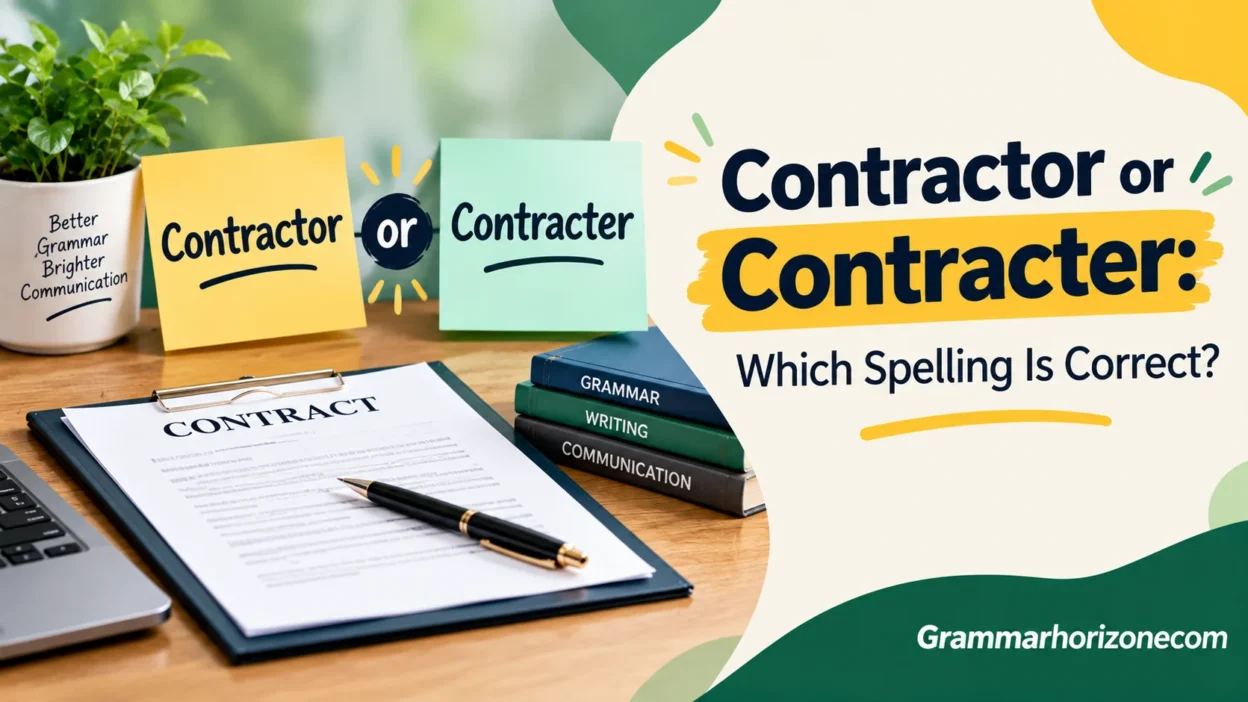
Contractor or Contracter is a common spelling question in American English, especially when writing about construction, business, or professional services. The correct spelling is contractor, while contracter is a spelling mistake. This spelling confusion happens because both forms look similar and relate to the word contract. However, using the correct spelling, standard spelling, and correct word choice improves writing accuracy and professional writing. Whether you are preparing a professional email, writing a proposal, or editing professional documents, correct spelling helps you create a clear message. Understanding English spelling, spelling rules, word formation, and spelling patterns also strengthens your English vocabulary, word recognition, and language learning.
The word contractor is widely used in construction, the construction industry, home renovation, home improvement, and government projects. It can describe a person or company working in business, freelancing, or freelance work, including those completing government contracts. In email writing and proposal writing, using the correct form makes your message look polished and trustworthy. For example, “We hired a contractor to repair the roof” is correct, while “We hired a contracter” is not. Although these may appear to be identical words, their spelling difference matters. Paying attention to word usage, contextual meaning, and semantic relationship helps you choose the right term and maintain spelling accuracy.
Effective business communication also relies on clear communication, strong writing skills, and reader clarity. Whether you are managing a construction project, hiring a freelancer, or reviewing a business agreement, use contractor spelling rather than contracter spelling. These are not two different job titles; one is the accepted spelling, and the other is incorrect. In everyday writing, checking words before sending important documents can improve your writing style and prevent avoidable errors. Learning correct terminology and practicing common English usage will help you write with confidence and make your message easier for readers to understand.
Quick Answer: Contractor or Contracter?
Contractor is the correct spelling in standard American English. Contracter is a misspelling when you mean a person or business that agrees to perform work or provide services under a contract.
For example:
- Correct: We hired a contractor to repair the roof.
- Incorrect: We hired a contracter to repair the roof.
The key difference is the ending. The correct word uses -or, not -er. Whenever you refer to someone who undertakes work under a contract, write contractor.
Contractor vs. Contracter: Key Differences
Although contractor and contracter look similar, they don’t have the same status in standard English. Contractor is an established word with a clear meaning, while contracter is generally an incorrect spelling of that word.
The difference isn’t a matter of American versus British English. Standard English uses contractor in both varieties.
| Feature | Contractor | Contracter |
| Spelling | Correct | Incorrect for the intended meaning |
| Standard English usage | Accepted | Nonstandard |
| Meaning | A person or business that performs work under a contract | Usually intended to mean contractor |
| Professional writing | Appropriate | Should be corrected |
| Example | The contractor completed the project. | The contracter completed the project. |
Remember: If you’re talking about someone hired to complete a project or provide services under an agreement, use contractor.
What Does Contractor Mean?
A contractor is a person or business that agrees to perform specific work, provide services, or supply goods under a contract. The agreement may describe the work, payment, deadlines, materials, and responsibilities of each party.
Many people associate contractors with construction, but the term covers much more than building and repair work. A software developer hired for a specific project can be a contractor. So can a company that provides maintenance services to a government agency.
The word describes a business or working arrangement rather than one particular occupation.
Common Types of Contractors
Contractors work across many industries. Their duties depend on their skills, agreements, and the services they provide.
- General contractor: Manages a construction or renovation project and coordinates the different trades involved.
- Independent contractor: Provides services independently rather than working as an employee, subject to the applicable legal classification rules.
- Construction contractor: Handles building, renovation, repair, or other construction work.
- Electrical contractor: Provides electrical installation, maintenance, or repair services.
- Government contractor: Supplies goods or performs services under an agreement with a government agency.
- IT contractor: Provides technology services, such as software development, network support, or cybersecurity work.
- Roofing contractor: Installs, repairs, or replaces roofs and related materials.
These roles can overlap. For example, a general contractor might hire an electrical contractor and a roofing contractor to handle separate parts of a house renovation.
Contractor Examples in Everyday English
Seeing the word in context makes its meaning easier to understand.
- The contractor gave us an estimate for the kitchen renovation.
- Our company hired an IT contractor to update its software.
- The building contractor ordered additional materials.
- The homeowner asked the contractor to explain the extra costs.
- The government selected a contractor to maintain its facilities.
- She works as an independent contractor for several businesses.
In each sentence, contractor refers to a person or business responsible for agreed work or services.
Why Is Contractor the Correct Spelling?
The correct spelling becomes easier to remember when you understand the word’s origin.
Contractor comes from the Latin word contractor, which referred to someone who makes a contract. The word is related to the Latin verb contrahere, meaning to draw together or enter into an agreement.
In modern English, a contractor is someone who undertakes work or provides services under a contract.
Understanding the Word Contract
The word contract is closely related to contractor, but the two words have different meanings.
A contract is an agreement between two or more parties. It often sets out the work to be completed, the payment terms, deadlines, and other responsibilities.
Consider these examples:
- A homeowner signs a contract for a bathroom renovation.
- A business signs a contract with a freelance designer.
- A government department awards a contract to a supplier.
The person or company undertaking the agreed work may be called a contractor.
Understanding the Suffix -or
The ending -or appears in many English words that identify people associated with an action or role.
| Base word | Related noun | Example |
| Act | Actor | The actor performed in a play. |
| Create | Creator | The creator designed the website. |
| Conduct | Conductor | The conductor led the orchestra. |
| Inspect | Inspector | The inspector examined the building. |
| Contract | Contractor | The contractor repaired the roof. |
These examples help you recognize a familiar pattern. However, English spelling doesn’t follow one universal rule for naming people who perform actions. Some words end in -er, while others use -or.
Easy memory tip: Connect contractor with contract. Remember that the person or business undertaking the work is the contractor.
What Does Contracter Mean?
In everyday writing, contracter is generally a misspelling of contractor. It isn’t the standard English spelling for someone who performs work under a contract.
The mistake is understandable because English uses the ending -er in many occupation names. Words such as teacher, worker, and builder may lead writers to assume that contracter follows the same pattern.
However, familiar spelling patterns don’t always tell you which form is correct. Some words have established spellings that you simply need to learn.
Why Do People Write Contracter Instead of Contractor?
Several common habits can cause this mistake.
Confusion about word endings: People often expect -er because it appears in many words describing jobs and occupations.
Typing too quickly: Someone writing an email or report may accidentally use the wrong ending without noticing.
Unfamiliarity with the word: English learners may recognize contract but may not know the correct spelling of contractor.
Overreliance on sound: When people write words from memory, they sometimes choose the spelling that looks familiar rather than the established form.
How to Correct Contracter in Professional Writing
If you find contracter in a document, replace it with contractor when you mean a person or business that undertakes work under an agreement.
Here are some examples:
– Incorrect: Please contact the contracter before Friday. Correct: Please contact the contractor before Friday.
– Incorrect: The contracter submitted an estimate. Correct: The contractor submitted an estimate.
– Incorrect: We need a reliable contracter for the renovation. Correct: We need a reliable contractor for the renovation.
This small correction makes your writing more professional. It’s especially useful in business proposals, invoices, service agreements, and project updates.
Contractor in a Sentence: Correct Examples
The best way to learn a word is to see how people use it in different situations. Contractor works naturally in construction, business, and everyday conversation.
Contractor Examples in Construction
Construction is one of the most common contexts for the word.
- The contractor estimated that the garage would take six weeks to complete.
- We hired a contractor to replace the damaged roof.
- The contractor reviewed the building plans before ordering supplies.
- Our general contractor coordinated the plumbers and electricians.
- The homeowner asked the contractor to explain the revised budget.
These examples show how contractors handle different parts of a construction project.
Contractor Examples in Business
Businesses also hire contractors for specialized services and temporary projects.
- The company hired a contractor to redesign its website.
- Our contractor will deliver the final report next month.
- The project manager discussed the deadline with the contractor.
- The contractor submitted an invoice for the completed work.
- The business selected a contractor with cybersecurity experience.
In these sentences, the word refers to a person or company providing professional services.
Contractor Examples in Everyday Conversation
You don’t need to work in construction or business to use the word correctly.
- Do you know a reliable contractor who can repair my fence?
- The contractor said the kitchen would be ready by Monday.
- We contacted three contractors before choosing one.
- My neighbor recommended a local contractor.
- The contractor returned to fix the problem.
These examples reflect the way people commonly use the word when discussing repairs, home improvement, and hired services.
Singular and Plural Forms of Contractor
The singular form is contractor, and the plural form is contractors. Simply add -s to refer to more than one.
| Form | Example |
| Singular | The contractor arrived early. |
| Plural | The contractors arrived early. |
| Indefinite article | We hired a contractor. |
| Definite article | The contractor signed the agreement. |
| Singular possessive | The contractor’s estimate was reasonable. |
| Plural possessive | The contractors’ proposals included different prices. |
Pay attention to the apostrophe in possessive forms. Contractor’s indicates ownership by one contractor, while contractors’ indicates ownership by multiple contractors.
Common Mistakes When Using Contractor
Correct spelling matters, but choosing the right word also helps readers understand your meaning. Several related words can cause confusion.
Spelling Contractor as Contracter
This is the main mistake discussed in this article.
- Incorrect: The contracter called this morning.
- Correct: The contractor called this morning.
When proofreading, pay special attention to the final letters. The correct spelling ends in -or.
Confusing Contractor With Contract
A contract is an agreement. A contractor is a person or business that undertakes work under an agreement.
Compare these sentences:
- The company signed a contract with the supplier.
- The contractor agreed to deliver the materials.
- We reviewed the contractor’s contract before approving the project.
The final example uses both words because each has a different role in the sentence.
Confusing Contractor With Contracting
The word contracting often refers to the process or business of performing work under contracts.
For example:
- Contractor: The contractor completed the renovation.
- Contracting: She runs a contracting business.
- Contract: They signed a contract for the repairs.
Choosing the correct form makes your sentence clearer and more precise.
Using Contractor When a More Specific Word Fits Better
Sometimes contractor is correct but too broad for the situation. A more specific term can help readers understand exactly what someone does.
For example, an electrician describes a particular trade, while contractor describes a broader role or business arrangement. An electrician may work as an employee, operate an independent business, or accept jobs as a contractor.
Choose the word that best describes the person’s actual role.
Contractor vs. Employee: Understanding the Difference
A contractor and an employee may perform similar tasks, but their working relationships can differ.
An employee generally works within an employer’s employment structure. An independent contractor typically provides services through a separate business arrangement. However, a job title or written agreement alone doesn’t determine someone’s legal classification.
The distinction matters because worker classification can affect taxes, benefits, workplace protections, and other legal responsibilities.
| Feature | Employee | Independent contractor |
| Working relationship | Works in an employment relationship | Provides services under an independent business arrangement |
| Work arrangements | Generally follows the employer’s applicable direction and policies | Often has greater independence over how services are delivered |
| Payment | Commonly receives wages or a salary | Commonly invoices for services or receives contract-based payments |
| Taxes | Employers generally withhold applicable employment taxes | May have self-employment tax obligations |
| Benefits | May qualify for employer-provided benefits | Doesn’t automatically receive employee benefits |
| Legal classification | Depends on the actual relationship and applicable law | Depends on the actual relationship and applicable law |
These are general differences rather than universal rules. The legal tests for classifying workers vary by jurisdiction and legal purpose.
A Practical Example of a Contractor
Imagine a business needs a new website. It could hire a full-time employee to manage website development or engage an independent developer to complete a defined project.
The developer might agree to deliver the website by a specific date for an agreed fee. Depending on the actual working arrangement and applicable law, that person may qualify as an independent contractor.
The important point is that contractor describes a working arrangement, not simply a job title. Calling someone a contractor doesn’t automatically determine their legal status.
Easy Ways to Remember Contractor or Contracter
If you frequently mix up these spellings, a few simple habits can help you remember the correct form.
Connect Contractor With Contract
Start with the familiar word contract. Then remember that the person or business undertaking the work is the contractor.
- Contract: The agreement between the parties.
- Contractor: The person or business performing the agreed work.
This connection reinforces both the spelling and the meaning.
Remember the -or Ending
The simplest reminder is that contractor ends in -or.
You don’t need a complicated grammar rule. Learn the complete word and use it consistently whenever you write about someone who performs contracted work.
Practice With a Simple Sentence
Use a short sentence to reinforce the correct spelling:
The contractor signed the contract.
Both words appear together, making the relationship between them easy to remember.
You can also practice with sentences related to your daily work:
- The contractor sent an estimate.
- We hired two contractors.
- The contractor completed the repairs.
Proofread Important Documents
Before sending an email, proposal, or invoice, check whether you’ve written contracter by mistake. A spell-check tool can help, but a quick manual review is still useful.
If you frequently use the word in professional writing, adding the correct spelling to your vocabulary notes can help you remember it.
A Practical Example: Correcting Contractor in a Business Document
Imagine a homeowner writing to a renovation company:
We need a contractor to finish the kitchen before the end of November. Please send your estimate and expected timeline.
The message is understandable, but construction is spelled incorrectly.
A corrected version reads:
We need a contractor to finish the kitchen before the end of November. Please send your estimate and expected timeline.
Only one word changed, yet the revised message looks more polished.
The same principle applies to construction bids, invoices, proposals, and service agreements. Correct spelling supports clear communication, especially when a document represents a business or sets expectations for a project.
Conclusion
The correct spelling is contractor, or contracter. This word is commonly used in construction, business, freelancing, and government projects. Using the correct spelling in professional emails, proposals, and other documents helps you communicate clearly and maintain a professional writing style. Remembering the difference between contractor and contracter can help you avoid common spelling mistakes and improve your overall writing accuracy.
Frequently Asked Questions
Q1. Is contractor or contracter correct?
Contractor is the correct spelling in standard English. Contracter is a misspelling and should be avoided in formal and informal writing.
Q2. What does contractor mean?
A contractor is a person or company hired to complete specific work or provide services. Contractors often work in construction, home improvement, information technology, and other industries.
Q3. What is the plural of contractor?
The plural of contractor is contractors. For example, “Three contractors submitted proposals for the building project.”
Q4. Why do people misspell contractor as contracter?
People may write contracter because it looks similar to contractor and seems related to the word contract. However, the standard spelling uses -or, making contractor the correct form.
Q5. How can I remember the correct spelling of contractor?
Remember that contractor ends in -or, just like other words such as operator and administrator. Checking the spelling before sending professional emails or preparing documents can also help you avoid this mistake.