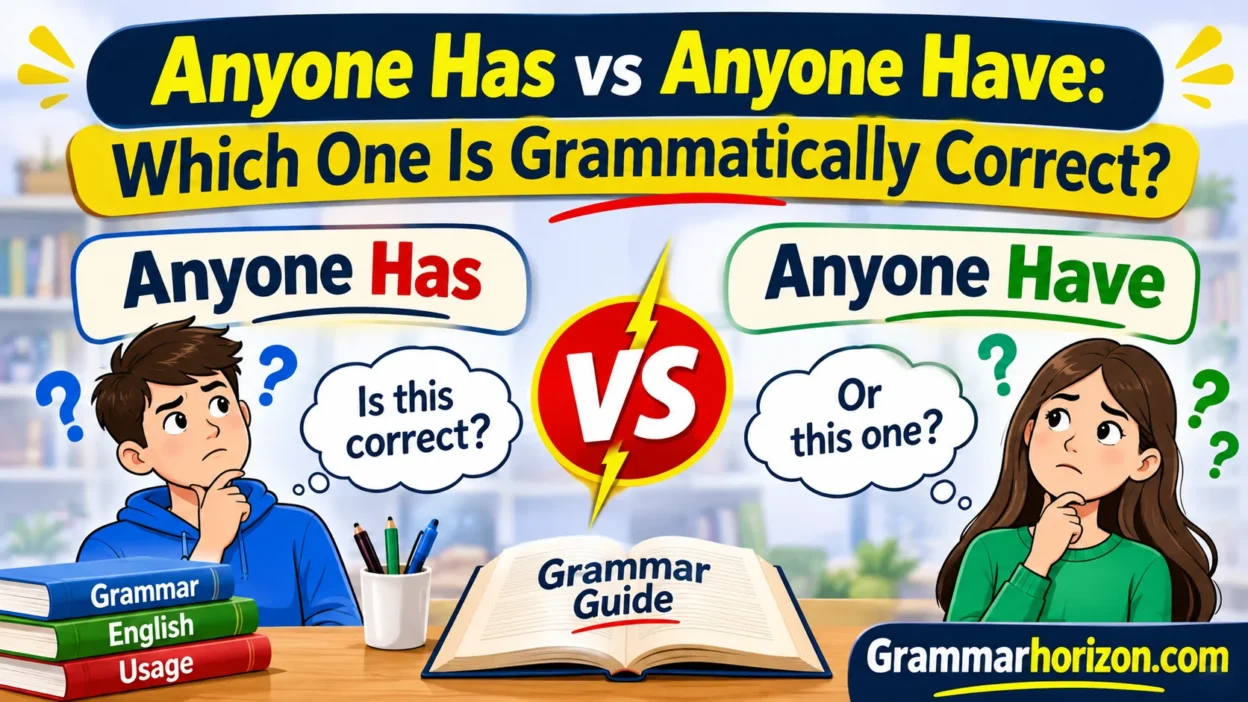
Anyone Has vs Anyone Have is a common source of grammatical confusion in everyday English, especially when choosing the correct verb forms for questions and statements. The word anyone is a singular indefinite pronoun, so it normally takes has in a simple present tense statement. This follows the basic grammar rules of subject-verb agreement, just like other singular pronouns and indefinite pronouns. For example, “Anyone has a chance” uses the correct third-person singular form. Understanding this sentence structure helps you recognize proper sentence patterns, improve natural English, and avoid common grammar mistakes.
However, the correct choice changes when an auxiliary verb, helping verb, or modal verb appears in a sentence. For example, “Does anyone have a chance?” uses does with anyone, followed by have in its base form of verb. The main verb stays in its base form because the auxiliary already carries the required verb agreement. This auxiliary construction also applies to question formation and negative construction. Similarly, modal constructions used have after words such as can and might. These grammatical situations show how verb placement and the verb before anyone affect correct verb usage in questions, statements, and negative sentences.
When improving English writing, I find that comparing simple examples makes these rules easier to understand than reading long explanations. Try reading aloud and notice how auxiliary verbs change the sentence. Use has in a simple statement, such as “Anyone has enough time,” but use have after does or a modal, as in “Does anyone have time?” or “Anyone can have time.” Regular practice and attention to everyday usage help strengthen grammar patterns, writing accuracy, and proper grammar. These small steps also support natural sentence formation and make correct English usage easier and more confident
Anyone Has vs Anyone Have: Quick Answer
Anyone has is generally correct in affirmative present-tense sentences because anyone is a singular indefinite pronoun. The singular subject takes has rather than have when the sentence uses the simple present tense without an auxiliary verb.
Anyone have is also grammatically correct in certain sentence structures, particularly when it follows an auxiliary verb or modal verb. For example, we say “Does anyone have a pen?” rather than “Does anyone has a pen?”
Here are some quick examples:
| Sentence | Correct or Incorrect | Reason |
| Anyone has a question. | Correct | Anyone is singular. |
| Anyone have a question. | Incorrect as a standard affirmative statement | The singular subject requires has. |
| Does anyone have a question? | Correct | Have follows does. |
| Does anyone has a question? | Incorrect | Does already carries the present-tense marking. |
| Anyone can have a question. | Correct | Have follows the modal verb can. |
| Anyone has to follow the rules. | Correct | Has is the main verb in the sentence. |
Easy rule to remember: Use has when anyone is the subject of an ordinary affirmative present-tense sentence. Use have after auxiliary verbs such as does and modal verbs such as can, will, and should.
Is Anyone Has or Anyone Have Correct?
Both expressions can be grammatically correct, but they serve different purposes. You need to examine the sentence rather than choose one form every time you see the word anyone.
In standard English, anyone has is correct when the pronoun directly takes a present-tense verb. However, anyone have is correct when another verb, such as does or can, comes before the main verb.
Consider these examples:
- Anyone has the opportunity to apply.
- Does anyone have an extra notebook?
- Anyone has access to the information.
- Can anyone have more than one account?
The important point is that anyone remains singular in all these examples. The verb form changes because the sentence structure changes, not because the pronoun becomes plural.
When to Use Anyone Has
Use anyone has when anyone is the subject and has acted as the main verb in a simple present-tense statement.
The word anyone refers to an unspecified person. Even though it can include many possible people, English grammar treats it as singular. Therefore, it follows the same basic verb pattern as he, she, and it.
For example:
- Anyone has the right to express an opinion.
- Anyone has the opportunity to join the program.
- Anyone has a chance to win the competition.
- If anyone has a problem, they should contact the manager.
- Anyone who has a valid ticket can enter the building.
Notice that the last two examples contain additional sentence structures. The verb has still agrees with anyone, even when other words appear between the subject and the rest of the sentence.
Another common pattern is anyone who has. It introduces information about an unspecified person.
Examples:
- Anyone who has experience can apply for this position.
- Anyone who has completed the course will receive a certificate.
- Anyone who has questions can speak to the teacher.
- Anyone who has permission may enter the room.
Remember: The phrase anyone who has is grammatically correct because the relative pronoun who refers to the singular antecedent anyone.
When to Use Anyone Have
Use anyone have when an auxiliary or modal verb requires the main verb to remain in its base form. In these sentences, have does not directly follow anyone as an ordinary simple present-tense verb.
For example:
- Does anyone have a spare phone?
- Can anyone have access to this account?
- Will anyone have time tomorrow?
- Should anyone have questions, please contact us.
- Did anyone have an opportunity to speak?
The helping verb carries the tense or grammatical function, so the main verb stays in its base form.
There is also an informal conversational use:
- Anyone have a pen?
- Anyone have any questions?
- Anyone have an idea?
These are common shortened questions in everyday speech. The full versions are:
- Does anyone have a pen?
- Does anyone have any questions?
- Does anyone have an idea?
In formal writing, academic work, and professional communication, the complete question is usually the better choice.
Why Is Anyone Considered Singular?
To understand anyone has vs anyone have, you first need to understand indefinite pronouns.
An indefinite pronoun is a word that refers to a person, place, or thing without identifying a particular one. It allows you to talk about someone or something without giving an exact name.
For example, when you say “Anyone can participate,” you don’t identify a specific person. You mean that any person who meets the relevant conditions can participate.
Although anyone can refer to one person from a large group, its grammatical form is singular. This is why it takes singular verbs in standard subject-verb agreement.
Here are some common singular indefinite pronouns:
| Indefinite pronoun | Correct example |
| Anyone | Anyone has a choice. |
| Anybody | Anybody is welcome. |
| Someone | Someone has my book. |
| Somebody | Somebody needs help. |
| Everyone | Everyone has an opportunity. |
| Everybody | Everybody enjoys the event. |
| Nobody | Nobody knows the answer. |
| No one | No one has permission. |
These pronouns follow the same general agreement pattern. For example, you wouldn’t normally write “Everyone have a choice” or “Nobody knows the answer” in standard English.
How Singular Subject-Verb Agreement Works
Subject-verb agreement means that the subject and verb must match in number. A singular subject generally takes a singular verb, while a plural subject takes a plural verb.
With the verb have, the difference is easy to see:
| Subject | Correct verb | Example |
| I | Have | I have a question. |
| You | Have | You have a choice. |
| He | Has | He has a car. |
| She | Has | She has a new job. |
| It | Has | It has a problem. |
| We | Have | We have enough time. |
| They | Have | They have a meeting. |
| Anyone | Has | Anyone has the right to ask. |
The third-person singular subjects he, she, it, and anyone use has in simple present-tense statements.
This pattern also applies to other verbs:
- Anyone knows the answer.
- Someone needs assistance.
- Everyone wants a better result.
- Nobody likes unnecessary delays.
The verb form changes according to the grammatical subject, not the number of people who might fit the description.
Why Anyone Does Not Take Have in Ordinary Statements
The confusion usually happens because people think about the number of individuals rather than the grammatical form of the pronoun.
For example, anyone can refer to hundreds of possible people. However, the word itself remains singular.
Compare these sentences:
- Anyone has a chance to participate.
- They have a chance to participate.
The first sentence uses anyone as a singular indefinite pronoun. The second uses they as a plural subject. Therefore, their verb forms are different.
This is an important rule to remember when writing sentences with anyone, everyone, somebody, and nobody.
Anyone Has vs Anyone Have in Different Sentence Structures
The best way to understand the difference is to examine how both forms work in statements, questions, negative sentences, and constructions with modal verbs.
Anyone Has vs Anyone Have in Affirmative Sentences
An affirmative sentence makes a positive statement. When anyone acts as the subject and the verb have expresses possession or another present-tense meaning, use has.
For example:
- Anyone has the right to share an opinion.
- Anyone has the ability to learn a new skill.
- Anyone who has experience can apply.
- If anyone has additional information, please share it.
- Anyone who has a membership card can enter.
In each example, anyone is grammatically singular. The word has agrees with the subject.
You can also use has in sentences that describe responsibilities, opportunities, or requirements.
For example:
- Anyone has to follow the safety instructions.
- Anyone who has a driving license can apply for the position.
- Anyone who has enough experience may qualify.
Remember: The phrase has to express necessity or obligation, and has is the main verb in this construction.
Anyone Has vs Anyone Have in Questions
Questions are one of the most common places where people confuse these two expressions.
In a standard simple present-tense question, English normally uses the auxiliary verb does before the subject. The main verb then returns to its base form, which is have.
For example:
- Does anyone have a question?
- Does anyone have a spare charger?
- Does anyone have experience in marketing?
- Does anyone have the meeting schedule?
- Does anyone have an extra ticket?
The word does carries the third-person singular marking. Therefore, you don’t need to add another singular ending to the main verb.
Compare:
| Incorrect sentence | Correct sentence |
| Does anyone has a pen? | Does anyone have a pen? |
| Does anyone has an idea? | Does anyone have an idea? |
| Does anyone has a problem? | Does anyone have a problem? |
| Does anyone has my number? | Does anyone have my number? |
A useful way to remember this rule is to compare it with a sentence using she:
- She has a question.
- Does she have a question?
The same rule applies to anyone:
- Anyone has a question.
- Does anyone have a question?
Anyone Has vs Anyone Have in Negative Sentences
Negative sentences express that something does not happen or that someone does not possess something.
When you use anyone with the auxiliary verb does not or its contraction doesn’t, the main verb must be have, not has.
Examples:
- Anyone who does not have access to this file should contact the manager.
- Not everyone has access to this file.
- Doesn’t anyone have a suggestion?
- Does anyone not have the required documents?
- Anyone who does not have permission cannot enter.
Here are more natural negative constructions:
| Sentence | Explanation |
| Anyone who doesn’t have a ticket cannot enter. | Doesn’t takes have. |
| Does anyone not have a copy? | Have follows does. |
| Nobody has the answer. | Nobody is singular. |
| Not everyone has the same opinion. | Everyone takes has. |
| Anyone without a password cannot log in. | Without avoids the auxiliary construction. |
Important: Don’t write “Does anyone else have a pen?” The auxiliary does is already present. The correct version is “Does anyone not have a pen?”
Anyone Have After Modal Verbs
Modal verbs are helping verbs that express ability, possibility, permission, advice, or willingness.
Common modal verbs include:
- Can
- Could
- May
- Might
- Will
- Would
- Shall
- Should
- Must
When a modal verb comes before the main verb, use the base form have.
Examples:
- Can anyone have two accounts?
- Could anyone have made this mistake?
- Will anyone have enough time to finish the project?
- Should anyone have a question, contact the office.
- Might anyone have seen my missing notebook?
- Would anyone have a better suggestion?
Notice that the word anyone remains singular. The verb have appears because modal verbs take the base form of the following verb.
Compare these examples:
| Incorrect | Correct |
| Can anyone has a car? | Can anyone have a car? |
| Will anyone has time? | Will anyone have time? |
| Should anyone has questions? | Should anyone have questions? |
| Could anyone has an answer? | Could anyone have an answer? |
| Must anyone has permission? | Must anyone have permission? |
The rule is simple: A modal verb is followed by the base form of the main verb.
Anyone Has vs Anyone Have in Sentences With To
The word to can introduce an infinitive verb. An infinitive uses the base form of a verb, so the correct expression is to have, not to has.
For example:
- Anyone wants to have a better understanding of the subject.
- Anyone needs to have the required documents.
- Anyone should be able to have access to the information.
- Anyone would like to have another opportunity.
- Anyone is allowed to have a personal opinion.
In these sentences, anyone may take a different verb before the infinitive phrase. The word have stays in its base form after to.
There is an important distinction between these two patterns:
- Anyone has to complete the form.
- Anyone wants to have a copy of the form.
In the first sentence, has to express an obligation. In the second, to have is an infinitive phrase following wants.
Do not confuse these structures when choosing the correct verb form.
Anyone Has vs Anyone Have: Examples in Sentences
Examples make grammar rules easier to understand because they show how a word works in real situations. The following sentences demonstrate the correct use of anyone has and anyone have in everyday English.
Examples Using Anyone Has
Use anyone has when the pronoun is the subject of a simple present-tense clause.
- Anyone has the right to ask questions during the meeting.
- If anyone has a problem, they should inform the supervisor.
- Anyone who has a valid passport can apply for the trip.
- Anyone has the opportunity to improve their English skills.
- If anyone has my notebook, please return it.
- Anyone who has completed the assignment can leave early.
- Anyone has the ability to learn something new.
- If anyone has a better suggestion, I would like to hear it.
- Anyone who has a membership card can use the facilities.
- Anyone who has enough experience can apply for the job.
Examples Using Anyone Have
Use anyone have after an auxiliary or modal verb, or in an informal shortened question.
- Does anyone have an extra pencil?
- Does anyone have the answer to this question?
- Can anyone have more than one email account?
- Did anyone have trouble finding the office?
- Will anyone have time to attend the meeting?
- Could anyone have left the door open?
- Should anyone have concerns, please contact the manager.
- Would anyone have a different opinion?
- Does anyone have experience with this software?
- Can anyone have access to the shared document?
Examples of Anyone Has vs Anyone Have in Daily Conversations
Here are some practical situations that show how these expressions appear in everyday communication.
| Situation | Correct sentence |
| Asking about a pen | Does anyone have a spare pen? |
| Talking about an opportunity | Anyone has a chance to succeed. |
| Asking about experience | Does anyone have work experience? |
| Giving instructions | If anyone has questions, ask the teacher. |
| Discussing permission | Can anyone have access to this room? |
| Talking about a requirement | Anyone has to follow the rules. |
| Asking about a meeting | Did anyone have time to attend? |
| Requesting suggestions | If anyone has an idea, please share it. |
Practical tip: When you write a question with does, check the verb that follows it. It should be the base form have, not has.
Common Mistakes to Avoid With Anyone Has vs Anyone Have
Even people who understand basic English grammar sometimes make mistakes with these expressions. Most errors happen because they overlook the role of auxiliary verbs or forget that anyone is singular.
Here are the common mistakes and their corrections.
Using Have Instead of Has in Affirmative Statements
One common mistake is using have directly after anyone in an ordinary affirmative present-tense sentence.
- Incorrect: Anyone have the right to participate.
- Correct: Anyone has the right to participate.
The subject anyone is singular, so it requires has when the verb directly follows it in this sentence structure.
Writing Does Anyone Has Instead of Does Anyone Have
Another frequent mistake is adding an unnecessary s to the main verb after does.
- Incorrect: Does anyone has a question?
- Correct: Does anyone have a question?
The auxiliary does already mark the third-person singular present tense. The main verb must remain in its base form.
Forgetting the Singular Nature of Anyone
Some writers assume that anyone is plural because it can refer to many possible individuals.
However, its grammatical number is singular.
- Incorrect: Anyone have their own responsibilities.
- Correct: Anyone has their own responsibilities.
In modern English, singular they is commonly used to refer back to an unspecified person. This doesn’t change the singular agreement of anyone with its verb.
Confusing Has With Have After Modal Verbs
Modal verbs always take the base form of the main verb.
For example:
- Incorrect: Anyone can has a different opinion.
- Correct: Anyone can have a different opinion.
The same pattern applies to will, could, would, should, and other modal verbs.
Using Anyone Have in Formal Questions Without an Auxiliary
In casual conversations, people sometimes say “Anyone have a question?” This is a shortened form of “Does anyone have a question?”
The shortened version is common in informal speech, but the complete question is more suitable for formal writing.
- Informal: Anyone have a suggestion?
- Formal: Does anyone have a suggestion?
Anyone Has vs Anyone Have: Comparison Table
The following table summarizes the most important differences between these expressions.
| Grammar situation | Correct form | Example |
| Simple affirmative statement | Anyone has | Anyone has a chance. |
| Present-tense question | Does anyone have | Does anyone have a question? |
| Past-tense question | Did anyone have | Did anyone have a ticket? |
| Modal verb | Anyone can have | Anyone can have an opinion. |
| Negative question | Doesn’t anyone have | Doesn’t anyone have a solution? |
| Conditional sentence | If anyone has | If anyone has information, tell me. |
| Relative clause | Anyone who has | Anyone who has a pass can enter. |
| Infinitive construction | To have | Anyone wants to have a choice. |
| Informal shortened question | Anyone have | Anyone have a charger? |
The table shows that both forms are useful, but they belong to different grammatical structures. You should never select has or have simply by looking at the word anyone. Check the complete sentence first.
Anyone vs Anybody: Does the Verb Change?
Anyone and anybody have almost the same meaning. Both refer to an unspecified person or any person within a particular group.
The main difference is their tone. Anyone is often preferred in formal writing, while anybody can sound slightly more conversational. However, both are acceptable in everyday English.
The important point is that both pronouns generally take singular verbs.
Consider these examples:
- Anyone has permission to enter.
- Anybody has permission to enter.
- Does anyone have a question?
- Does anybody have a question?
- If anyone has a suggestion, please share it.
- If anybody has a suggestion, please share it.
Changing anyone to anybody does not change the verb agreement.
| Pronoun | Correct verb form | Example |
| Anyone | Has | Anyone has a choice. |
| Anybody | Has | Anybody has a choice. |
| Someone | Has | Someone has my phone. |
| Somebody | Has | Somebody has the answer. |
| Everyone | Has | Everyone has a responsibility. |
| Everybody | Has | Everybody has an opportunity. |
| Nobody | Has | Nobody has the key. |
Anyone vs Someone vs Everyone vs Nobody
These four pronouns are useful when talking about people without mentioning their names. Although they have different meanings, they follow the same singular subject-verb agreement rule.
Anyone: Refers to any person or an unspecified person.
Example: Anyone has the opportunity to participate.
Someone: Refers to an unspecified person.
Example: Someone has left a bag outside.
Everyone: Refers to all the people in a particular group.
Example: Everyone has a responsibility to complete the work.
Nobody: Refers to no person.
Example: Nobody has the correct answer.
The following comparison makes their meanings clearer:
| Word | Meaning | Example |
| Anyone | Any person | Anyone has the right to speak. |
| Someone | An unspecified person | Someone has my keys. |
| Everyone | All people in a group | Everyone has a role. |
| Nobody | No person | Nobody has the information. |
These words may refer to different numbers of people in meaning, but they are grammatically singular. Therefore, use has in ordinary affirmative present-tense sentences.
Conclusion
Understanding the difference between Anyone Has vs Anyone Have becomes easier when you follow basic subject-verb agreement rules. Use anyone has in simple statements because anyone is a singular indefinite pronoun. However, use anyone have after auxiliary verbs such as does and modal verbs such as can or might. Remembering this simple rule will help you avoid common grammar mistakes, write better sentences, and use natural English with confidence.
Frequently Asked Questions
Q1. Is Anyone Has Grammatically Correct?
Yes, anyone has is grammatically correct in simple statements. For example, “Anyone has the right to ask questions.“
Q2. Is Anyone Have Grammatically Correct?
Yes, anyone have is correct when it follows an auxiliary verb or modal verb. For example, “Does anyone have a pen?“
Q3. Should I Use Has or Have With Anyone?
Use has in simple present-tense statements. Use have after auxiliary verbs such as does and modal verbs such as can, will, and might.
Q4. Why Do We Say Does Anyone Have Instead of Does Anyone Has?
Because does already carries the third-person singular form. The main verb must remain in its base form, which is have.
Q5. Is Anyone Singular or Plural?
Anyone is a singular indefinite pronoun. It generally takes singular verb agreement, such as in the sentence “Anyone has a chance.“