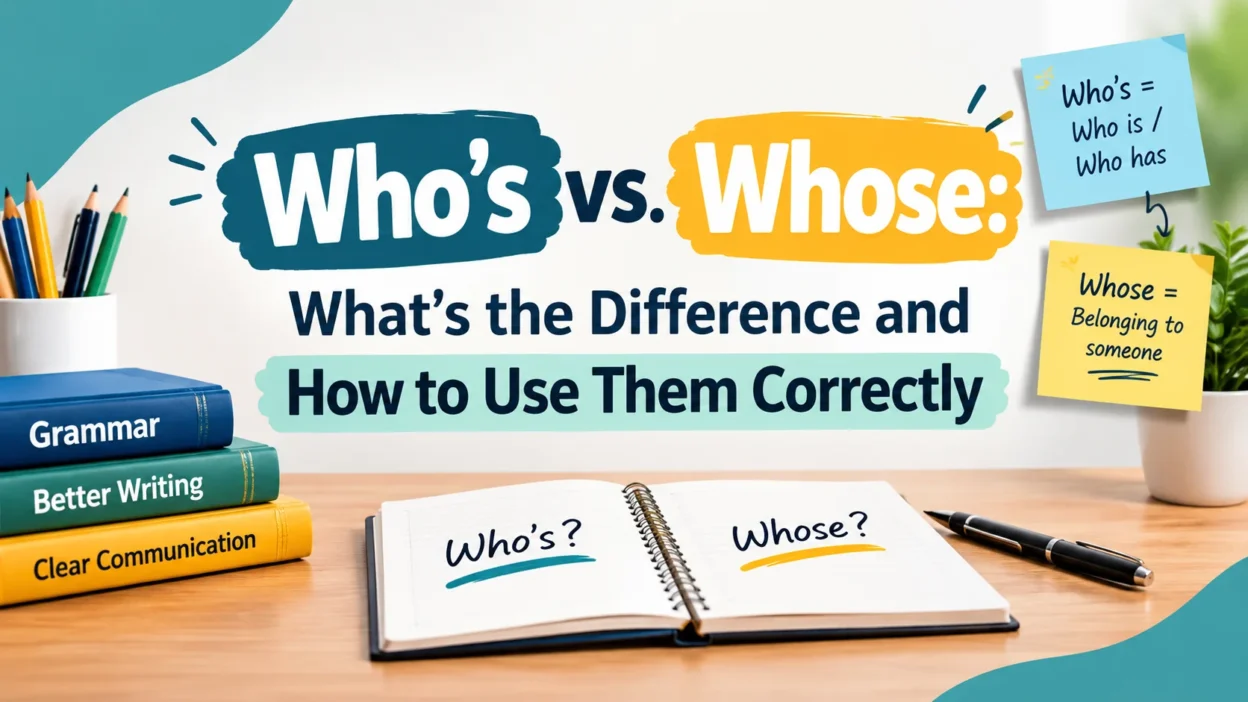
Who’s vs. Whose can become much easier when you connect whose with possession and ownership. Whose is the possessive form of the pronoun who and asks about association or who something belongs to. For example, “Whose bag is this?” asks who owns the bag. The word whom can also help you understand the relationship because whose identifies the person connected to something. In English grammar, this is a simple rule that makes the difference easier to remember.
The biggest difference is that who’s is a contraction of who is or who has, while whose shows possession. The key sign in who’s is the apostrophe, which indicates missing letters. Both words are homophones, so they sound the same, even though their meanings and functions are completely different. This can be confusing because the words are similar and almost identical in everyday speech. A useful practical test is to replace who’s with “who is” or “who has.” If the sentence still makes sense, who’s is usually the right word; if the sentence shows ownership, use whose.
In formal writing, professional contexts, communication, and exams, using the correct word keeps your meaning clear and prevents the sentence from becoming unclear. Common grammar problems often come from confusing these two forms, but short examples and comparisons can provide a helpful guide. When you’re unsure, remember that whose means “belonging to whom,” while who’s means “who is” or “who has.” This simple method makes choosing easier and helps keep your English writing correct, clear, and professional.
Quick Answer: Who’s vs. Whose
Who’s is a contraction of who is or who has.
Whose is a possessive word that asks or tells you who something belongs to or is associated with.
For example:
- Who’s coming to dinner? = Who is coming to dinner?
- Who’s finished the assignment? = Who has finished the assignment?
- Whose jacket is this? = Who does this jacket belong to?
- The student whose book is missing is absent. = The book belongs to or is associated with the student.
A simple rule makes the difference easy:
If you can replace “who’s” with “who is” or “who has,” use who’s. If the sentence expresses possession or association, use whose.
Who’s vs. Whose: Comparison Overview
| Word | Meaning | Function | Example |
| Who’s | Who is | Contraction | Who’s at the door? |
| Who’s | Who has | Contraction | Who’s taken my pen? |
| Whose | Belonging to whom | Possessive determiner/pronoun | Whose phone is this? |
| Whose | Associated with whom/what | Relative word | The woman whose car was stolen called. |
The biggest trap comes from the apostrophe. English often uses apostrophes for possession, as in Sarah’s book or the dog’s bowl. However, who’s doesn’t follow that pattern.
Here, the apostrophe indicates contraction. It represents omitted letters from who is or who has.
Meanwhile, whose already serves as the possessive form. It doesn’t need an apostrophe.
What Does Who’s Mean?
The word who’s has two standard meanings. You can expand it to either who is or who has, depending on the sentence.
Who’s as “Who Is”
The most common use of who’s is as a shortened form of who is.
Consider these examples:
- Who’s waiting outside?
- Who’s responsible for this project?
- Who’s your favorite teacher?
- Who’s coming with us?
- Who’s at the front desk?
Try expanding the first sentence:
Who’s waiting outside? → Who is waiting outside?
The meaning remains intact, so who’s correct.
The same rule works inside statements:
I know who’s responsible.
This means:
I know who is responsible.
The contraction makes the sentence sound natural without changing its grammatical role.
Who’s as “Who Has”
Who’s can also represent who has.
For example:
- Who’s finished the report?
- Who’s taken my notebook?
- Who’s seen this movie before?
- Who’s been to New York?
In Who’s finished the report?, replacing the contraction gives:
Who has finished the report?
That sentence works perfectly.
The structure that follows who’s can help you identify this meaning. A past participle such as finished, taken, seen, or been often signals who has.
What Does Whose Mean?
Whose expresses possession, ownership, or association. It can appear in direct questions as well as relative clauses.
For example:
- Whose keys are these?
- Whose laptop is on the table?
- Whose idea was that?
- Whose dog is barking?
In each case, whose asks about the person or thing connected with something.
You can think of it as asking:
“Who does this belong to?”
So:
Whose phone is this?
essentially asks:
“Who does this phone belong to?”
Whose in Relative Clauses
Whose also connects a person or thing with something associated with it.
For example:
- The woman whose car was stolen called the police.
- I met a writer whose books have sold millions of copies.
- The student whose essay won the prize received an award.
- We visited a house whose roof needed repairs.
In these sentences, whose introduces information about a noun.
In the writer whose books became popular, the books are associated with the writer.
That relationship doesn’t always mean legal ownership. It can describe a broader connection.
Main Differences Between Who’s vs Whose
Who’s means “who is” or “who has,” while whose shows possession or association with someone or something.
Meaning
The first difference is meaning.
Who’s means:
- who is
- who has
Whose means:
- belonging to whom
- associated with whom or what
Compare these sentences:
Who’s calling?
This means Who is calling?
Whose phone is ringing?
This asks who owns or is associated with the phone.
The words may sound similar, but the questions are completely different.
Apostrophe
The apostrophe in whose marks are missing letters.
who’s = who is
The apostrophe replaces the space and letters removed when the two words combine.
With whose, no letters have been removed. Therefore, there is no apostrophe.
This is similar to another famous grammar pair:
- it’s = it is
- its = possessive form
The same basic principle applies to who’s and whose.
Grammatical Function
Who’s works as a contraction within a clause.
Whose works as a possessive interrogative or relative word.
For example:
Who’s running the meeting?
Here, who’s meaning is who is.
Whose meeting is this?
Here, whose identifies the person associated with the meeting.
Understanding the grammatical function helps you avoid relying only on spelling.
Who’s vs. Whose Examples
The quickest way to understand the distinction is to see the words working in real sentences.
Examples With Who’s
Who’s meaning who is:
- Who’s at the door?
- Who’s your manager?
- Who’s ready to leave?
- Who’s responsible for the decision?
- Do you know who’s coming tonight?
Who’s meaning who has:
- Who’s finished the test?
- Who’s eaten the last cookie?
- Who’s seen my keys?
- Who’s been here before?
- Who’s taken the documents?
Examples With Whose
- Whose coat is hanging here?
- Whose car is blocking the driveway?
- Whose idea was it?
- Whose child is playing outside?
- Do you know whose bag this is?
Notice how whose always points toward possession or association.
Side-by-Side Examples
| Who’s | Whose |
| Who’s coming tonight? | Whose house are we visiting? |
| Who’s at the door? | Whose package arrived? |
| Who’s responsible? | Whose responsibility is this? |
| Who’s taken my pen? | Whose pen is this? |
| Who’s leading the team? | Whose team is this? |
These pairs show why simply listening to pronunciation isn’t enough. Context determines the correct spelling.
The “Who Is” vs “Who Has” Replacement Test
When you’re stuck between who’s and whose, use the replacement test.
Step One: Replace Who’s With “Who Is”
Take the sentence:
Who’s coming to the meeting?
Replace who’s:
Who is coming to the meeting?
It works. Therefore, who’s is correct.
Step Two: Try “Who Has”
Consider:
Who’s completed the assignment?
Replace it:
Who has completed the assignment?
That also works. So who’s is correct here too.
Step Three: Check for Possession
Now consider:
Whose notebook is this?
Try replacing whose with who is:
Who is notebook is this?
That doesn’t work.
Try who has:
Who has notebook is this?
That doesn’t work either.
The sentence asks about ownership, so whose is the correct choice.
This three-step method takes only a few seconds and works in most everyday situations.
Common Mistakes With Who’s vs Whose
The most common mistakes happen when writers use who’s for possession or whose when they mean “who is” or “who has.”
Using Who’s to Show Possession
One of the most common errors is writing:
Who’s phone is this?
The correct version is:
Whose phone is this?
Why? Because the sentence asks who the phone belongs to. It doesn’t mean who is phone or who has phone.
The apostrophe doesn’t turn who’s into a possessive word.
Using Whose Instead of Who’s
Another common mistake looks like this:
Whose coming to the party?
The correct sentence is:
Who’s coming to the party?
Here, who’s meaning is who is.
A quick replacement confirms it:
Who is coming to the party?
That works naturally.
Confusing Who’s With Whose in Questions
Compare:
Who’s at the door?
This asks which person is at the door.
Whose bag is at the door?
This asks who owns or is associated with the bag.
The first question focuses on identity. The second focuses on possession.
Misreading Who’s as Possessive
English learners sometimes assume who’s works like John’s.
That’s understandable because both contain apostrophes. However, their jobs differ.
John’s car uses John’s to show possession.
Who’s driving the car? uses who’s as a contraction.
The apostrophe doesn’t have the same function in both words.
Is “Whose” Always About Ownership?
Not necessarily.
Whose can describe ownership, but it can also express a relationship, characteristic, or association.
For example:
The employee whose idea won the award received recognition.
The employee doesn’t necessarily own the idea in a legal sense. The sentence identifies the idea as belonging to or being associated with that employee.
Other examples include:
- The company whose products became popular expanded overseas.
- The student whose grades improved received praise.
- The dog whose owner moved away was adopted.
- The author whose novels inspired the film attended the premiere.
So, remember possession or association, rather than limiting whose to physical ownership.
Can Whose Be Used for Things?
Yes. Whose can refer to people, animals, organizations, and inanimate things.
For example:
- A house whose windows are broken
- A company whose sales increased
- A book whose cover is damaged
- A machine whose engine needs repair
Some writers avoid whose with inanimate objects because they associate it only with people. However, standard English allows this construction.
In many cases, whose sounds sound more natural than a more complicated alternative.
For example:
The company whose website crashed apologized to customers.
This is clear and concise.
Who’s vs. Whose in Formal and Informal Writing
Both words are grammatically correct in formal writing when used properly.
However, who’s is a contraction. Some highly formal contexts may prefer the expanded form who is or who has.
For example:
Who’s responsible for the report?
is perfectly normal.
A more formal version might be:
Who is responsible for the report?
The meaning doesn’t change.
Whose, meanwhile, isn’t inherently informal. You can use it in academic writing, business documents, journalism, and everyday conversation.
Who’s vs. Whose in Questions
Questions make the distinction especially easy to see.
Who’s
- Who’s calling?
- Who’s coming?
- Who’s responsible?
- Who’s been there?
- Who’s finished the work?
Whose
- Whose book is this?
- Whose car is parked outside?
- Whose idea was it?
- Whose keys are these?
- Whose name is on the document?
A useful shortcut is to ask what information the question seeks.
Who’s usually asks about a person performing an action or being in a state.
Whose asks about the person connected to something.
Who’s vs. Whose in Relative Clauses
Both forms can appear in longer sentences, which sometimes makes the distinction harder.
Consider:
The teacher who’s leading the class is new.
Here, who’s meaning is who is.
Now compare:
The teacher whose class starts at nine is new.
Here, whose connects the teacher with the class.
Another pair makes the contrast even clearer:
- I spoke to the manager who’s handling the complaint.
- I spoke to the manager whose department handles complaints.
In the first sentence, who’s describes what the manager is doing.
In the second, whose describes something associated with the manager.
Read More.https://grammarhorizon.com/steam-or-steem/
Conclusion
Understanding Who’s vs. Whose becomes simple once you remember their different jobs. Who’s is a contraction of who is or who has, while whose shows possession, ownership, or belonging. Although they sound the same, using the correct form keeps your English writing clear and grammatically correct.
FAQs
Q1. What is the difference between who’s and whose?
Who’s means who is or who has, while whose is the possessive form of who and shows ownership or association.
Q2. Is who’s a possessive word?
No. Who’s is a contraction of who is or who has. Whose is the possessive form.
Q3. Does whose mean belonging to whom?
Yes. Whose can be understood as belonging to whom. For example, “Whose phone is this?”
Q4. Why do who’s and whose sound the same?
They are homophones, meaning they have different meanings and spellings but generally have the same pronunciation.
Q5. How can I remember when to use who’s?
Try replacing who’s with who is or who has. If the sentence still makes sense, who’s is likely correct.
Q6. How can I remember when to use whose?
Use whose when you are asking about ownership, possession, or a relationship with something.
Q7. Is whose correct in formal writing?
Yes. Whose is completely standard and appropriate for formal, academic, and professional writing.
Q8. Is the apostrophe in who’s important?
Yes. The apostrophe in who’s shows that letters have been removed from who is or who has.
Q9. Which is correct: “Who’s book” or “Whose book”?
“Whose book” is correct because the sentence asks who the book belongs to. “Who’s book” is incorrect.