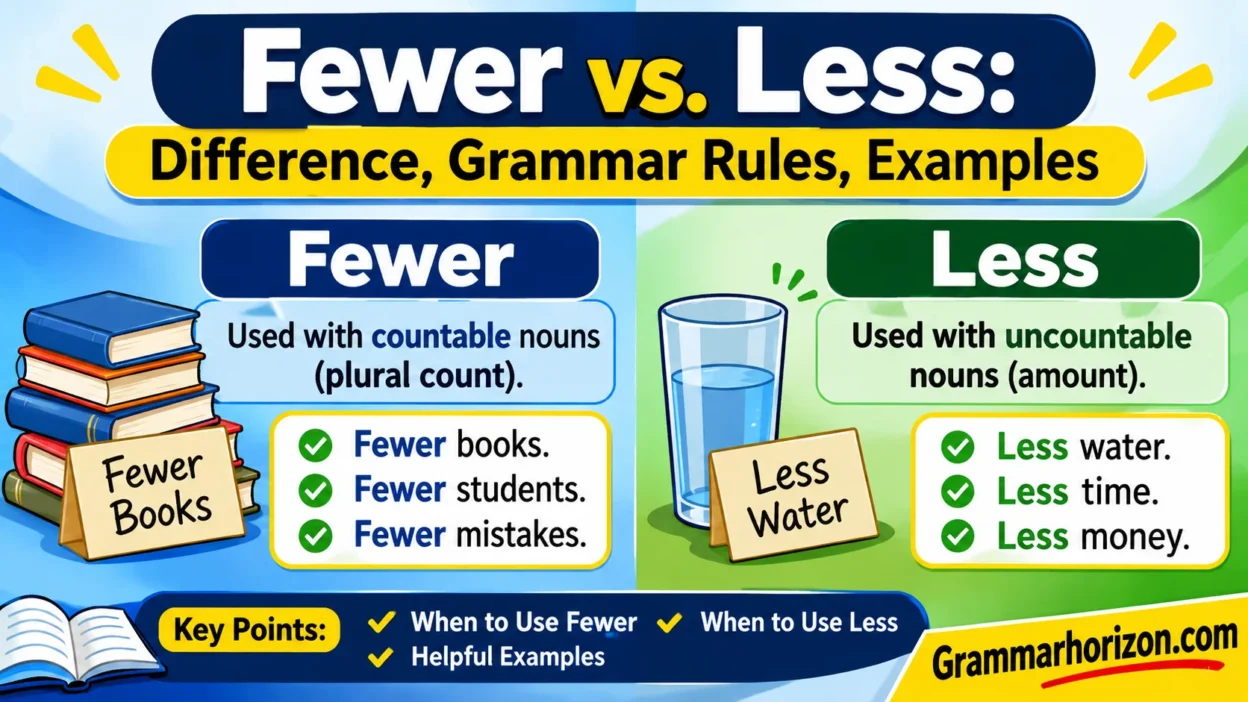
Fewer vs. Less is a common English grammar confusion because both words describe a smaller quantity, but they are used with different types of nouns. Fewer is used with countable nouns, which means individual things that can be counted separately. For example, you should write fewer apples because apples are individual items that you can count. On the other hand, less is used with uncountable nouns, such as water, because water is measured by amount rather than counted separately. This grammatical distinction makes it easier to choose the correct word and understand the difference between fewer and less.
For English learners and native speakers, knowing these grammatical rules can prevent grammar mistakes in everyday English. Both words have similar meanings, but fewer describes smaller numbers of countable items, while less refers to smaller amounts of uncountable things. A useful memory tip is to ask yourself whether you can count something individually or need to measure it. This simple method makes remembering the correct usage easier. For example, you can count apples, books, and chairs, but you measure water, milk, and sugar. These practical examples help explain noun types, quantity expressions, and common exceptions in English usage.
Understanding these usage rules also improves sentence structure, writing skills, and language accuracy. When you practice using fewer and less, you develop better word choice, correct grammar, and clear writing. In my experience, checking whether a noun is countable or uncountable is one of the most practical ways to avoid mistakes. Regular practice, a good grammar guide, and everyday communication can improve your English vocabulary, grammatical understanding, and natural wording. These habits also help you write clearly and communicate in natural English.
Quick Answer: Fewer vs. Less
Fewer is used with countable plural nouns to describe a smaller number of individual items, people, or things. Less is generally used with uncountable nouns to describe a smaller amount, quantity, degree, or extent.
| Fewer | Less |
| Used with countable nouns | Generally used with uncountable nouns |
| Refers to a smaller number | Refers to a smaller amount |
| Fewer books | Less information |
| Fewer students | Less homework |
| Fewer mistakes | Less confusion |
| Fewer chairs | Less furniture |
Simple rule to remember: If you can count something individually, use fewer. If you describe an amount or quantity, use less.
What Does Fewer Mean?
Fewer means a smaller number of people, things, objects, or other items that can be counted individually. It is the comparative form of few and is commonly used with plural countable nouns.
When you use fewer, you’re comparing two quantities and explaining that one group contains a smaller number of individual items than another group, an earlier situation, or an expected amount.
For example, if you had 15 books last month but have only 10 now, you have fewer books. Similarly, if a company receives 50 applications this year instead of 80 last year, it has received fewer applications.
Fewer is commonly used in everyday speech, academic writing, business communication, and formal documents whenever the noun represents countable items.
Examples of Fewer in Sentences
- There are fewer students in the classroom today.
- I made fewer mistakes in my latest assignment.
- We need fewer chairs for the meeting.
- She bought fewer clothes this month.
- The company hired fewer employees this year.
- He has fewer responsibilities than his manager.
- There were fewer cars on the road this morning.
In each example, the noun refers to something that can be counted separately. You can count students, mistakes, chairs, clothes, employees, responsibilities, and cars, which makes fewer the appropriate choice.
What Does Less Mean?
Less refers to a smaller amount, quantity, degree, or extent of something. It is the comparative form of little when little refers to quantity.
Unlike fewer, less is generally used with uncountable nouns. These nouns don’t usually represent separate items that you count one by one. Instead, you measure, estimate, or describe them as an overall amount.
For example, you can have less water, less patience, less energy, or less time. Although you can measure these things, you don’t normally count them as individual units in their basic forms.
Less can also describe a reduced degree of a quality, condition, feeling, or action. It works naturally in comparisons involving effort, stress, difficulty, noise, and many other abstract concepts.
Examples of Less in Sentences
- I have less money than I had last month.
- We need less water to prepare this recipe.
- She has less time to complete the assignment.
- He feels less stress at his new job.
- This project requires less effort than the previous one.
- There is less traffic on the highway today.
- You should use less sugar in your coffee.
These examples describe amounts, quantities, or degrees rather than separate countable items. That’s why less works in each sentence.
The Main Difference Between Fewer and Less
The main difference between fewer and less comes down to number versus amount. Fewer describes a smaller number of individual things, while less describes a smaller quantity of something.
However, both words can appear in comparisons, and their meaning can depend on the noun that follows them. Understanding whether a noun is countable or uncountable is the easiest way to make the correct choice.
| Sentence | Correct word | Reason |
| We have ___ apples. | Fewer | Apples are countable. |
| We have ___ milk. | Less | Milk is uncountable. |
| She received ___ emails. | Fewer | Emails are individual items. |
| He needs ___ advice. | Less | Advice is uncountable. |
| They made ___ phone calls. | Fewer | Phone calls can be counted. |
| I have ___ patience today. | Less | Patience is an amount or quality. |
If you understand the noun, you can usually select the correct word without memorizing dozens of separate examples.
When to Use Fewer: Grammar Rules
Use fewer with countable plural nouns when referring to a smaller number of people, items, objects, or things.
Fewer With Countable Nouns
Use fewer when you’re talking about nouns that can be counted individually. Countable nouns have singular and plural forms. You can usually place a number before them to show exactly how many you have.
For example, you can have one chair, two chairs, or ten chairs. When the number of chairs decreases, you can say you have fewer chairs. The same rule applies to books, people, students, bags, phones, and other countable nouns.
Examples:
- We have fewer books in the new library.
- Fewer people attended the event this year.
- She has fewer friends at her new school.
- The store sells fewer products during the winter.
- I need fewer boxes to pack my belongings.
Fewer With People, Objects, and Animals
Fewer also works with nouns representing people, objects, animals, and other things that can be counted separately. This usage is common when describing changes in population, attendance, inventory, or the number of living things.
For example, a farmer may have fewer chickens after selling some of them. A school may have fewer teachers because several have retired. A wildlife area may contain fewer birds after a decline in population.
Examples:
- There are fewer dogs in the shelter this week.
- Fewer workers are needed to complete this task.
- We saw fewer birds near the lake.
- The museum has fewer visitors during weekdays.
- The shop has fewer jackets in stock.
Fewer With Numbers and Quantities
Use fewer when the noun represents countable units, even if the quantity is large. The number of items doesn’t change the grammatical rule.
For example, fewer than 20 students, fewer than 100 pages, and fewer than 1,000 customers all use fewer because students, pages, and customers are countable nouns.
Examples:
- Fewer than 12 students passed the exam.
- The report contains fewer than 50 pages.
- Fewer than 100 people registered for the workshop.
- We received fewer than 20 orders yesterday.
Fewer Than vs. Less Than
The expressions fewer than and less than are both used to indicate that something falls below a particular number, limit, or quantity. However, the noun or measurement determines which one is appropriate.
Use fewer than with countable items and less than with amounts, measurements, and uncountable quantities.
| Fewer than | Less than |
| Fewer than 10 employees | Less than $10 |
| Fewer than 20 tickets | Less than 20 minutes |
| Fewer than 50 students | Less than 50 pounds |
| Fewer than 100 books | Less than 100 miles |
Examples:
- Fewer than 30 guests attended the wedding.
- The package contains fewer than 10 items.
- The journey takes less than two hours.
- The laptop costs less than $800.
The important thing is to identify what the number represents. If it counts individual objects, fewer is generally appropriate. If it describes a measurement or amount, less is often the better choice.
When to Use Less: Grammar Rules
Use less with uncountable nouns, measurements, amounts, and abstract qualities to indicate a smaller quantity, degree, or extent of something.
Less With Uncountable Nouns
Use less with uncountable nouns that describe amounts, substances, concepts, or things you don’t usually count individually.
Common uncountable nouns include:
- Water
- Money
- Time
- Energy
- Food
- Information
- Advice
- Furniture
- Equipment
- Traffic
- Homework
These nouns don’t normally take a plural form when used in their standard uncountable meanings. You can measure or compare their amounts, which is why less is the natural choice.
Examples:
- I need less information to make a decision.
- We spent less money on groceries this week.
- She has less energy after working all day.
- You should drink less soda.
- There is less furniture in the new office.
Less With Measurements
Less is also used with measurements of time, distance, weight, volume, temperature, and other quantities. These expressions refer to measurements rather than individual objects, even when a number appears in the sentence.
For example, you might travel less than five miles, finish a task in less than 30 minutes, or purchase less than two pounds of rice. In these cases, less refers to the measurement or amount.
Examples:
- The drive takes less than 40 minutes.
- The package weighs less than five pounds.
- We walked less than three miles.
- The tank holds less than 10 gallons.
- The temperature dropped to less than 10 degrees.
This is why you can correctly use less with a number in certain expressions. The presence of a number doesn’t automatically mean fewer is required.
Less With Abstract Ideas and Qualities
Less can describe a reduced degree of an abstract quality, emotion, condition, or experience. These nouns don’t represent separate countable items. Instead, they describe how much of something exists or how strongly someone experiences it.
For example, you may feel less anxiety, experience less pressure, show less confidence, or face less difficulty with a task.
Examples:
- He feels less pressure in his new position.
- This decision creates less confusion.
- I have less confidence in that plan.
- She experienced less anxiety after practicing.
- The new process causes less frustration.
Less can also be used with adjectives and adverbs to show a lower degree of a quality or action.
- The second option is less expensive.
- He is less confident today.
- She drives less carefully in bad weather.
- This explanation is less complicated.
In these sentences, less doesn’t describe the number of items. It describes degree, quality, or how something happens.
Exceptions to the Fewer vs. Less Rule
Although the traditional rule is straightforward, everyday English includes some exceptions and special cases. Knowing these situations will help you understand why less sometimes appears with plural nouns or numbers.
Less With Countable Nouns in Certain Expressions
In casual conversation, you may hear less used with plural countable nouns, such as less people, less cars, or less problems. This usage is common in spoken English, but traditional grammar generally recommends fewer with plural countable nouns.
For example:
- Informal: There are less people in the office today.
- Traditional usage: There are fewer people in the office today.
Although many speakers use less this way, fewer is the safer choice in academic writing, professional communication, formal editing, and English grammar tests.
Less With Time, Money, and Distance
Time, money, and distance can be expressed through numbers, but they are often treated as amounts or measurements rather than individual countable items.
For example, when you say less than an hour, you’re describing a period of time. When you say less than $100, you’re referring to a monetary amount. When you say less than five miles, you’re describing distance.
| Expression | Why less is used |
| Less than an hour | Time measurement |
| Less than $20 | Amount of money |
| Less than five miles | Distance measurement |
| Less than two pounds | Weight measurement |
| Less than a gallon | Volume measurement |
These expressions are standard English, not exceptions that make the fewer-versus-less rule unreliable. They work because the word less describes the measurement or amount.
Less in Everyday English
You may encounter expressions such as less people, less students, or less cars in casual conversations, online posts, and informal writing. People often choose less because it sounds quick and familiar.
However, traditional grammar distinguishes between countable plural nouns and uncountable nouns. In edited writing, fewer people, fewer students, and fewer cars are usually preferred.
If you’re unsure which form to use, choose fewer with plural countable nouns. It is the most reliable option when writing for a broad audience.
Fewer vs. Less in Everyday Situations
Understanding grammar rules becomes easier when you see how fewer and less work in real-life situations. Both words appear in shopping, cooking, education, workplace communication, and everyday conversations.
Fewer vs. Less in Shopping and Spending
Shopping involves both countable items and uncountable amounts, so you may use fewer and less in the same sentence.
Use fewer when you’re talking about the number of products, bags, or items you buy. Use less when you’re talking about the amount of money you spend or the quantity of a substance you purchase.
Examples:
- I bought fewer shirts this month.
- We need fewer grocery bags.
- She spent less money on clothing.
- I’m trying to use less plastic.
- The store had fewer customers but made less money.
Fewer vs. Less at Work
In a workplace, fewer usually refers to countable tasks, meetings, employees, mistakes, or projects. Less describes the amount of work, time, pressure, effort, or stress involved.
Examples:
- We have fewer meetings this week.
- The team made fewer mistakes in the report.
- I have less work to finish today.
- The new system requires less effort.
- The company is spending less money on training.
Choosing the right word can make professional communication clearer, especially when you’re discussing workload, productivity, staffing, or project progress.
Fewer vs. Less in Food and Cooking
Food is a useful example because some ingredients are countable while others are uncountable. You can count eggs, apples, tomatoes, and cookies. However, you generally measure flour, milk, sugar, salt, and oil by amount.
Examples:
- Add fewer eggs to the recipe.
- Use less flour to make the dough lighter.
- We ate fewer cookies after dinner.
- Add less salt to the soup.
- She bought fewer bananas and less milk.
Remember that the noun determines the correct word. Food doesn’t automatically require less, and individual ingredients don’t automatically require fewer.
Fewer vs. Less in School and Education
Students and teachers use these words when discussing assignments, class sizes, academic workload, study time, and learning materials.
Examples:
- There are fewer students in this class.
- We have fewer assignments this semester.
- I need less time to complete my homework.
- The teacher gave us less information about the test.
- The school received fewer applications this year.
In educational writing, fewer works with countable academic items, while less works with quantities and uncountable concepts.
Common Mistakes With Fewer vs Less
People often confuse fewer and less because they focus on the idea of reduction rather than the noun that follows. These mistakes are easy to correct once you recognize the difference between countable and uncountable nouns.
| Incorrect sentence | Correct sentence | Explanation |
| Less students attended. | Fewer students attended. | Students are countable. |
| Fewer water is available. | Less water is available. | Water is uncountable. |
| We have fewer time. | We have less time. | Time is an amount. |
| She bought less apples. | She bought fewer apples. | Apples are countable. |
| I need fewer money. | I need less money. | Money is uncountable. |
| There are less chairs. | There are fewer chairs. | Chairs are countable. |
Mistake 1: Using Less With Countable Plural Nouns
Using less with plural countable nouns is one of the most common mistakes. Although you may hear it in informal speech, fewer is the traditional choice in standard written English.
Incorrect: We have less customers today.
Correct: We have fewer customers today.
Customers are individual people who can be counted, so fewer is appropriate.
Mistake 2: Using Fewer With Uncountable Nouns
Some writers use fewer because they see a quantity or number in the sentence. However, fewer doesn’t work with most uncountable nouns.
Incorrect: I need fewer information about the project.
Correct: I need less information about the project.
Information is an uncountable noun. You can refer to pieces of information when counting individual units, but the noun information itself is normally uncountable.
Mistake 3: Choosing the Word Based on the Number
A number doesn’t always mean you should use fewer. The noun or measurement matters more than the number itself.
Incorrect: It took fewer than 30 minutes.
Correct: It took less than 30 minutes.
Minutes in this expression refer to a measurement of time. Less is traditionally used for the duration.
Mistake 4: Ignoring the Noun in Comparisons
When comparing two quantities, people sometimes choose fewer or less based on the first word they notice. Instead, look at the noun being compared.
- Correct: We have fewer employees than last year.
- Correct: We have less office space than last year.
- Correct: She drinks less coffee than before.
- Correct: She eats fewer sandwiches than before.
The comparison may be similar, but the noun determines the grammar.
Fewer vs. Less: Comparison Examples
These paired examples show how the word changes when you replace a countable noun with an uncountable noun.
| Countable noun (Fewer) | Uncountable noun (Less) |
| Fewer chairs | Less furniture |
| Fewer bottles | Less water |
| Fewer assignments | Less homework |
| Fewer coins | Less money |
| Fewer people | Less traffic |
| Fewer questions | Less information |
| Fewer clothes | Less clothing |
| Fewer mistakes | Less confusion |
| Fewer ingredients | Less flour |
| Fewer hours (individual units) | Less time (duration or amount) |
For example, fewer bottles means a smaller number of bottles. Less water means a smaller quantity of water. You could have fewer bottles but still have more water if the remaining bottles are larger.
Likewise, fewer assignments means a smaller number of tasks, while less homework refers to a reduced amount of schoolwork. The difference isn’t simply about the quantity. It also depends on how the noun is classified and used.
Easy Tricks to Remember Fewer vs. Less
If you often mix up fewer and less, use these simple tricks to check your sentence before writing it.
Use the Counting Test
Ask yourself whether you can count the noun as separate items.
- If you can count it individually, use fewer.
- If you describe it as an amount, use less.
For example, you can count pencils, books, people, and cars. Therefore, use fewer pencils, fewer books, fewer people, and fewer cars.
You can’t normally count water, money, patience, or traffic as individual units in their basic forms. Therefore, use less water, less money, less patience, and less traffic.
Remember Number vs. Amount
Keep this simple reminder in mind:
- Fewer = number
- Less = amount
This quick association helps you select the correct word without overthinking the grammar.
Check the Noun, Not the Sentence Length
A long sentence doesn’t require a complicated grammar decision. Find the noun that fewer or less describes, and check whether it’s countable or uncountable.
For example:
“We received fewer complaints this month because the new service requires less effort from customers.”
In this sentence, complaints are countable, so fewer is correct. Effort is uncountable, so less is correct.
Fewer vs. Less in Questions
Fewer and less work the same way in questions as they do in statements. The difference depends on the noun, not whether the sentence is a question.
Use fewer when asking about countable items and less when asking about an amount or degree.
Questions Using Fewer
- Are there fewer people here today?
- Did you buy fewer apples this time?
- How many fewer students joined the class?
- Do we have fewer chairs than we need?
- Were there fewer mistakes in the final report?
Questions Using Less
- Do you have less time this afternoon?
- Is there less sugar in this drink?
- Did you spend less money this month?
- Why is there less traffic today?
- Can we use less paper for this project?
The correct word makes each question grammatically natural and helps communicate exactly what you’re comparing.
Conclusion
Understanding the difference between fewer vs. less helps you improve your English grammar and avoid common writing mistakes. Remember that fewer is used with countable nouns, such as apples, books, and chairs, while less is used with uncountable nouns, such as water, milk, and sugar. Once you understand this simple rule, choosing the correct word becomes easier. Regular practice and attention to noun types can help you write clearly and communicate more naturally.
Frequently Asked Questions
Q1. What is the main difference between fewer and less?
Fewer is used with countable nouns, while less is used with uncountable nouns. For example, fewer apples and less water are correct expressions.
Q2. Is fewer or less correct for money?
Less is generally correct when referring to money as an amount. For example, “I have less money this month.”
Q3. Should I use fewer or less with people?
Use fewer because people are countable. For example, “Fewer people attended the meeting.”
Q4. Is it less than five or fewer than five?
Fewer than five is traditionally preferred when referring to countable items. For example, “Fewer than five students arrived.”
Q5. Can fewer and less ever be used interchangeably?
They are not generally interchangeable. However, less is accepted in some expressions involving numbers, measurements, time, distance, and money. For example, “less than five miles” is correct.