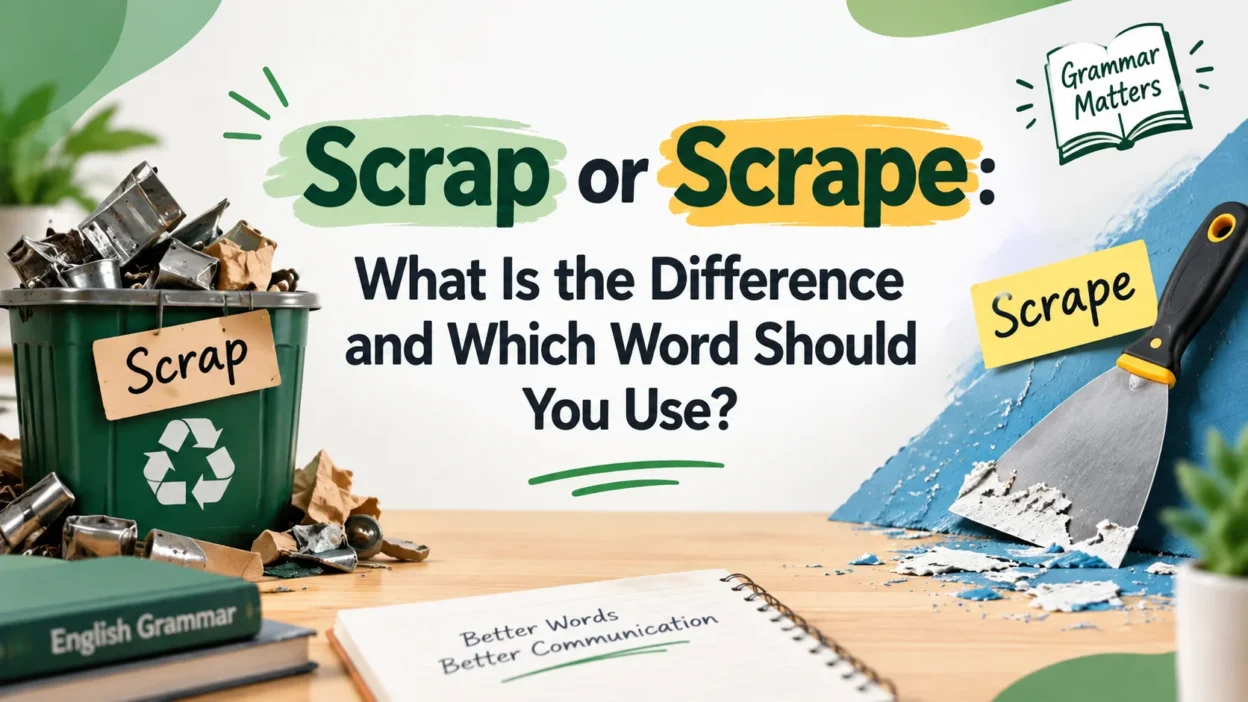
The Scrap or Scrape difference matters because these words look similar but have different meanings in English. Scrap can mean to cancel something, throw away something, or refer to a small leftover piece of materials. Scrape usually means to rub, scratch, or remove something from a surface. Knowing this distinction helps you choose the right word in everyday communication and professional writing.
A simple memory aid is to connect scrap with cancel, throw away, and leftover, while scrape connects with rub, scratch, and removing something. For example, a company might scrap a plan, a factory may have scrap materials, or you may save a small leftover piece of wood. In contrast, you might scrape paint from a wall, scrape food from a pan, or scrape mud from your shoes. These examples show how context, meaning, and action determine which word fits.
The most common mistakes happen when people focus on the similar spelling pattern or sound instead of the intended meaning. In construction, cooking, business writing, technical reports, news reports, casual speech, and a social media post, choosing the wrong word can cause confusion or misunderstandings. A useful practical tip is to ask whether you mean canceling something, throwing something away, or describing a leftover; choose scrap. If you mean removing something by rubbing or scratching, choose scrape. This approach makes your writing clearer and helps you use both words confidently.
Quick Answer: Scrap or Scrape?
The correct word depends on what you want to say.
Scrap means to throw something away, abandon an idea, cancel a plan, or describe a small piece of material.
Examples:
- The company decided to scrap the outdated product.
- She found a scrap of paper under the desk.
- The workers collected scrap metal from the factory.
Scrape means to remove something by rubbing, create a mark through friction, or manage something with difficulty.
Examples:
- He used a tool to scrape the paint off the wall.
- I accidentally scraped my knee while playing outside.
- They managed to scrape by with very little money.
A quick memory trick:
You scrap something when you stop using it. You scrape something when you rub against it.
Scrap or. Scrape: Comparison Overview
| Word | Meaning | Common Uses | Example |
| Scrap | To discard, cancel, or refer to a small piece | Plans, projects, leftover materials | They scrapped the old design. |
| Scrape | To rub, remove, scratch, or barely succeed | Surfaces, injuries, difficult situations | She scraped ice from the windshield. |
Both words can act as nouns and verbs, but their meanings remain separate.
| Word | Verb Meaning | Noun Meaning |
| Scrap | To cancel or discard something | A small piece, leftover material, or fight |
| Scrape | To remove by rubbing or scratch something | A mark, minor injury, or difficult situation |
What Does “Scrap” Mean?
The word scrap has several meanings, but most of them connect to the idea of something small, unwanted, or abandoned.
Scrap as a Verb
As a verb, scrap means to get rid of something, cancel it, or decide not to continue with it.
This meaning often appears when people talk about plans, projects, ideas, or products.
Examples:
- The government scrapped the proposal after public criticism.
- The company scrapped the launch because of technical problems.
- They scrapped their vacation plans because of bad weather.
When someone scraps something, they usually make a decision to stop using it. The object or idea may still exist, but they no longer want to continue with it.
A business example makes this clearer:
A technology company spends months developing a new app. Before release, testing reveals major security problems. Instead of fixing the issues, the company decides to scrap the project and start over.
In this situation, the company does not physically remove the app. It simply abandons the plan.
Scrap as a Noun
As a noun, scrap can describe a small leftover piece of something.
Common examples include:
- A scrap of paper
- A scrap of fabric
- Scrap metal
- Food scraps
For example:
- She wrote the phone number on a scrap of paper.
- The factory sells scrap metal to recycling companies.
The word often describes something that remains after the main material has been used.
A tailor might save scraps of fabric from old clothes. A construction company might collect scrap metal from demolished buildings.
Scrap Meaning “A Fight”
In informal English, scrap can also mean a small fight or argument.
Examples:
- The two teenagers got into a scrap outside the store.
- They had a minor scrap during the meeting.
This meaning is less common in professional writing, but you may hear it in casual conversations.
What Does “Scrape” Mean?
The word scrape focuses on friction, contact, or removing something from a surface.
Whenever one object rubs against another and causes removal or damage, scrape is often the correct word.
Scrape as a Verb
As a verb, scrape means to remove something by rubbing a tool or object against a surface.
Examples:
- She scraped the mud off her shoes.
- He scraped the ice from the car window.
- The painter scraped away the old wallpaper.
The action usually requires pressure or movement.
Think about cleaning a dirty pan. You do not simply remove burnt food. You often need to rub the surface with a tool. That action is scraping.
Scrape Meaning Physical Injury
A scrape can also describe a small injury caused by rubbing against something rough.
Examples:
- The child had a scrape on his elbow.
- I got a scrape when I fell off my bike.
A scrape usually damages only the surface of the skin. It is different from a deep cut or serious wound.
Scrape Meaning Difficulty or Struggle
The word also appears in expressions that describe difficult situations.
Common phrases include:
- Scrape by
- Scrape through
- Scrape together
Examples:
- She scraped by on a small salary.
- He scraped together enough money for rent.
- The team scraped through to the final round.
These expressions suggest barely achieving something.
Someone who scrapes by does not have plenty of resources. They manage with just enough.
Main Differences Between Scrap and Scrape
The main difference is that scrap means to discard or cancel something, while scrape means to rub, scratch, or remove something from a surface.
Meaning Difference
The biggest difference between scrap and scrape comes down to purpose.
Scrap means removal through a decision.
You scrap a plan because you choose to stop it.
Examples:
- They scrapped the project.
- The company scrapped the old system.
Scrape means removal through physical action.
You scrape paint because you physically rub it away.
Examples:
- She scraped paint from the door.
- He scraped dirt from his shoes.
Usage Difference
The words appear in different situations.
Use scrap when discussing:
- Canceling plans
- Discarding objects
- Recycling materials
- Leftover pieces
- Ending projects
Use scrape when discussing:
- Cleaning surfaces
- Removing layers
- Minor injuries
- Barely succeeding
- Gathering limited resources
Common Collocations With Scrap and Scrape
Certain words naturally appear with scrap and scrape.
Common Uses of Scrap
| Phrase | Meaning | Example |
| Scrap metal | Discarded metal for recycling | The company buys scrap metal. |
| Scrap paper | A small leftover piece of paper | He wrote notes on scrap paper. |
| Scrap a plan | Cancel an idea | They scrapped the plan. |
| Scrap a project | Stop development | The team scrapped the project. |
| Food scraps | Leftover food pieces | Compost food scraps instead of throwing them away. |
Common Uses of Scrape
| Phrase | Meaning | Example |
| Scrape off | Remove from a surface | Scrape off the sticker. |
| Scrape away | Remove gradually | Workers scraped away the old paint. |
| Scrape your knee | Get a minor injury | She scraped her knee while running. |
| Scrape by | Barely manage | They scraped by financially. |
| Scrape together | Collect with difficulty | He scraped together enough cash. |
Scrap or Scrape in Different Contexts
Scrap or Scrape in Different Contexts explains how each word changes meaning depending on the situation, helping you choose the correct term in everyday, professional, and practical examples.
Plans and Decisions
When talking about abandoning an idea, use scrap.
Correct:
- The company scrapped the advertising campaign.
Incorrect:
- The company scrapped the advertising campaign.
The second sentence suggests physically rubbing or removing the campaign, which does not make sense.
Cleaning and Maintenance
When removing something from a surface, use scrape.
Correct:
- I scraped the sticker off the window.
Incorrect:
- I scraped the sticker off the window.
The sticker is not being canceled. It is being physically removed.
Materials and Recycling
Industries frequently use scrap when discussing waste materials.
Examples:
- Scrap metal
- Scrap wood
- Scrap plastic
A recycling center collects materials that people no longer need and processes them into new products.
Injuries
Use scrape for minor surface injuries.
Correct:
- He scraped his arm on the fence.
Incorrect:
- He scraped his arm on the fence.
A person cannot “scrap” their skin in this meaning.
Scrap or. Scrape: Sentence Examples
| Scrap | Scrape |
| They scrapped the old strategy. | She scraped mud from her boots. |
| He saved a scrap of fabric. | I scraped my hand on the wall. |
| The factory sells scrap metal. | They scraped ice from the road. |
| The team scrapped the failed idea. | He scraped together enough money. |
These examples show that the two words may look similar, but they describe completely different actions.
Common Mistakes With Scrap and Scrape
Common Mistakes With Scrap and Scrape highlights the frequent errors people make when confusing these similar-looking words and shows how to use each one correctly in sentences.
Mistake: Using Scrap Instead of Scrape
Incorrect:
- I scraped the dirt off my shoes.
Correct:
- I scraped the dirt off my shoes.
The action involves rubbing and removing dirt, so scrape is correct.
Mistake: Using Scrape Instead of Scrap
Incorrect:
- They scrapped the old business plan.
Correct:
- They scrapped the old business plan.
The plan was canceled, not physically removed.
Scrap and Scrape in Formal and Informal English
Both words are common in everyday and professional English.
Scrap frequently appears in:
- Business reports
- Manufacturing
- Recycling industries
- News articles
Example:
- The manufacturer scrapped the defective model.
Scrape frequently appears in:
- Instructions
- Cleaning guides
- Medical descriptions
- Everyday conversations
Example:
- Scrape the excess mixture from the bowl.
Neither word is informal or incorrect. The key is choosing the one that matches your meaning.
Read More:Usage or Useage: Which Spelling Is Correct?
Conclusion
Understanding the Scrap or Scrape difference makes English usage easier and prevents common English confusion. Remember that scrap can mean to cancel, discard, or describe a small leftover piece, while scrape usually means to rub, scratch, or remove something from a surface. By paying attention to context, meaning, and the type of action, you can avoid mistakes and communicate more clearly in everyday conversations, professional writing, and other situations.
FAQs
Q1. Is scrap and scrape the same thing?
No. Scrap and scrape have different meanings. Scrap can mean cancel, discard, or a leftover piece, while scrape means to rub, scratch, or remove something from a surface.
Q2. What does scrap mean?
Scrap can be a verb meaning to cancel or abandon something, such as “They decided to scrap the plan.” As a noun, it can mean a small leftover piece of material.
Q3. What does scrape mean?
Scrape usually means to remove something from a surface by rubbing or dragging something against it. For example, “She used a tool to scrape paint from the wall.”
Q4. Is it scrap a plan or scrape a plan?
The correct phrase is scrap a plan. It means to cancel or abandon the plan. Scrape a plan doesn’t have the same meaning.
Q5. Is it scrap paint or scrape paint?
The usual phrase is scrape paint when you mean removing paint from a surface. For example, “He had to scrape paint from the door.”
Q6. What is an easy way to remember scrap and scrape?
Use this memory aid: scrap = cancel, throw away, leftover; scrape = rub, scratch, remove. This simple distinction can help you choose the correct word.