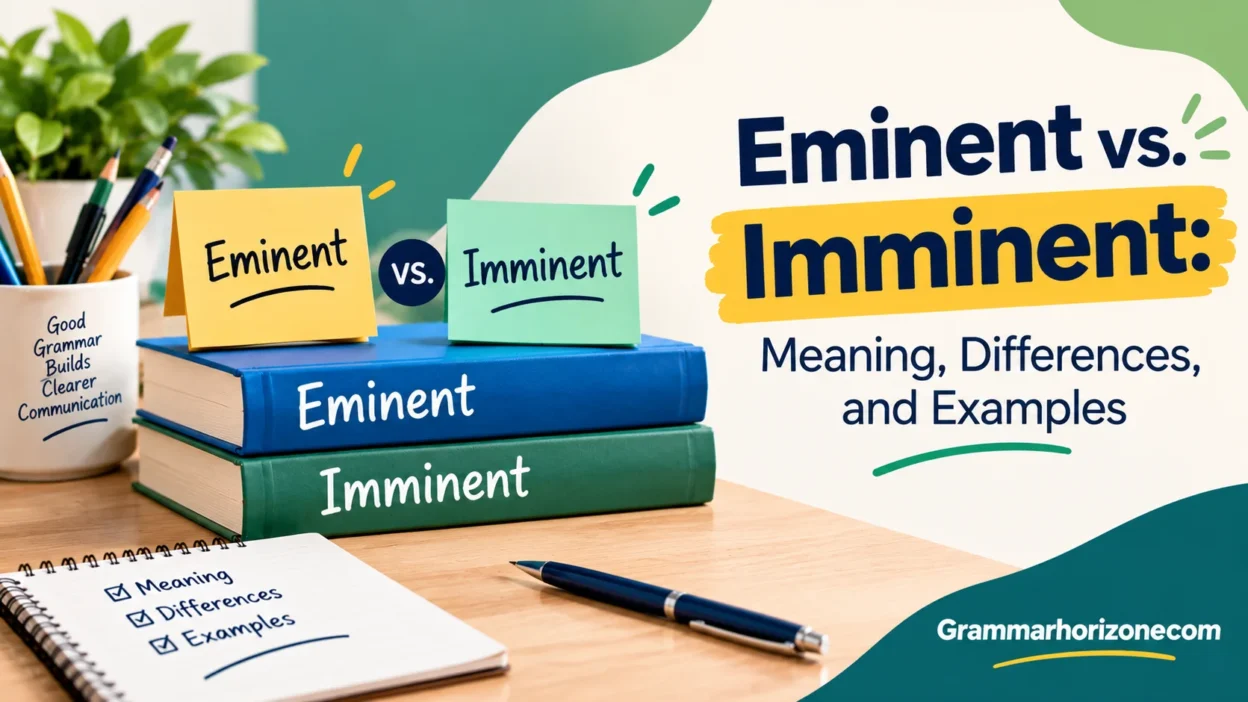
Eminent vs. Imminent compares two commonly confused words that look and sound similar but have different meanings. Eminent describes a famous, respected, or notable person who has earned recognition through professional achievements, public service, or an outstanding contribution. For example, an eminent scientist may have a strong reputation because of important research. Other related words include distinguished, influential, celebrated, prestigious, and well-known.
Imminent describes an event that is about to happen or expected to occur very soon. An imminent storm, an imminent danger, an upcoming deadline, or an approaching event refers to something in the near future. For example, “A storm is imminent” means the storm is expected soon. Words such as impending, forthcoming, urgency, and anticipation can help explain situations involving an expected event.
A simple way to distinguish these words is to use eminent for a person’s reputation and imminent for something approaching in time. For example, “The eminent professor received an award” describes a respected expert, while “An important deadline is imminent” describes an approaching event. Paying attention to context, sentence patterns, and word meanings helps you avoid common mistakes and improve your English grammar, vocabulary, and writing accuracy.
Quick Answer: Eminent vs. Imminent
Eminent means famous, respected, or distinguished because of someone’s achievements, expertise, or position. Imminent means likely to happen very soon. Use eminent when describing reputation or distinction and imminent when describing an approaching event, change, or situation.
- Eminent: The university invited an eminent professor to deliver a lecture.
- Imminent: The weather service warned that a severe storm was imminent.
Remember this simple rule: Eminent means distinguished, while imminent means about to happen.
Comparison Overview of Eminent vs. Imminent
Although these words share several letters, they serve different purposes. Comparing their meanings and common uses makes the distinction easier to remember.
| Feature | Eminent | Imminent |
| Meaning | Distinguished, famous, or respected | Expected to happen very soon |
| Part of speech | Adjective | Adjective |
| Main focus | Reputation, achievement, or importance | Timing and expectation |
| Common subjects | Scientists, doctors, scholars, judges | Storms, deadlines, arrivals, changes |
| Common phrases | Eminent scholar, eminent scientist | Imminent danger, imminent arrival |
| Synonyms | Renowned, distinguished, prominent | Impending, approaching, near |
| Example | An eminent historian discussed the discovery. | An imminent announcement attracted attention. |
| Memory trick | Excellence and recognition | Immediate and approaching |
The table reveals the central difference. Eminent describes the standing or distinction of a person or thing. Imminent describes the timing of an expected event.
For example, an eminent scientist might announce an imminent discovery. The scientist is distinguished because of their expertise, while the discovery is expected soon. Both words work together because they describe different things.
What Does Eminent Mean?
The word eminent describes someone who stands out because of achievement, expertise, reputation, or position. It often refers to people who have earned respect in their professional fields. Eminent doctors, respected judges, renowned scientists, and distinguished scholars are common examples.
Writers often choose eminent when they want to convey more than simple popularity. A famous person may be widely recognized, but an eminent person usually has a distinguished standing or recognized importance in a particular field.
Consider this example:
An eminent scientist delivered a lecture about the future of renewable energy.
The adjective eminent tells readers that the scientist has a distinguished reputation. It doesn’t suggest that the scientist will arrive soon or that something is about to happen.
However, being eminent doesn’t mean someone is always correct. The word describes distinction or standing, not perfection, honesty, or moral character.
Examples of Eminent in Sentences
Examples make it easier to recognize how eminent works in different contexts.
- Academic: An eminent professor explained the challenges of teaching a second language.
- Medical: The hospital consulted an eminent cardiologist about the patient’s condition.
- Legal: An eminent judge addressed the audience at a national law conference.
- Scientific: The research team invited an eminent physicist to review its findings.
- Literary: The festival honored an eminent novelist for her contributions to American literature.
- Business: The company hired an eminent financial expert to advise its leadership team.
- Historical: Eminent historians gathered to discuss the events that shaped the country.
- Education: An eminent educator shared practical strategies for improving student literacy.
In each sentence, eminent highlights reputation, professional achievement, or distinction. The word helps readers understand why the person stands out.
Compare these two examples:
- The eminent doctor received an award for her medical research.
- The doctor’s retirement was imminent.
The first sentence focuses on professional distinction. The second describes an event expected soon.
Synonyms and Antonyms of Eminent
Several words share a meaning with eminent, but each carries a slightly different tone. Choosing the right synonym helps you express your point more precisely.
| Word | Meaning |
| Distinguished | Respected for achievements or qualities |
| Renowned | Widely known and recognized |
| Prominent | Important, influential, or noticeable |
| Celebrated | Publicly recognized and praised |
| Esteemed | Highly respected |
| Obscure | Little known or understood |
| Unknown | Not recognized or familiar |
| Undistinguished | Not especially notable |
For example, a renowned author is widely known for literary work. An esteemed teacher is highly respected by students or colleagues. An eminent scholar has a distinguished position in an academic field.
These words often overlap, but they’re not always interchangeable. Prominent may emphasize visibility or influence, while eminent often conveys distinction and recognized standing.
Common Phrases That Use Eminent
Learning common word combinations helps you use eminent naturally in your writing.
- Eminent scholar: An academic recognized for expertise or achievement.
- Eminent scientist: A scientist distinguished by professional contributions.
- Eminent authority: A person recognized as an expert in a particular field.
- Eminent person: Someone with a distinguished reputation or position.
- Eminent physician: A doctor known for expertise or professional achievements.
- Eminent domain: A legal term describing the government’s power to acquire private property for public use, subject to applicable legal requirements.
The phrase eminent domain is particularly important because it has a specific legal meaning. It refers to a government’s authority to acquire private property for a public purpose under the applicable law. The phrase doesn’t simply mean a famous or respected area.
In everyday writing, however, you’re more likely to encounter expressions such as eminent scholar, eminent scientist, and eminent public figure.
What Does Imminent Mean?
The word imminent describes something that is expected to happen very soon. It often appears when an event is approaching and people may need to prepare, respond, or make a decision.
Common examples include an imminent storm, an imminent arrival, an imminent announcement, and an imminent change. The word emphasizes timing rather than reputation.
Consider this sentence:
The authorities warned residents that flooding was imminent.
Here, imminent tells readers that flooding is expected soon. It doesn’t describe the importance or reputation of the flooding.
Although the word frequently appears in warnings about danger, it doesn’t always describe something negative. A celebration, product launch, arrival, or long-awaited announcement can also be imminent.
For example:
- The company confirmed the imminent launch of its new application.
- We waited at the airport for the imminent arrival of our relatives.
- The school announced an imminent change to its examination schedule.
- The team prepared for an imminent decision about the project.
In each example, the event is expected soon. The word doesn’t specify an exact time, and it doesn’t guarantee that the event will occur as planned.
Examples of Imminent in Sentences
The following examples show how imminent works across different situations.
- Weather: Residents prepared for an imminent storm.
- Safety: The security team recognized signs of imminent danger.
- Business: The company denied rumors of an imminent merger.
- Education: Students prepared for an imminent examination deadline.
- Travel: The airport announced the imminent arrival of the flight.
- Politics: Reporters speculated about an imminent government announcement.
- Technology: Engineers detected a risk of imminent system failure.
- Entertainment: Fans anticipated the imminent release of the band’s new album.
Notice that each sentence describes an approaching event or situation. None uses imminent to describe someone’s reputation.
There’s also a useful difference between imminent and possible. A possible event might happen at some point, but an imminent event is expected soon. The context may still involve uncertainty, yet the word suggests that the event is close in time.
Synonyms and Antonyms of Imminent
Several words can replace imminent, depending on the sentence and intended tone.
| Word | Meaning or usage |
| Impending | Expected to happen soon |
| Approaching | Getting closer in time or distance |
| Near | Close in time or space |
| Forthcoming | Expected or planned to arrive or become available |
| Looming | Approaching, often with a sense of worry |
| Distant | Far away in time or space |
| Remote | Far removed or unlikely, depending on context |
| Unlikely soon | Not expected in the near future |
Impending is one of the closest synonyms for imminent. You can write “an impending storm” or “an imminent storm” without greatly changing the meaning.
However, these synonyms have different shades of meaning. Looming often suggests worry or danger, as in “a looming crisis.” Forthcoming can sound more neutral, as in “a forthcoming announcement.”
For example, an imminent announcement is expected very soon. A forthcoming announcement is planned or expected, but the wording doesn’t always emphasize urgency.
Common Phrases That Use Imminent
These expressions appear in news reports, safety notices, business communications, and everyday conversations.
- Imminent danger: A threat expected to occur very soon.
- Imminent threat: A harmful event or risk that appears close at hand.
- Imminent arrival: Someone or something expected to arrive shortly.
- Imminent change: A change expected soon.
- Imminent collapse: A collapse that appears likely to happen soon.
- Imminent announcement: An announcement expected shortly.
- Imminent deadline: A deadline that is approaching rapidly.
- Imminent release: A product, book, film, or other item expected to become available soon.
For example, a safety notice might say, “Residents should leave the area because of imminent danger.” The word signals urgency and helps readers understand that they may need to act quickly.
In less urgent situations, upcoming may sound more natural. You might say “an upcoming meeting” in a casual email, while an imminent decision suggests that the decision is expected very soon.
Main Differences Between Eminent and Imminent
The main difference between eminent and imminent lies in what each word describes. One focuses on distinction or standing, while the other focuses on an approaching event.
Understanding this difference helps you avoid mistakes in academic writing, professional communication, news articles, and everyday conversations.
Meaning and Context: Eminent vs. Imminent
Use eminent when discussing a person’s reputation, professional standing, or recognized achievements. Use imminent when discussing something expected to happen soon.
Compare these examples:
| Sentence | Correct word | Reason |
| The university invited an ___ historian. | Eminent | The historian is distinguished. |
| An announcement is ___. | Imminent | The announcement is expected soon. |
| The hospital consulted an ___ surgeon. | Eminent | The surgeon has a respected reputation. |
| Officials warned of ___ flooding. | Imminent | The flooding is expected soon. |
| The ___ author received a literary award. | Eminent | The word describes the author’s standing. |
| The author’s retirement is ___. | Imminent | The retirement is expect to retire soon. |
A simple question can help you select the correct word: Are you describing someone’s reputation or the timing of an event?
If you’re describing recognition, eminent is usually the right choice. If you’re describing something that is about to happen, choose imminent.
Sentence Structure and Usage
Both words are adjectives, which means they modify nouns. However, they commonly appear with different types of nouns.
Eminent often modifies nouns referring to people or experts.
Examples include:
- An eminent professor
- An eminent physician
- An eminent historian
- An eminent public figure
- An eminent legal scholar
Imminent commonly modifies nouns referring to events, dangers, changes, or developments.
Examples include:
- An imminent storm
- An imminent arrival
- An imminent decision
- An imminent threat
- An imminent transition
These are common usage patterns rather than strict rules. The most important consideration is whether the adjective expresses the intended meaning.
Eminent vs. Imminent in Similar Sentences
Sometimes, changing one letter changes the entire message.
Example one
- The eminent director addressed the audience.
- The director’s resignation was imminent.
The first sentence describes the director’s standing. The second indicates that the resignation is expected soon.
Example two
- An eminent scientist joined the research team.
- An imminent breakthrough excited the research team.
The scientist is distinguished in the first sentence. The anticipated breakthrough is approaching in the second.
Example three
- The eminent judge reviewed the case.
- The judge warned that an imminent ruling could affect the company.
The judge’s reputation and the timing of the ruling are separate ideas. Each adjective adds a different kind of information.
How to Remember the Difference Between Eminent vs Imminent
Similar spellings can make words difficult to remember, especially when they differ by just one letter. Fortunately, a simple memory trick can help you distinguish eminent from imminent.
Remember Eminent With Excellence
Connect eminent with excellence. Both words begin with the letter E, which can remind you that eminent often describes someone respected for achievements, knowledge, or professional standing.
Think of an eminent professor, a distinguished doctor, or a renowned scientist. These people have earned recognition in their fields.
For example:
The school invited an eminent educator to discuss ways to improve student literacy.
The educator’s reputation makes eminent the correct choice.
Remember Imminent With Immediate
Connect imminent with immediate. Both begin with the letters I-M, which can remind you that an imminent event is approaching or expected very soon.
Imagine a weather alert warning that a storm is imminent. The message indicates that the storm may arrive shortly.
Another example:
The manager called an urgent meeting because a major system failure appeared imminent.
The word emphasizes the possibility of a near-term event.
A Simple Context Test
When you’re unsure which word to use, try replacing it with a simpler expression.
- If distinguished or respected fits the sentence, use eminent.
- If approaching or about to happen fits the sentence, use imminent.
Try these examples:
- The hospital hired an ___ researcher.
- An announcement about the research findings is ___.
The answers are eminent and imminent, respectively. The researcher has a distinguished reputation, while the announcement is expected soon.
Conclusion
Understanding Eminent vs. Imminent helps you choose the correct word in everyday and professional writing. Eminent describes a famous, respected, or distinguished person, while imminent describes an event that is about to happen soon. Although these words have similar spelling and pronunciation, their meanings are different. By learning their definitions and practicing them in sentences, you can avoid common mistakes and improve your English vocabulary, grammar, and writing skills.
Frequently Asked Questions
Q1. What is the main difference between eminent and imminent?
Eminent describes a respected or notable person, while imminent describes something that is expected to happen very soon.
Q2. How do you use eminent in a sentence?
You can use eminent to describe someone respected for their achievements. For example, “The eminent scientist received an award for her research.”
Q3. How do you use imminent in a sentence?
Use imminent when an event is about to happen. For example, “Dark clouds suggest that a storm is imminent.”
Q4. Are eminent and imminent pronounced the same way?
No. They have similar pronunciations, but they sound slightly different. Eminent begins with an “em” sound, while imminent begins with an “im” sound.
Q5. What is an easy way to remember eminent vs. imminent?
Remember that eminent relates to an important or respected person, while imminent relates to an event that is approaching soon.