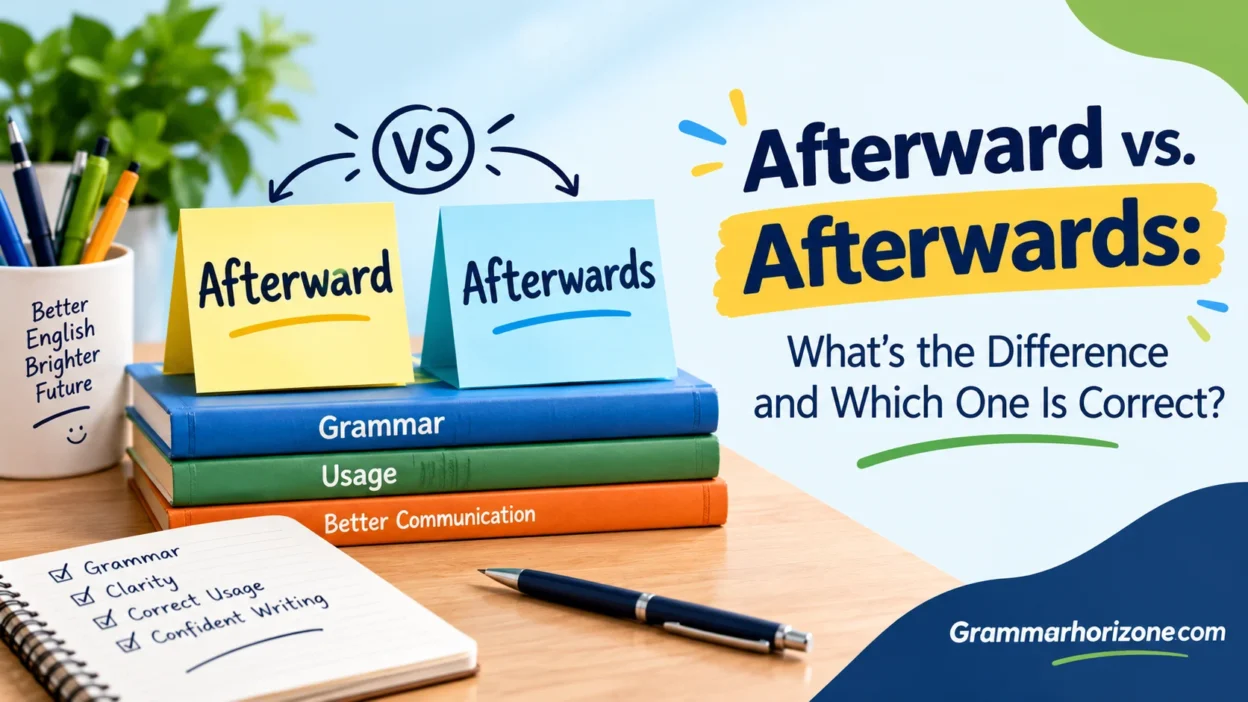
Afterward vs. Afterwards can be confusing when you’re learning English or improving your writing. However, both words are correct and have the same meaning. They are adverbs that describe something happening later, usually following a particular event or action. For example, you might finish a meeting and go to lunch afterward or afterwards. Both forms describe a subsequent action and show the time and sequence of events. Their grammatical function and basic usage are the same.
The main spelling difference comes from regional preference. Afterward is the standard spelling in American English, while afterwards is more common in British English. This regional variation appears in newspapers, books, and other publications. In American usage, writers generally prefer the shorter form, whereas British usage favors the longer version. Both are accepted word forms in the English language. When making a word choice for written English, follow the language rules and style guide of your publication.
From a practical grammar perspective, you can use either spelling without changing your sentence structure. For example, “We had dinner and went for a walk afterward” and “We had dinner and went for a walk afterwards” are equally correct. When editing English publications, focus on consistency rather than treating one form as better. Understanding adverbial usage, linguistic variation, vocabulary, and grammatical usage makes this choice easier. These spelling conventions and word preferences reflect language differences between American and British English. Both spellings describe a later occurrence or something happening later in relation to an earlier event.
Quick Answer: Afterward vs. Afterwards
Afterward and afterwards both mean later, subsequently, or after something has happened. They are interchangeable in most situations, and neither spelling is grammatically incorrect.
The main difference is regional usage:
- Afterward: More common in American English.
- Afterwards: More common in British English.
- Meaning: Both words mean later or after that.
- Part of speech: Both function as adverbs.
- Correctness: Both are accepted English spellings.
Examples:
- We finished the meeting and went home afterward.
- We finished the meeting and went home afterwards.
Both sentences are correct. If you’re writing for an American audience, afterward is generally the preferred choice. If your audience follows British English, afterwards is usually more familiar.
What Does Afterward Mean?
Afterward is an adverb that means at a later time or following a particular event. It describes something that happens after an action, conversation, situation, or experience.
Writers use this word to explain the order of events without repeating the details of what happened first. It helps connect two actions and makes sentences easier to understand.
For example:
- She finished her homework and watched television afterward.
- We discussed the project and had lunch afterward.
- He realized his mistake afterward.
- The manager reviewed the documents and contacted the client afterward.
In these examples, the word indicates that the second action happened after the first. It doesn’t provide an exact time or tell readers how long someone waited. It simply establishes that one event followed another.
How to Use Afterward in a Sentence
You can place afterward at the beginning or end of a sentence. Its position depends on the sentence structure and the emphasis you want to create.
At the beginning of a sentence:
- Afterward, we decided to visit the museum.
- Afterward, she explained why she had changed her mind.
- Afterward, the team discussed the results.
In the middle of a sentence:
- The company afterward announced several changes.
- The manager afterward contacted the employees.
At the end of a sentence:
- We went out for dinner afterward.
- He apologized afterward.
- I’ll speak with you afterward.
The ending position is particularly common in everyday English. However, beginning a sentence with afterward is also grammatically correct.
What Does Afterwards Mean?
Afterwards is an adverb that means later, subsequently, or following an event. It has the same definition and grammatical function as afterward. The additional letter s doesn’t give it a different meaning.
This spelling is especially common in British English, although American English speakers also use it.
For example:
- We visited the library and went shopping afterwards.
- She felt much better afterwards.
- They discussed the results afterwards.
- He called his parents afterwards.
Each sentence describes an action that takes place after something else. The word helps readers understand the sequence without requiring an exact time reference.
How to Use Afterwards in a Sentence
You can use afterwards in the same sentence positions as afterward. It works naturally in everyday conversations, professional communication, and academic writing.
At the beginning of a sentence:
- Afterwards, we returned to the hotel.
- Afterwards, the teacher answered everyone’s questions.
- Afterwards, they decided to celebrate.
In the middle of a sentence:
- The company afterwards introduced a new policy.
- She afterwards explained the reason for her decision.
At the end of a sentence:
- We went to the park afterwards.
- I’ll send you the details afterwards.
- They talked about the experience afterwards.
The word is especially natural in British English. However, its use isn’t limited to the United Kingdom.
Main Differences Between Afterward vs Afterwards
The main difference between afterward and afterwards is their regional preference. Both words describe something that happens later, and neither has a different grammatical meaning.
Understanding their similarities and regional differences can help you choose the right spelling for your writing.
Meaning and Definition
Both words mean later or after a previously mentioned event. They help explain when something happens in relation to another action.
Consider these examples:
- I completed the assignment and submitted it afterward.
- I completed the assignment and submitted it afterwards.
Both sentences communicate the same information. In each example, submitting the assignment happens after completing it.
You can also replace either word with expressions such as later, subsequently, or after that, depending on the context.
American English Usage
In American English, afterward is generally the more common spelling.
You can find it in American books, newspapers, professional documents, academic assignments, and everyday communication.
For example:
- The meeting ended, and everyone left afterward.
- She reviewed the report and made corrections afterward.
- We visited our grandparents afterward.
However, afterwards isn’t incorrect in the United States. It is also an accepted spelling, although afterward is generally preferred.
British English Usage
In British English, afterwards is generally more common.
British writers frequently use it in newspapers, books, academic materials, professional documents, and everyday conversations.
For example:
- We went to the cinema and had dinner afterwards.
- She spoke with her teacher afterwards.
- They visited their friends afterwards.
British English also accepts afterward. However, afterwards is usually the more familiar regional choice.
Spelling Difference
The visible spelling difference between the two words is the final letter s.
- Afterward: A-F-T-E-R-W-A-R-D
- Afterwards: A-F-T-E-R-W-A-R-D-S
The additional letter doesn’t change the basic meaning or grammatical function. Both spellings are standard adverbs.
You don’t need to memorize separate definitions. Instead, remember which spelling is generally preferred in your target variety of English.
Afterward vs. Afterwards: Comparison Table
The following table highlights the similarities and differences between the two words.
| Feature | Afterward | Afterwards |
| Meaning | Later or after that | Later or after that |
| Part of speech | Adverb | Adverb |
| American English | More common | Also accepted |
| British English | Also accepted | More common |
| Spelling | Without s | With s |
| Grammatical role | Describes a later action | Describes a later action |
| Formal writing | Correct | Correct |
| Informal writing | Correct | Correct |
As the comparison shows, neither spelling is grammatically superior. Your choice should depend mainly on your audience and preferred English spelling convention.
When to Use Afterward or Afterwards
Although both spellings are correct, choosing one consistently can make your writing clearer and more professional.
When to Use Afterward
Choose afterward when you’re writing in American English or following an American publication’s style guide.
It works well in:
- Business emails
- Academic assignments
- Professional reports
- Newspaper articles
- Blog posts
- Everyday conversations
Examples:
Business writing: The manager reviewed the proposal and contacted the department afterward.
Academic writing: The researchers collected the information and analyzed the results afterward.
Everyday communication: Let’s finish shopping and grab something to eat afterward.
In each situation, afterward clearly shows that one event follows another.
When to Use Afterwards
Choose afterwards when you’re writing in British English or following a British publication’s style guide.
It works naturally in:
- British academic writing
- Personal letters
- Professional correspondence
- News articles
- Everyday conversations
- Informal storytelling
Examples:
Business writing: The director reviewed the proposal and spoke with the employees afterwards.
Academic writing: The students completed the experiment and discussed their observations afterwards.
Everyday communication: We can visit the market and have lunch afterwards.
The spelling is also suitable for other English-speaking audiences that commonly follow British spelling conventions.
Maintain Consistency in Your Writing
Consistency matters more than treating one spelling as universally correct.
For example, if you’re writing an American English article, using afterward throughout the article is a sensible choice. If you’re preparing a British English document, afterwards will usually fit better.
Avoid switching between the two spellings without a clear reason.
Inconsistent:
We finished the meeting afterward. We went for coffee afterwards and returned to the office later.
Consistent American English:
We finished the meeting afterward. We went for coffee afterward and returned to the office later.
Consistent British English:
We finished the meeting afterwards. We went for coffee afterwards and returned to the office later.
Following one spelling convention makes your writing look more polished.
Afterward vs Afterwards in Different Sentences
Understanding examples is one of the easiest ways to learn how to use these words naturally. Both spellings work in everyday conversations, professional communication, and storytelling.
Everyday Conversation Examples
- I’ll call you afterward.
- We can talk about it afterwards.
- She went home afterward.
- They decided to get something to eat afterwards.
- He finished his work and relaxed afterward.
- We watched a movie and went to bed afterwards.
These examples show how both words fit naturally into ordinary conversations.
Academic and Professional Examples
- The professor explained the lesson and answered questions afterward.
- The students completed their assignments and submitted them afterwards.
- The company reviewed its financial performance afterward.
- The research team discussed the findings afterwards.
- The manager contacted the client afterward.
- The employees attended a training session and completed an assessment afterwards.
In professional and academic settings, both words communicate the sequence of events clearly.
Storytelling and Narrative Examples
- She opened the old box and smiled afterward.
- He remembered the conversation afterwards.
- They left the building and discussed what had happened afterward.
- The children played outside and went inside afterwards.
- She received the letter and called her brother afterward.
- He realized the importance of the decision only afterwards.
In storytelling, these words help move the narrative forward. They allow writers to describe what happened next without repeating longer phrases.
Conclusion
Both afterward and afterwards are correct spellings with the same meaning and grammatical function. The main difference is regional preference: American English generally uses afterward, while British English favors afterwards. You can use either form without changing your sentence’s meaning. Just follow your preferred English style and remain consistent throughout your writing.
Frequently Asked Questions
Q1. Is afterward or afterwards correct?
Both are correct. Afterward is common in American English, while afterwards is preferred in British English.
Q2. What is the main difference between afterward and afterwards?
The main difference is regional spelling preference. Both words mean something happens later or following an event.
Q3. Is afterward American or British English?
Afterward is the preferred spelling in American English.
Q4. Is afterwards more common in British English?
Yes. Afterwards is widely used in British English and other varieties that follow British spelling conventions.
Q5. Can I use afterward and afterwards in the same sentence?
Yes, both words are grammatically correct. However, it’s better to choose one form and use it consistently throughout your writing.