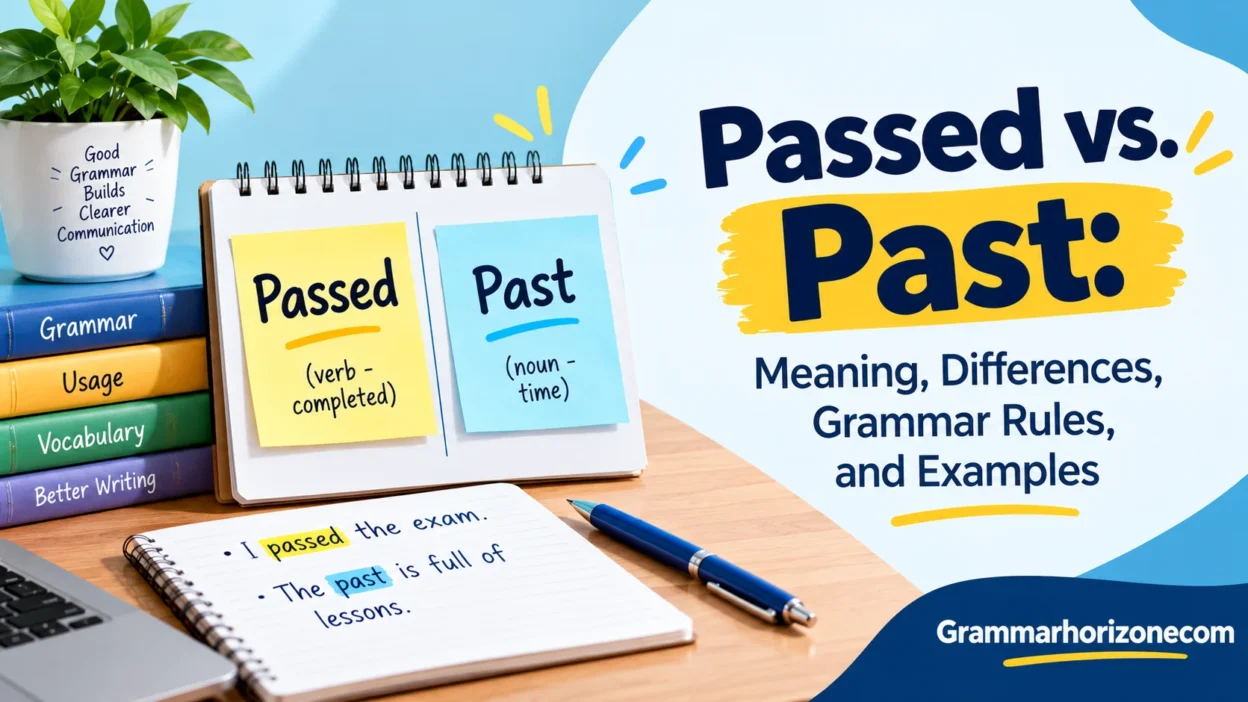
Passed vs. Past can be confusing because both words sound exactly the same when spoken, but they have different meanings and grammatical functions. Both are homophones, which means you cannot use them interchangeably. Passed is the past tense and past participle of the verb pass. It describes an action, such as completing a task or moving through something. In contrast, past refers to an earlier time, a previous experience, or movement beyond a particular point.
Understanding how these words work in different situations can help you avoid common spelling mistakes and grammar mistakes. For example, “I passed my driving test” is correct because passed ” describes an action that has already happened. However, “I walked past the library” is also correct because past describes movement beyond a location. Although their spellings look similar, each word has a different purpose in proper contexts.
When choosing between these words, pay attention to the meaning of your sentence rather than how it sounds. Using the wrong one can change the entire meaning. A simple way to remember the difference is to use passed when describing an action and past when referring to an earlier time or something beyond a place. This small distinction will make your writing clearer and more accurate.
Quick Answer: Passed vs. Past
Passed is the past tense and past participle of the verb pass. It describes an action that has already happened, such as succeeding in an examination, moving beyond something, handing an object to someone, or the progression of time.
Past refers to an earlier time, previous events, or something beyond a particular point. It can function as a noun, adjective, adverb, or preposition.
Here are two simple examples:
- Passed: Sarah passed her driving test on the first attempt.
- Past: Sarah walked past the school on her way home.
The easiest way to remember the difference is that passed describes an action, while past generally refers to time, position, or movement beyond something.
What Does Passed Mean?
Passed is the simple past tense and past participle of the verb pass. It describes an action or process that has been completed. Depending on the context, it can mean moving beyond something, succeeding in a test, transferring an object, or allowing time to go by.
For example, when someone says, “I passed my English examination,” passed means that the person achieved the required result. In another sentence, “The bus passed our house,” it describes the bus moving beyond a particular location.
Passed is a verb, so it usually describes what someone or something did. It can appear in different sentence structures depending on the tense and meaning.
Common Uses of Passed
Passed has several meanings in everyday English. Understanding these uses will help you recognize when it is the correct word.
1. To Move Beyond Someone or Something
Use passed when a person, vehicle, or object moves ahead of or beyond another person or place.
Examples:
- The runner passed two competitors before reaching the finish line.
- A large truck passed our vehicle on the highway.
- She passed me while walking through the shopping center.
- The train passed the station without stopping.
2. To Succeed in an Examination
Passed also means successfully completing a test, examination, or assessment by achieving the required result.
Examples:
- James passed his mathematics examination.
- My sister passed her driving test on the first attempt.
- Most students passed the final assessment.
- I studied hard and passed my English test.
3. To Give or Transfer Something
Use passed when someone hands an object to another person or transfers something from one individual to another.
Examples:
- He passed the salt to his father.
- The teacher passed the papers around the classroom.
- Maria passed the football to her teammate.
- Please pass me the notebook.
4. When Time Moves Forward
Passed can describe time moving forward or a period coming to an end.
Examples:
- Several hours passed before the doctor arrived.
- The summer passed more quickly than we expected.
- A few minutes passed while everyone waited.
- Many years passed before they met again.
5. To Describe Someone’s Death
Passed appears in the expression “passed away,” which is a polite and gentle way of saying that someone has died.
Examples:
- Her grandfather passed away peacefully.
- We remembered our friend who passed away last year.
- His beloved teacher passed away after a long illness.
Passed in Different Verb Tenses
Understanding the different forms of the verb pass can help you use passed correctly.
| Verb form | Example |
| Present tense | I pass the library every morning. |
| Simple past | I passed the library yesterday. |
| Past participle | I have passed the library several times. |
| Present continuous | I am passing the library now. |
| Past continuous | I was passing the library when it started raining. |
| Future tense | I will pass the library tomorrow. |
Remember that passed is used for both the simple past form and the past participle of pass. Helping verbs such as has, have, and had can appear before the past participle.
What Does Past Mean?
Past refers to a period before the present or something beyond a particular point in time, distance, or direction. Unlike passed, it is not a verb. It can function as a noun, adjective, adverb, or preposition.
For example, in the sentence “I often think about my past,” the word past refers to earlier experiences. In “We walked past the restaurant,” it describes movement beyond a particular location.
Past also appears in common expressions such as past mistakes, past experience, past midnight, and in the past.
Past as a Noun
As a noun, past refers to an earlier period, previous experiences, or events that have already happened. It can describe someone’s personal history or the history of a particular place, organization, or society.
Examples:
- We should learn from the mistakes of the past.
- She often talks about her past.
- The town has an interesting past.
- His past continues to influence his decisions.
- We cannot change what happened in the past.
In these examples, past identifies something that belongs to an earlier time rather than the present.
Past as an Adjective
As an adjective, past describes something that happened, existed, or belonged to an earlier period. It usually appears before a noun and provides information about when something occurred.
Examples:
- The past year brought several changes to our business.
- She learned valuable lessons from past experiences.
- Our past mistakes helped us make better decisions.
- Three past presidents attended the ceremony.
- The past few months have been challenging.
Here, past modifies nouns such as year, experiences, mistakes, presidents, and months.
Past as an Adverb
As an adverb, past describes movement beyond or by a particular person, object, or location. It helps explain where something moves in relation to another point.
Examples:
- The children ran past without stopping.
- A motorcycle sped past.
- She walked past and waved at me.
- The dog ran past and disappeared around the corner.
- We watched the parade march past.
In these sentences, past modifies the action and explains the direction or movement.
Past as a Preposition
As a preposition, past shows that something is beyond a particular location, point, or time. It usually comes before a noun or noun phrase.
Examples:
- The pharmacy is just past the supermarket.
- We drove past the old railway station.
- The temperature dropped past freezing.
- She stayed awake past midnight.
- The school is located past the main entrance.
In these sentences, past establishes a relationship between an action or position and another reference point.
Passed vs. Past: Main Differences
The main difference between passed vs. past is their grammatical function. Passed is the past tense and past participle of the verb pass, while past can function as a noun, adjective, adverb, or preposition.
Both words can relate to movement or time, which explains why people sometimes confuse them. However, their roles in sentences are different.
| Passed | Past |
| Past tense of the verb pass | Refers to an earlier time or position |
| Functions as a verb | Functions as a noun, adjective, adverb, or preposition |
| Describes completed actions | Describes time, position, or direction |
| She passed the examination. | She studied in the past. |
| He passed the building. | He walked past the building. |
| Time passed quickly. | We discussed past events. |
| He passed the ball. | The ball rolled past the goal. |
Important grammar rule: Passed is a verb form, while past is not a verb. When you need the past form of pass, you should use passed.
Passed vs. Past in Similar Sentences
Sometimes both words can appear in sentences with similar meanings. However, their grammatical roles remain different.
Consider these examples:
- Passed: The car passed our house.
- Past: The car drove past our house.
Both sentences describe a car moving beyond a house. In the first sentence, passed is the main verb. In the second, drove is the main verb, and past describes the car’s movement in relation to the house.
Here are more comparisons:
- Passed: He passed the school on his way to work.
- Past: He walked past the school on his way to work.
- Passed: She passed the deadline without submitting her assignment.
- Past: The deadline is now in the past.
- Passed: The teacher passed the papers to the students.
- Past: The students talked about their past experiences.
These comparisons show why you should consider the complete sentence instead of choosing a word based only on how it sounds.
When to Use Passed
Use passed when describing an action associated with the verb pass. It is appropriate when something has moved beyond another object, someone has succeeded in a test, an item has been transferred, or time has moved forward.
Here are the main situations in which passed is correct:
- Completed movement: Use passed when someone or something moves beyond another person or location.
- Successful examination: Use passed when someone achieves the required result in a test or course.
- Giving something: Use passed when a person hands an object to someone else.
- Progression of time: Use passed when describing time that has gone by.
- Death: Use passed away as a polite expression for someone’s death.
- Transfer of information: Use passed when information, instructions, or messages are communicated to another person.
Examples:
- The bus passed our street without stopping.
- I passed my science test last week.
- She passed the documents to her manager.
- Two hours passed before the meeting began.
- His grandmother passed away peacefully.
- The manager passed the instructions to the entire team.
A useful way to check your sentence is to replace passed with another past-tense action word, such as moved, handed, or succeeded. If the sentence still makes sense, passed may be the correct choice.
When to Use Past
Use past when referring to an earlier period, previous experiences, or something beyond a particular point. It is also the correct word when describing movement beyond a place without using pass as the main verb.
Here are the main situations in which past is appropriate:
- Earlier time: Use past when discussing events that happened before the present.
- Previous experiences: Use past when referring to something that happened earlier in someone’s life.
- Earlier periods: Use past before nouns such as week, month, year, and decade.
- Movement beyond a location: Use past when describing someone or something moving beyond a particular place.
- Time on a clock: Use past when telling the time, such as half past five.
- A point beyond a limit: Use past when describing something that goes beyond a particular stage, level, or boundary.
Examples:
- I learned many lessons from my past.
- The past few weeks have been very busy.
- We walked past the grocery store.
- It is half past seven.
- The conversation continued past midnight.
- She pushed herself past the point of exhaustion.
Remember that past can describe both time and physical position. Choose it according to the meaning and grammatical structure of your sentence.
Passed vs. Past in Everyday Expressions
Both words appear in several common English expressions. Learning these phrases will help you recognize the correct spelling without having to think about the grammar every time.
Common Expressions With Passed
Passed away: A polite expression meaning someone has died.
Example: My uncle passed away several years ago.
Passed down: Used when something is transferred from one generation or person to another.
Example: This family tradition was passed down through generations.
Passed out: Means to lose consciousness or distribute something, depending on the context.
Example: He passed out after standing in the heat for too long.
Passed on: Can mean transferring something, declining an opportunity, or dying, depending on the context.
Example: She passed on the opportunity to join the company.
Passed through: Describes movement through a place or area.
Example: We passed through several small towns during our journey.
Passed the test: Means successfully completing an examination or assessment.
Example: Daniel passed the test on his first attempt.
Common Expressions With Past
In the past: Refers to an earlier period.
Example: People relied more on handwritten letters in the past.
Past experience: Refers to something someone has experienced before.
Example: Her past experience helped her solve the problem.
Past mistakes: Refers to errors made previously.
Example: We should learn from our past mistakes.
Past due: Describes something that should have been completed or paid by an earlier deadline.
Example: Your electricity bill is past due.
Past midnight: Refers to a time later than midnight.
Example: The students continued studying past midnight.
The past few days: Refers to several days immediately before the present.
Example: It has rained heavily over the past few days.
Conclusion
Understanding the difference between passed and past makes your writing clearer and helps you avoid common grammar mistakes. Remember that passed describes an action, while past refers to an earlier time, a previous experience, or movement beyond a location. Although both words sound the same, using them in the correct context will make your sentences more accurate and easier to understand.
Frequently Asked Questions
Q1. What is the main difference between passed and past?
Passed is the past tense and past participle of the verb pass, while past refers to an earlier time or something beyond a particular point.
Q2. Is passed a verb or an adjective?
Passed is primarily the past tense and past participle of the verb pass. It can also function as an adjective in certain contexts.
Q3. Is past ever used as a verb?
No. Past is not a verb. It can function as a noun, adjective, preposition, or adverb.
Q4. Is it passed my house or past my house?
Use past my house when describing movement beyond your house. For example, “She walked past my house.”
Q5. Why do passed and past sound the same?
Passed and past are homophones. They have the same pronunciation but different spellings, meanings, and grammatical functions.