In English grammar, would vs will, closely related words, common grammar topic, English learners, modal auxiliary verbs, modal verbs, auxiliary verbs, actions, intentions, possibilities, future events, different meanings, grammatical functions, correct word choice, situation, speaker’s purpose, intended message, future actions, decisions, promises, predictions, willingness, hypothetical situations, conditional results, polite requests, preferences, past habits, past perspective, everyday communication
Word usage, sentence meaning, grammar rules, clear intention, future intention, conditional action, condition, available time, expected action, imagined possibility, contextual meaning, action dependency, time reference, correct usage, similar sentences, understanding differences, sentence construction, verb forms, sentence structure, conditional situations, natural sentences, modal verbs
Grammatical accuracy, language learning, English language, everyday conversations, spoken communication, professional settings, direct statement, softer tone, polite language, personal preferences, academic writing, written communication, future perspective, purpose of a sentence, modal auxiliary usage, communication skills, language clarity, future predictions, grammatical distinctions, meaningful expression, correct expression, confidence
Quick Answer: Would vs Will
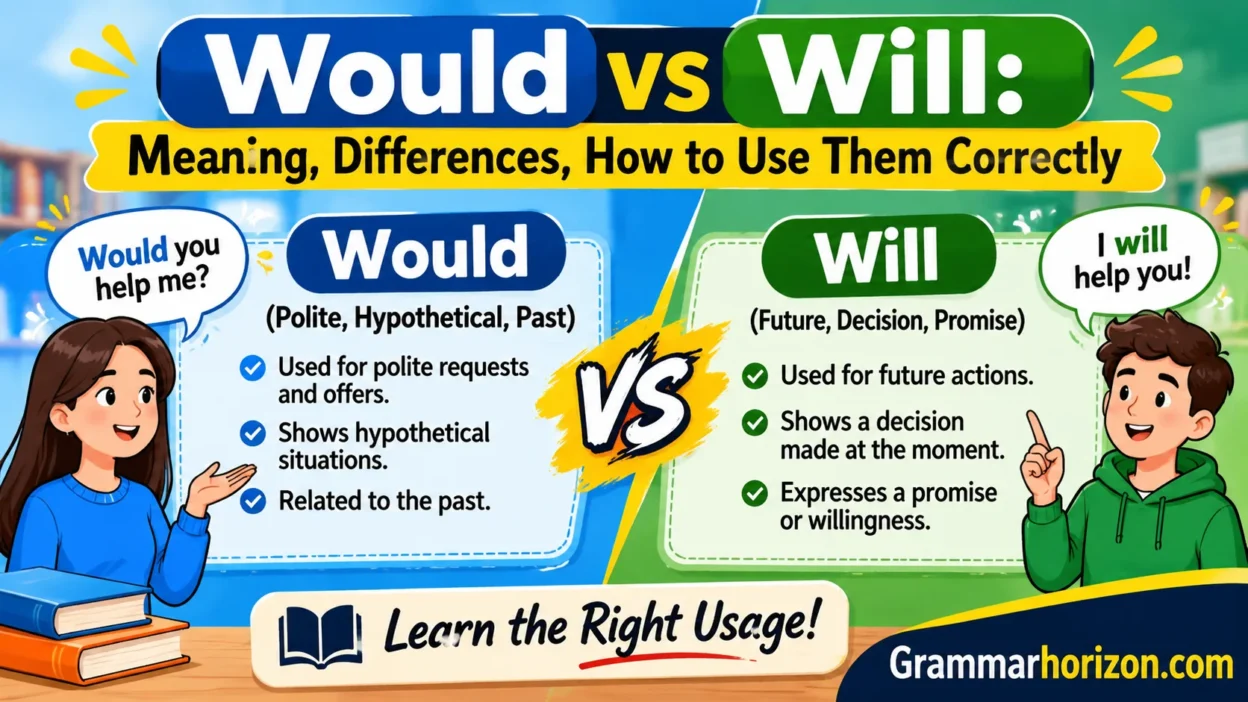
The main difference between would and will is that will generally expresses future intentions or expected actions, while would commonly express hypothetical situations, polite requests, preferences, and conditional outcomes.
- Will: Used for future actions, spontaneous decisions, promises, predictions, and willingness.
- Would: Used for hypothetical situations, conditional actions, polite requests, preferences, past habits, and reported speech.
| Would | Will |
| Expresses hypothetical situations. | Expresses future actions and intentions. |
| Makes requests sound more polite. | Makes direct requests and offers. |
| Describes conditional results. | Describes expected future results. |
| Can describe repeated past habits. | Can express promises and commitments. |
| Example: I would help if I could. | Example: I will help you tomorrow. |
Simple rule: Use will when discussing something you intend or expect to happen. Use would when discussing something imagined, conditional, polite, or viewed from a past perspective.
What Does Will Mean?
Will is a modal auxiliary verb used to express future actions, decisions, intentions, predictions, promises, and willingness. It helps describe events that are expected or intended to happen after the present moment.
Will does not change its form according to the subject. You can use it with I, you, he, she, it, we, and they.
Examples:
- I will visit my parents tomorrow.
- She will complete her assignment.
- They will attend the meeting.
- We will support your decision.
In each sentence, will communicates an action that the speaker expects, intends, or promises to happen.
Uses of Will in English
There are several situations in which will is appropriate. Understanding these uses helps you recognize when it is the correct choice.
Expressing Future Actions
One of the most common uses of will is to describe future events and actions. It communicates something that is expected or intended to happen later.
Examples:
- I will visit the library tomorrow.
- She will start her new job next Monday.
- We will travel to New York next summer.
- The company will launch its new product soon.
These sentences describe actions that relate to the future rather than the present.
Making Spontaneous Decisions
Use will when you make a decision at the moment of speaking. These decisions are often responses to situations that happen unexpectedly.
Examples:
- The phone is ringing. I will answer it.
- I am feeling tired. I will take a short break.
- Someone is at the door. I will check.
- We need more chairs. I will bring some.
In these examples, the speaker decides what to do while speaking.
Making Promises and Commitments
Will is also used to make promises and communicate commitments. It shows that someone intends to perform an action or take responsibility.
Examples:
- I will always support you.
- I will never share your secret.
- We will complete the project on time.
- She will return your money tomorrow.
These statements communicate commitment rather than simply describing a possible future event.
Expressing Predictions and Expectations
You can use will to make predictions about future events based on your knowledge, expectations, or opinions.
Examples:
- It will rain tomorrow.
- The team will probably win the match.
- This technology will change the industry.
- You will enjoy the movie.
These sentences express what the speaker believes is likely to happen. However, a prediction using will does not guarantee that the event will occur.
Showing Willingness or Determination
Will can also express someone’s willingness to perform an action or determination to achieve a goal.
Examples:
- I will help you move the furniture.
- She will do whatever it takes to succeed.
- He will not accept unfair treatment.
- They will work together to solve the problem.
In these sentences, will communicates readiness, determination, or a firm decision.
What Does Would Mean?
Would is a modal auxiliary verb commonly used as the past form of will in reported speech and future-in-the-past constructions. It also expresses hypothetical situations, conditional results, polite requests, preferences, and repeated actions in the past.
Although would is closely connected to will, its meaning changes according to the context.
Examples:
- I would buy that car if I had enough money.
- Would you please close the window?
- She said she would visit us.
- We would play outside every evening as children.
These sentences demonstrate different uses of would, including hypothetical actions, polite requests, reported speech, and repeated past habits.
Uses of Would in English
Would has several important grammatical functions. It helps speakers express ideas that might be imagined, conditional, polite, or connected to past experiences.
Describing Hypothetical or Imaginary Situations
Would is commonly used when discussing situations that are imagined rather than presented as definite facts.
Examples:
- I would live near the beach if I could afford it.
- She would travel around the world if she had enough money.
- He would become a doctor if he enjoyed studying medicine.
- We would buy a bigger house if we had more savings.
These sentences describe situations that are not currently true or depend on certain circumstances.
Expressing Conditional Results
Would frequently appear in conditional sentences to explain what could happen if a particular condition were fulfilled.
Examples:
- If I had more time, I would learn another language.
- If she studied harder, she would pass the examination.
- If we lived closer, we would visit you more often.
- If he knew the answer, he would tell us.
In each example, the action involving would depend on the condition introduced by if.
Making Polite Requests and Offers
Would can make questions, requests, and offers sound more respectful and less direct. It is especially useful in professional communication and formal conversations.
Examples:
- Would you help me with this task?
- Would you mind opening the window?
- Would you like some coffee?
- Would you like to join us for dinner?
These expressions sound courteous because they allow the listener to respond without feeling pressured.
Expressing Preferences and Wishes
Use would to communicate preferences, choices, and things someone wants to happen.
Examples:
- I would rather stay home tonight.
- She would like to become a teacher.
- We would prefer a quieter restaurant.
- He would rather travel by train.
The expressions would rather and would like are particularly common in everyday English.
Describing Repeated Actions in the Past
Would can describe actions that happened repeatedly in the past, particularly when recalling memories, routines, or familiar experiences.
Examples:
- My grandfather would tell us stories every evening.
- We would play football after school.
- She would visit her grandmother every Sunday.
- During summer holidays, they would swim in the river.
In this usage, would describe repeated past behavior rather than a hypothetical situation.
Expressing Future Actions from a Past Perspective
Would is also used when discussing something someone expected or intended to happen in the future from an earlier point in time.
Examples:
- She said she would call me later.
- He promised he would finish the work.
- They believed the project would succeed.
- I knew you would understand.
The action was in the future when the original statement or thought occurred.
Main Differences Between Would vs Will
Although would and will are closely related, their grammatical functions and meanings are different. Choosing the correct word depends on whether you are discussing a future intention, a hypothetical situation, a polite request, or an event viewed from the past.
Difference in Meaning and Purpose
Will generally communicates future actions, decisions, predictions, promises, and willingness.
Would generally communicate hypothetical situations, conditional results, preferences, polite requests, and future-in-the-past situations.
Examples:
- I will attend the conference tomorrow.
- I would attend the conference if I were available.
The first sentence communicates an intention. The second describes an action that depends on a condition.
Difference in Certainty and Commitment
Will often sounds more direct because it communicates a decision, intention, or prediction.
Would can sound less definite because it frequently describes imagined situations or actions that depend on particular conditions.
Examples:
- I will help you with the assignment.
- I would help you with the assignment if I had time.
The first sentence expresses a commitment. The second makes assistance conditional.
However, this difference is not absolute. Would can also express firm intentions in reported speech, while will can communicate predictions rather than certainty.
Difference in Politeness
Would is often more polite than will when making requests or offering something.
Compare these examples:
- Will you help me?
- Would you help me?
Both questions are grammatically correct. However, would generally sounds softer and more courteous.
This difference is useful when speaking with customers, colleagues, managers, or people you do not know well.
Difference in Hypothetical Situations
Would is commonly used to describe imagined situations and their possible results. Will is generally used when discussing expected results in real or open future conditions.
Examples:
- If it rains, we will stay inside.
- If it rained, we would stay inside.
The first sentence presents a possible future condition. The second presents a more hypothetical possibility.
Would vs Will Comparison Table
| Feature | Will | Would |
| Main purpose | Future intentions and actions | Hypothetical actions and other conditional meanings |
| Future predictions | Commonly used | Used in specific contexts |
| Promises | Commonly used | Used in reported promises |
| Polite requests | Can be used | Often preferred |
| Hypothetical situations | Not the usual choice | Commonly used |
| Past habits | Not normally used | Commonly used |
| Conditional sentences | First conditional | Second and third conditionals |
| Reported speech | Direct speech | Often replaces will |
| Example | I will help you. | I would help you if I could. |
When to Use Will
Knowing the specific situations in which will is appropriate can help you avoid unnecessary confusion.
Use will in the following situations:
- Future actions: I will visit my uncle tomorrow.
- Spontaneous decisions: I will answer the phone.
- Promises: I will keep your secret.
- Predictions: The weather will improve soon.
- Willingness: I will help you with your homework.
- Determination: We will never give up.
- Offers: I will carry your bags.
Examples of Will in Everyday Sentences
Here are additional examples showing how will works in different situations:
- I will send you the documents tonight.
- They will arrive at the airport at noon.
- She will explain the instructions again.
- We will discuss the problem tomorrow.
- He will take responsibility for his actions.
- The children will enjoy the school trip.
- I will contact you when I reach home.
- Our teacher will announce the results next week.
In each example, will expresses an intended, expected, or predicted action.
When to Use Would
Would has several important functions in English. It is especially useful when you want to discuss imagined circumstances, make polite requests, describe preferences, or refer to repeated past actions.
Use would in the following situations:
- Hypothetical situations: I would move abroad if I had the opportunity.
- Conditional results: She would succeed if she worked harder.
- Polite requests: Would you please help me?
- Offers: Would you like another cup of tea?
- Preferences: I would rather stay at home.
- Past habits: We would visit the park every weekend.
- Reported speech: He said he would arrive early.
- Future in the past: I knew they would win.
Examples of Would in Everyday Sentences
- I would love to visit Italy.
- She would help her neighbors whenever they needed assistance.
- He would buy a new laptop if he had enough money.
- We would appreciate your feedback.
- They would prefer to travel during the winter.
- My father would read bedtime stories to us.
- I would never make that decision without thinking.
- She would accept the invitation if she were available.
These examples show that would can communicate several meanings beyond its connection with the past tense of will.
Would vs Will in Conditional Sentences
Conditional sentences explain the relationship between a condition and its possible result. Both would and will appear in conditional structures, but their use depends on whether the situation is realistic, hypothetical, or related to an unreal past event.
First Conditional: Will
The first conditional describes a realistic possibility in the future. It commonly follows this structure:
If + present simple, will + base form of the verb.
Examples:
- If it rains, we will cancel the picnic.
- If you study regularly, you will improve your English.
- If she arrives early, we will start the meeting.
- If they invite me, I will attend the event.
These sentences describe possible future situations and their expected results.
Second Conditional: Would
The second conditional describes hypothetical or unlikely situations in the present or future.
Its structure is:
If + past simple, would + base form of the verb.
Examples:
- If I had more money, I would buy a new car.
- If she lived nearby, we would meet more often.
- If he worked harder, he would achieve better results.
- If I were you, I would accept the offer.
The past simple form in this structure does not necessarily refer to past time. Instead, it helps communicate that the situation is hypothetical or less likely.
Third Conditional: Would Have
The third conditional describes an unreal past situation and its imagined result.
Its structure is:
If + past perfect, would have + past participle.
Examples:
- If I had studied harder, I would have passed the examination.
- If she had left earlier, she would have caught the train.
- If they had invited us, we would have attended the party.
- If he had saved money, he would have bought the house.
These sentences describe events that did not happen and imagine a different past result.
Important Rule About Would in If-Clauses
In standard second and third conditional structures, would normally appear in the main clause rather than the if-clause.
Incorrect: If I would have more time, I would help you.
Correct: If I had more time, I would help you.
However, would can appear in an if-clause in certain special situations, such as when expressing willingness or making a polite request.
Example:
– If you would wait here, the manager will speak with you shortly.
Here, would expresses willingness rather than forming a standard second conditional.
Would vs Will in Reported Speech
Reported speech allows you to communicate what someone said without repeating their exact words. In many situations, will changes to would when a statement is reported using a past reporting verb.
This change is called backshifting.
For example:
Direct speech: She said, “I will visit you tomorrow.”
Reported speech: She said that she would visit me the following day.
Notice that will changes to would because the reporting verb said is in the past.
Examples of Will Changing to Would
- Direct: He said, “I will help you.”
- Reported: He said he would help me.
- Direct: They said, “We will finish the project.”
- Reported: They said they would finish the project.
- Direct: Sarah said, “I will call you.”
- Reported: Sarah said she would call me.
- Direct: The teacher said, “The examination will begin at nine.”
- Reported: The teacher said the examination would begin at nine.
When Does Will Not Need to Change to Would?
Backshifting is not always necessary. If the statement remains true or refers to a future event that is still relevant, the original tense may be retained.
For example:
– The manager said that the office will remain closed tomorrow.
This can be appropriate when the closure is still in the future and the speaker wants to emphasize its current relevance.
The choice depends on the context and the speaker’s intended meaning.
Conclusion
Understanding the difference between would vs will makes English communication clearer and more natural. Although both are modal auxiliary verbs, they serve different purposes. Will generally expresses future actions, decisions, promises, and predictions, while would is commonly used for hypothetical situations, polite requests, preferences, and conditional results. Choosing the correct word depends on the context and intended meaning. With regular practice and attention to sentence structure, you can use both words confidently in everyday conversations, academic writing, and professional communication.
Frequently Asked Questions
Q1. What is the main difference between would and will?
Will expresses future actions, decisions, promises, and predictions. Would usually expresses hypothetical situations, conditional results, polite requests, and preferences.
Q2. Is would the past tense of will?
Yes, would is commonly used as the past form of will in reported speech and when describing future actions from a past perspective. However, it also has other uses, such as expressing hypothetical situations and polite requests.
Q3. When should I use will in a sentence?
Use will when talking about future actions, making promises, expressing willingness, or giving predictions.
Example: “I will finish my homework tonight.”
Q4. When should I use would instead of will?
Use would for hypothetical situations, conditional sentences, polite requests, and preferences.
Example: “I would travel more if I had enough money.”
Q5. Can would and will be used in the same sentence?
Yes. Both words can appear in the same sentence when they serve different grammatical purposes.
Example: “I will help you if I can, but I would need more time if the task becomes difficult.”