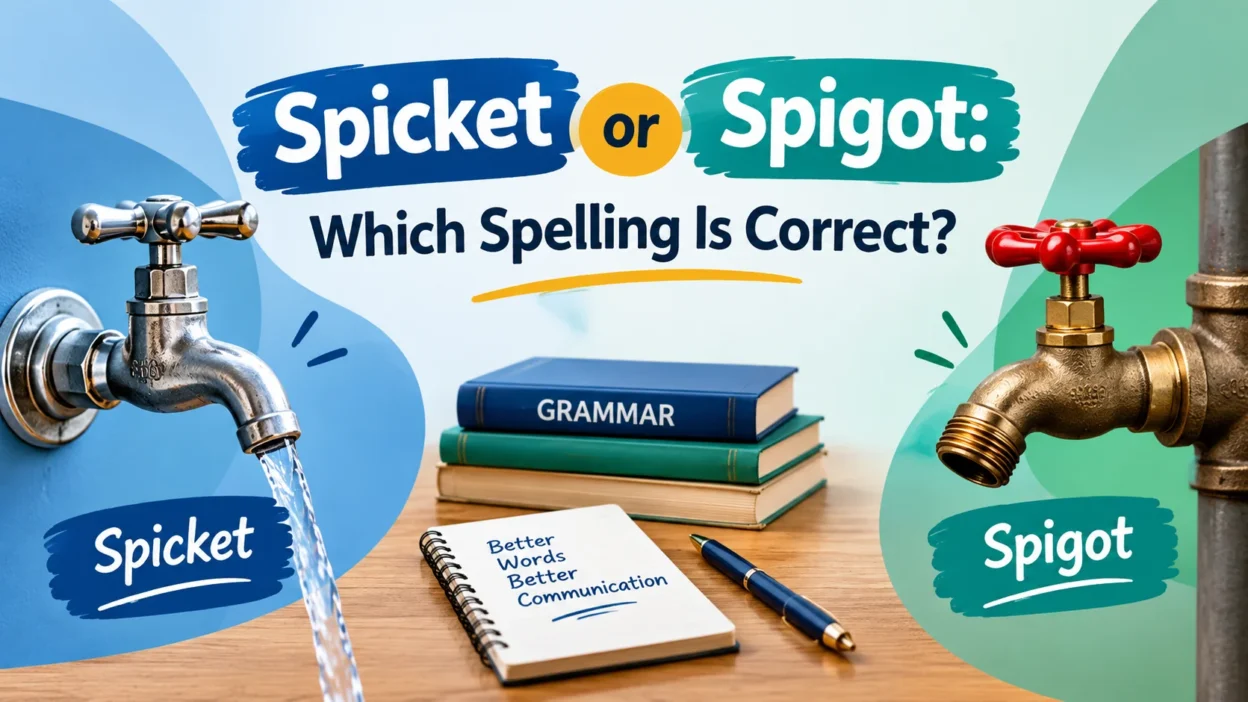
When Spicket or Spigot causes confusion, the key difference is usually spelling, not the basic meaning, because both can appear in everyday speech and sound similar. In standard English, spigot is the widely accepted and correct spelling for an outdoor water tap or faucet. In American English, it can describe a garden faucet, outdoor water taps, and other plumbing fixtures that control water. This difference often creates uncertainty because spigot appears in casual conversation and informal communication.
For spelling accuracy and communication clarity, spigot is the safest choice in formal contexts, such as an email, instructions, or professional writing. Spicket is commonly treated as a regional variant or spelling mistake in standard English. When you meet this tricky question, checking dictionaries can make the distinction easier than relying on pronunciation alone. The proper usage is to spell the word correctly as spigot when standard written English matters, whether you are fixing a plumbing problem or describing an outdoor faucet.
In everyday conversation, you may still hear a person use spicket, especially in a regional setting, but that does not make it the preferred written form. The answer becomes clearer when you separate speech from writing and understand the forms used in accepted English. Spigot remains the stronger choice when you want clear usage, accurate spelling, and a standard term for a tap or water fixture. Once you know this small detail, you can use the word with greater confidence in both casual and formal communication.
Quick Answer: Spicket or Spigot?
Spigot is the standard spelling you should normally use in American English.
A spigot is a device that controls the flow of liquid. In everyday American speech, it often refers to an outdoor water faucet where you attach a garden hose.
Spicket is also a real word. Dictionaries such as Merriam-Webster record it as a regional form of spigot, especially in parts of the South and Midland United States. That means someone who writes or says spicket isn’t necessarily inventing a word or making a random spelling error.
For general writing, however, choose spigot.
Best general choice: spigot
Regional variant: spicket
Comparison Overview
| Feature | Spigot | Spicket |
| Standard spelling | Yes | Regional variant |
| Basic meaning | A device that controls liquid flow | Same basic meaning |
| Common US use | Broad | Regional |
| Associated with Southern/Midland speech | Sometimes | More strongly |
| Suitable for formal writing | Yes | Usually avoid |
| Used for outdoor water faucets | Yes | Yes |
| Dictionary-listed | Yes | Yes |
The key point is simple: spigot has wider standard usage, while spicket has regional roots and recognition.
What Does Spigot Mean?
A spigot is a fitting, valve, or faucet that controls the release of liquid. The word can describe several types of devices depending on the setting.
You might encounter a spigot on:
- An outdoor wall
- A garden water line
- A barrel
- A tank
- A large container
- A plumbing system
- A keg or cask
In modern American English, the word commonly brings one image to mind: the outdoor faucet connected to a house.
For example:
Please turn off the spigot before you leave.
Here, spigot means the faucet controlling the water supply.
The word can also describe something that regulates a flow more generally. In figurative language, writers sometimes use spigot to describe something that can be opened, closed, increased, or reduced.
For instance:
The company turned off the financial spigot after sales declined.
The physical meaning comes first. The figurative meaning simply borrows the idea of controlling a flow.
What Does Spicket Mean?
Spicket has the same basic meaning as spigot, but its usage is more regional.
This distinction matters because many spelling guides oversimplify the issue by saying that spicket is simply wrong. That’s not entirely accurate. Major dictionaries recognize spicket as a regional variant of spigot.
In other words, the word exists. However, its geographic distribution and familiarity differ from the standard form.
If someone says:
The spicket is leaking.
They are referring to the same kind of outdoor faucet that another speaker might call a spigot.
The difference often comes down to regional vocabulary and pronunciation rather than meaning.
Main Differences Between Spicket or Spigot
The main difference is that spigot is the standard spelling, while spicket is a recognized regional variant used mainly in parts of the United States.
Spelling Difference
The most obvious difference is the ending.
- Spigot ends with -got
- Spicket ends with -cket
The spelling spigot represents the standard form used in dictionaries and general writing. Spicket developed as a regional variant and remains familiar in certain parts of the United States.
If you’re unsure which spelling to use, spigot is the better default.
Regional Usage
Regional English can produce words that sound unusual outside a particular area. Spicket provides a good example.
Speakers in parts of the South and Midland United States may use spicket naturally. Someone from another region may rarely encounter it.
That doesn’t automatically make the regional form “bad English.” Language doesn’t always follow one neat national pattern.
Consider everyday words such as soda, pop, and coke. People can use different terms for similar things depending on where they live. Vocabulary often carries a geographic fingerprint.
Spicket works in much the same way.
Formal and Informal Writing
When you’re writing for a broad audience, spigot is the stronger choice.
Use spigot in:
- Professional documents
- Instruction manuals
- Educational writing
- Plumbing information
- Business communication
- General articles
- Technical descriptions
You might use spicket when you’re deliberately representing regional speech or quoting someone.
For example, a writer describing a Southern character might retain the character’s regional vocabulary. In that situation, spicket can help preserve the voice.
Meaning
There isn’t a major meaning difference between the two forms.
Both can refer to a device that controls liquid flow, particularly a faucet or valve.
The major distinction concerns standardization and regional usage, not the object itself.
Why Do People Say or Write “Spicket”?
Pronunciation plays a major role in this confusion.
When people learn words through conversation rather than reading, they often spell unfamiliar words according to the sounds they hear. Regional pronunciation can make this effect even stronger.
If someone regularly hears a form that sounds closer to spicket, writing that form seems perfectly natural.
This happens with many English words. Spoken language comes first for most children, while spelling comes later. As a result, people naturally build connections between sound and letters.
Regional speech can reinforce those connections.
That’s one reason spicket continues to appear even though spigot remains the more widely accepted standard form.
Spigot or Spicket Pronunciation
The pronunciation of spigot can vary somewhat across speakers and regions. Some pronunciations can sound close enough to spigot that the spelling difference becomes difficult to notice in conversation.
That’s where the trap lies.
Imagine hearing someone say the word while standing outside with a garden hose. You probably aren’t thinking about its historical spelling. You’re thinking about turning the water on.
Later, when you need to write the word, you may remember the sound rather than the letters.
This is a classic example of why pronunciation alone doesn’t always reveal standard spelling.
The History of Spigot
The history of spigot helps explain why the word has been around for so long.
The term dates back to Middle English, with dictionary evidence placing its first known use in the 14th century. Earlier forms referred to a stopper, peg, or device used to control liquid in containers such as barrels and casks.
That older meaning connects naturally with the modern one.
Think about a wooden barrel filled with liquid. A small plug controls whether the liquid stays inside or flows out. Over time, the idea developed into the more familiar valve or faucet used in plumbing.
The basic concept hasn’t changed much:
A spigot controls a flow.
Modern plumbing simply made the mechanism more sophisticated.
Is Spicket a Misspelling or a Real Word?
Here’s where the answer gets interesting.
Spicket is a real word, but it isn’t the preferred general spelling.
That distinction is important.
Calling it a simple spelling error ignores its established regional use. At the same time, treating spicket and spigot as completely interchangeable in every context ignores the fact that spigot has much broader standard usage.
A useful way to think about it is:
Spigot = standard, widely recognized form
Spicket = recognized regional form
Therefore, if you’re writing for readers across the United States, spigot gives you the clearest and safest choice.
Spigot, Faucet, and Tap: What’s the Difference?
These words overlap, but regional habits influence how people use them.
| Word | Common meaning | Typical use |
| Spigot | Faucet or valve controlling liquid | Outdoor water connection |
| Faucet | Device controlling water flow | Kitchen or bathroom |
| Tap | Faucet or valve | Very common in British English |
| Spicket | Regional form of spigot | Regional US usage |
An American homeowner might say, “The outdoor spigot is leaking.”
The same person could call the fixture over the kitchen sink a faucet.
Meanwhile, British English commonly uses a tap for both indoor and outdoor water fixtures.
These differences aren’t always rigid. Context and regional habits influence word choice.
How to Use Spigot in a Sentence
Here are several natural examples:
- The garden hose is connected to the spigot.
- Please turn off the outdoor spigot.
- The plumber replaced the broken spigot.
- Water started leaking from the spigot.
- We installed a new frost-resistant spigot.
- The barrel has a small spigot near the bottom.
Notice how naturally spigot fits everyday American English.
The word works especially well when you’re talking about outdoor plumbing or a device that releases liquid.
How to Use Spicket in a Sentence
Because spicket is a regional form, you’ll most often see it in regional speech or writing.
For example:
- The spicket outside the house is leaking.
- Turn the spicket off before winter.
- Dad attached the hose to the spicket.
- The old spicket needs to be replaced.
These sentences aren’t difficult to understand. In fact, many readers will recognize exactly what the writer means.
However, when the audience is broad, changing spicket to spigot usually makes the writing more familiar.
Read More: https://grammarhorizon.com/ballon-or-balloon/
Conclusion
Spigot is the standard and widely accepted spelling for an outdoor water tap or faucet. While spicket may appear in regional speech or informal writing, spigot is the safest choice for clear, correct English. Remembering this difference can improve your spelling accuracy, communication clarity, and confidence in both formal and everyday writing.
FAQs
Q1. Is spicket or spigot correct?
Spigot is the standard and generally preferred spelling in English. Spicket is often considered a regional variant or nonstandard spelling.
Q2. What does spigot mean?
A spigot is a device used to control the flow of water, especially an outdoor tap or faucet.
Q3. Is spicket a real word?
Spicket appears in regional usage and everyday speech, but spigot is the standard form preferred in formal English writing.
Q4. Are spicket and spigot pronounced the same?
They can sound very similar in everyday speech, which is one reason people become confused about their spelling.
Q5. Should I use spigot in formal writing?
Yes. Spigot is the safer choice for formal writing, professional communication, emails, and other situations where standard spelling matters.