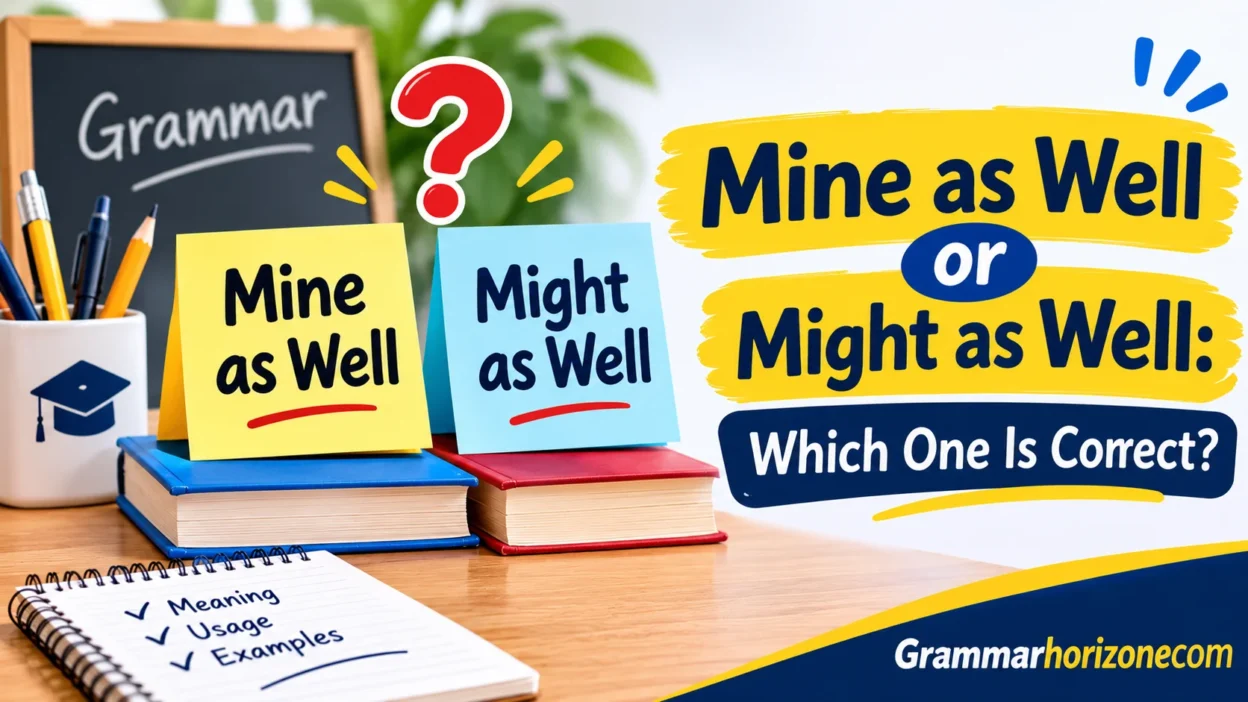
Mine as Well or Might as Well often confuses English learners because both phrases have similar sounds but different meanings. In English grammar, might as well is the standard expression for suggesting an action, making suggestions, or presenting a practical decision as a reasonable choice. It is a modal expression that shows possibility, while mine is a possessive pronoun that shows ownership. These phrases may appear in everyday conversations, spoken English, written English, text messages, and informal writing, but they have different grammatical functions.
Correct word usage depends on the context, sentence structure, and word meaning. For example, “We might as well go home” is a correct expression because it suggests a sensible action. However, “We mine as well go home” is an incorrect expression and one of the common grammar mistakes. You can use “This book is mine as well” correctly because it shows ownership. These sentence examples explain the expression meaning and highlight the usage differences between the phrases. Similar expressions, such as may as well, can also express a similar idea.
Learning these grammar rules improves language learning and expands your English vocabulary. It also strengthens communication, writing skills, and speaking skills in conversational English and informal communication. Pay attention to similar sounds instead of choosing words only by how they sound. Recognizing the linguistic differences helps you avoid spelling mistakes and other mistakes. With better understanding and regular practice, you can use these English expressions naturally and improve grammatical accuracy, sentence formation, and language clarity in standard English.
Quick Answer: Mine as Well or Might as Well?
Might as well is the correct expression when you want to suggest doing something because it seems reasonable, convenient, or worthwhile. Mine as well is incorrect when used with this meaning.
For example:
- Correct: We might as well leave early to avoid traffic.
- Incorrect: We mine as well leave early to avoid traffic.
The word might is a modal verb that expresses possibility or introduces a practical suggestion. The word mine is a possessive pronoun that shows ownership.
Remember this simple rule: Use might as well when suggesting an action. Use mine when talking about something that belongs to you.
What Does Might as Well Mean?
Might as well is a common English expression used to suggest an action that seems reasonable or worthwhile in a particular situation. It often appears when someone has no strong reason to avoid an action or when an opportunity makes doing something convenient.
For example:
“I’ve already finished my work, so I might as well help my colleague.”
In this sentence, the speaker has completed their own work and sees helping a colleague as a sensible choice. The expression doesn’t mean that helping is necessary. Instead, it presents the action as a reasonable option.
The phrase can also suggest that doing something is better than doing nothing.
Meaning and Definition of Might as Well
The expression might as well generally mean that someone should consider doing something because there is little reason not to do it.
It can communicate several ideas:
- A practical suggestion: An action makes sense in a particular situation.
- A convenient choice: An opportunity is available, so taking advantage of it seems reasonable.
- An alternative: One action is preferable to another available option.
- Acceptance: There is no better option, so proceeding with the available choice makes sense.
For example:
- We might as well order dinner since nobody wants to cook.
- You might as well ask for help if you’re having trouble.
- It’s already late, so we might as well stay here.
- Since you’re going to the store, you might as well buy some milk.
In each example, the expression presents an action as a sensible decision based on the circumstances.
When to Use Might as Well
You can use might as well in everyday English when suggesting an action without making it sound like a strict instruction.
Here are some common situations:
When making a suggestion
Use it to recommend an action that seems useful.
Example: “We might as well take an umbrella because the sky looks cloudy.”
When an opportunity is available
Use it when something is already possible or convenient.
Example: “Since we’re already downtown, we might as well visit the museum.”
When there is no better alternative
Use it when other options aren’t particularly useful.
Example: “The train isn’t arriving for another hour, so we might as well wait here.”
When accepting a situation
It can show that you’re accepting what has happened and deciding what to do next.
Example: “We missed the morning bus, so we might as well catch the afternoon one.”
Examples of Might as Well in Sentences
The following examples show how naturally the expression fits into everyday communication.
- You might as well finish your homework before watching television.
- We might as well start the meeting now.
- If you’re already going outside, you might as well take the trash out.
- I might as well call him and explain the situation.
- They might as well stay another night.
- Since the shop is still open, we might as well go inside.
- You might as well save your work before closing the computer.
- We might as well prepare everything before the guests arrive.
- She might as well apply for the position.
- They might as well discuss the problem today.
Notice that might as well is followed by the base form of a verb, such as finish, start, call, or stay.
What Does Mine as Well Mean?
The phrase mine as well is not a standard replacement for might as well. When someone writes it to suggest an action, they’re usually making a spelling or grammatical mistake.
The confusion comes from the similar sound of mine and might in some accents or fast conversations. However, these words have completely different grammatical functions.
Mine indicates possession. It tells the reader that something belongs to the speaker.
For example:
- This laptop is mine.
- The blue jacket is mine.
- Your responsibility isn’t mine.
- That seat is mine, not yours.
These sentences don’t suggest an action. Instead, they identify ownership.
Meaning of Mine
Mine is a possessive pronoun. It replaces a noun phrase to show that something belongs to a particular person.
For example:
“Your phone is on the table, but mine is in my bag.”
Here, mine replaces “my phone.” It avoids repeating the same noun and makes the sentence easier to read.
Consider these additional examples:
| Sentence | Meaning |
| This book is mine. | The book belongs to me. |
| That house is mine. | I own that house. |
| The final decision is mine. | I am responsible for the decision. |
| Your opinion differs from mine. | Your opinion differs from my opinion. |
| This responsibility is mine. | I am responsible for this task. |
Mine can also appear in sentences with as well when the sentence genuinely refers to ownership or something associated with the speaker.
For example:
“Your responsibility is mine as well.”
This sentence means that the speaker shares the responsibility.
Is Mine as Well Grammatically Correct?
Mine as well is generally incorrect when someone uses it to mean might as well. For example, “We mine as well leave now” is not grammatically correct standard English.
However, the individual words can appear together in a grammatically correct sentence.
Consider this example:
“Your responsibility is mine as well.”
This sentence is correct because mine indicates ownership or responsibility, while as well means too or also.
Another example:
“Your chances are good, and mine are good as well.”
Here, the speaker compares their chances with someone else’s.
The important point is that mine as well does not function as a standard expression for making suggestions.
Why Mine as Well Is Usually a Mistake
There are several reasons people confuse these expressions.
- Similar pronunciation: In quick speech, might as well can sound unclear to someone unfamiliar with the expression.
- Autocorrect errors: Typing suggestions may replace unfamiliar words with more familiar ones.
- Lack of grammatical knowledge: Some writers don’t recognize that might and mine perform different grammatical functions.
- Informal communication: Text messages and social media posts often contain spelling mistakes that spread through repeated use.
The easiest way to avoid this error is to identify what you want to communicate. If you’re suggesting an action, use might as well. If you’re showing ownership, use mine.
When Mine and As Well Can Appear in the Same Sentence
Although mine as well isn’t a standard alternative to might as well, the words mine and as well can appear in the same sentence.
For example:
- Your responsibility is mine as well.
- That problem affects my family and mine as well.
- Your opinion matters, and mine does as well.
- The final decision is mine as well.
These sentences communicate ownership, involvement, or shared responsibility.
The phrase as well usually means also or too. Its placement depends on the sentence structure.
For example:
- Your responsibility is mine as well.
- Your responsibility is mine, too.
- That responsibility belongs to me as well.
All three examples communicate a similar idea.
Might as Well or. Mine or Well: Main Differences
The main difference between might as well and mine as well is their grammatical function. The first is an established English expression for suggesting an action, while the second combines a possessive pronoun with the phrase as well.
Understanding their roles will help you avoid mistakes in both speaking and writing.
| Comparison | Might as Well | Mine as Well |
| Correct usage | Standard expression | Correct in suitable ownership-related contexts |
| Main word | Might | Mine |
| Grammatical function | Modal expression | Possessive pronoun with an adverbial phrase |
| Meaning | A practical suggestion or choice | Something belongs to me, too |
| Common use | Everyday suggestions | Ownership and shared situations |
| Example | We might as well leave. | The responsibility is mine as well. |
Differences in Grammatical Function
Might is a modal auxiliary verb. It works with another verb to express possibility, suggestions, or other meanings. In might as well, it forms part of an established expression.
Example: “You might as well take a break.”
Here, might help introduce a reasonable suggestion.
Mine, on the other hand, is a possessive pronoun. It replaces a noun phrase and identifies ownership.
Example: “This responsibility is mine as well.”
Here, mine means that the responsibility belongs to the speaker, too.
Differences in Meaning and Context
The context determines which expression belongs in your sentence.
Consider these examples:
- “We might as well go home.” This suggests that going home is a reasonable decision.
- “The final responsibility is mine as well.” This means the speaker shares responsibility.
Both sentences are grammatically correct, but they communicate different ideas. You cannot replace might with mine in the first sentence without changing its grammatical structure.
How to Use Might as Well in a Sentence
Learning how to use might as well correctly requires understanding the situations in which the expression sounds natural. It commonly appears in conversations when people discuss plans, make suggestions, or choose between available options.
The phrase usually has a relaxed tone. It doesn’t force someone to take action. Instead, it presents an action as a reasonable choice.
Might as Well for Making Suggestions
You can use might as well to suggest an action when you believe it would be useful or convenient.
For example:
- We might as well invite Sarah to dinner.
- You might as well speak to your manager directly.
- They might as well start preparing for the examination.
- I might as well send the email today.
These sentences suggest possible actions without making them sound like strict orders.
For example, if your friend is already preparing dinner, you could say, “We might as well invite our neighbors.”
You’re suggesting something that fits the situation.
Might as Well for Practical Decisions
Sometimes, a particular action makes sense because of the circumstances. In these situations, might as well helps communicate a practical decision.
Examples:
- Since the weather is pleasant, we might as well go for a walk.
- I’ve finished my assignments, so I might as well clean my room.
- The office is still open, so we might as well submit the documents today.
- Since you’re visiting the market, you might as well buy some groceries.
In each example, the speaker identifies a reason that makes the action worthwhile.
Might as Well When There Is No Better Alternative
Another common use occurs when you have limited options. You may not particularly want to do something, but it seems better than the alternatives.
For example:
“We missed the last bus, so we might as well take a taxi.”
The speaker isn’t necessarily excited about taking a taxi. However, it provides a practical solution to the problem.
Other examples include:
- The restaurant is full, so we might as well try another one.
- Nobody is answering the phone, so we might as well leave a message.
- The meeting has been postponed, so we might as well return to work.
- We have nowhere else to go, so we might as well wait here.
Might as Well for Expressing Acceptance
The expression can also show acceptance of an unexpected or unavoidable situation.
For example:
“I didn’t plan to stay overnight, but since the roads are closed, I might as well stay at the hotel.”
The speaker accepts the situation and chooses a reasonable next step.
This usage often carries a slightly reluctant or resigned tone. It suggests that the speaker may not have wanted the situation but has decided to make the best of it.
Might as Well in Casual Conversations
Might as well is common in informal English. Friends, family members, and coworkers use it when discussing everyday decisions.
Here is a short conversation:
Alex: “The movie starts in twenty minutes. Should we get something to eat?”
John: “Sure, we might as well grab a quick snack.”
In this conversation, John agrees that getting food is a reasonable use of the available time.
Another example:
Emma: “We have an extra ticket for the concert.”
Liam: “Then we might as well invite Mark.”
The expression makes the suggestion sound natural and conversational.
Might as Well in Different Sentence Structures
The expression might as well can appear in different sentence structures. However, its basic grammatical pattern remains the same.
The usual structure is:
Subject + might as well + base form of the verb
For example:
- I might as well leave.
- She might as well stay.
- We might as well begin.
- They might as well wait.
The verb after might as well stays in its base form. You don’t add -s, -ed, or -ing directly after the expression.
Might as Well at the Beginning of a Sentence
You can place might as well at the beginning of a sentence when the subject is understood from the conversation.
For example:
- Might as well finish the work now.
- Might as well ask before making a decision.
- Might as well take an umbrella.
These are informal constructions. In complete sentences, include the subject:
- We might as well finish the work now.
- You might as well ask before making a decision.
Might as Well in the Middle of a Sentence
The most common placement is after the subject and before the main verb.
Examples:
- I might as well complete the project today.
- She might as well apply for the position.
- They might as well book their tickets early.
- My brother might as well join us for lunch.
This structure is suitable for everyday writing and standard conversational English.
Might as Well in Negative Sentences
You can also use a negative form to suggest that an action isn’t worth taking.
The usual structure is:
Subject + might as well not + base form of the verb
Examples:
- We might as well not go if the weather gets worse.
- You might as well not wait because the office is closed.
- They might as well not attend if they aren’t interested.
- I might as well not buy another phone because mine works perfectly.
In these sentences, the speaker suggests that avoiding the action is the more practical choice.
Might as Well in Questions
You can use might as well in questions when discussing whether an action makes sense.
For example:
- Do you think we might as well take a taxi?
- Should we stay here, or might we as well go home?
- Do you think she might as well apply for the job?
These questions help people discuss possible decisions and practical alternatives.
Might as Well With Different Subjects
The expression works with different subjects because the modal verb might doesn’t change according to the subject.
| Subject | Correct sentence |
| I | I might as well call him. |
| You | You might as well try again. |
| He | He might as well wait. |
| She | She might as well leave early. |
| We | We might as well start now. |
| They | They might as well join us. |
Notice that might stays the same in every sentence. You don’t write mights as well when the subject is he or she.
Might as Well or. Other Similar Expressions
Several English expressions have meanings similar to might as well. However, they aren’t always interchangeable. Understanding their differences helps you choose the most natural phrase.
Might as Well or. May as Well
Might as well and may as well are both correct expressions. They can suggest doing something because it seems like the easiest or most logical choice when there isn’t a better alternative.
Examples:
- We might as well leave before the traffic gets worse.
- We may as well leave before the traffic gets worse.
Both sentences are correct and have nearly the same meaning.
Might as Well or. Should
Might as well and should can both appear when discussing possible actions, but they express different levels of recommendation.
- Might as well: An action seems reasonable or convenient.
- Should: An action is advisable, expected, or the right thing to do.
Examples:
- We might as well take a taxi because the bus is late.
- We should take a taxi because the road is dangerous.
The first sentence presents a practical option. The second gives stronger advice based on a specific concern.
Might as Well or. Could
Could expresses possibility, ability, or an available option. Might as well suggests that taking an available option makes sense.
Examples:
- We could visit the library after lunch.
- We might as well visit the library since we’re already nearby.
The first sentence simply identifies an option. The second explains why choosing that option is reasonable.
Might as Well or. Might as Well Have
The expressions might as well and might as well have are related, but their grammatical structures and meanings differ.
Might as well + base verb generally refers to a practical choice or suggestion.
Example: “We might as well leave now.”
Might as well have + past participle can describe a past situation that had almost the same result as another action or situation.
Example: “I might as well have stayed home because the event was canceled.”
This means attending the event made little difference because it was canceled.
Another example:
“He might as well have told everyone because the news spread quickly.”
This suggests that keeping the information private made little difference.
Conclusion
Understanding the difference between mine as well and might as well helps you avoid common English grammar mistakes. Use might as well when suggesting an action or describing a reasonable choice. Use mine as well when showing ownership. Although the phrases sound similar, their meanings and grammatical functions are different. With regular practice and attention to context, you can use both expressions correctly in spoken and written English.
Frequently Asked Questions
Q1. Is it mine as well or might as well?
Might as well is correct when suggesting an action. Mine as well is correct only when the word mine shows ownership.
Q2. What does might as well mean?
Might as well means that an action is a sensible or reasonable choice in a particular situation.
Q3. Is mine as well grammatically correct?
Yes. It is correct when mine refers to something that belongs to you, as in “That responsibility is mine as well.”
Q4. Can I use may as well instead of might as well?
Yes. May as well and might as well often have similar meanings when suggesting a practical action.
Q5. Why do people confuse mine as well and might as well?
People confuse them because they have similar sounds in casual speech. However, their meanings, spelling, and grammatical functions are different.